Advertisements
Advertisements
प्रश्न
(–4)–4 × (4)–1 = (4)5
विकल्प
True
False
Advertisements
उत्तर
This statement is False.
Explanation:
LHS = (–4)–4 × (4)–1
Using law of exponents,
am × an = (a)m + n ...[∵ a is non-zero integer]
∴ (–4)–4 × (4)–1 = (4)–4 × (4)–1
= (4)–4 – 1
= (4)–5
LHS ≠ RHS
APPEARS IN
संबंधित प्रश्न
For a non-zero integer x, (x4)–3 is equal to ______.
`(1/10)^0` is equal to ______.
Simplify:
`(((-2)/3)^-2)^3 xx (1/3)^-4 xx 3^-1 xx 1/6`
If `5^(3x - 1) ÷ 25 = 125`, find the value of x.
`(16 xx 10^2 xx 64)/(2^4 xx 4^2)`
An insect is on the 0 point of a number line, hopping towards 1. She covers half the distance from her current location to 1 with each hop. So, she will be at `1/2` after one hop, `3/4` after two hops, and so on.
Where will the insect be after n hops?
Find a single repeater machine that will do the same work as hook-up.
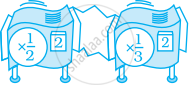
For hook-up, determine whether there is a single repeater machine that will do the same work. If so, describe or draw it.

Find x.
`(- 1/7)^-5 ÷ (- 1/7)^-7 = (-7)^x`
