Topics
Linear Equations in Two Variables
- Foundation of Linear Equations in Two Variables
- Simultaneous Linear Equations
- Graph of a Linear Equation in Two Variables
- Methods of Solving Linear Equations in Two Variables > Graphical Method
- Methods of Solving Linear Equations in Two Variables > Determinant method (Cramer’s Rule)
- Equations Reducible to Linear Equations
- Application of Simultaneous Equations
Quadratic Equations
- Concept of Quadratic Equations
- Factorisation Method
- Completing the Square Method
- Quadratic Formula (Shreedharacharya's Rule)
- Nature of Roots of a Quadratic Equation
- Relation Between Zeroes (Roots) and Coefficients of a Quadratic Equation
- Formation of a Quadratic Equation with Given Roots
- Application of Quadratic Equation
Arithmetic Progression
Financial Planning
Probability
Statistics
Definition: Graph of a Linear Equation
The graph of a linear equation in two variables is the set of all points (x,y) whose coordinates satisfy the equation.
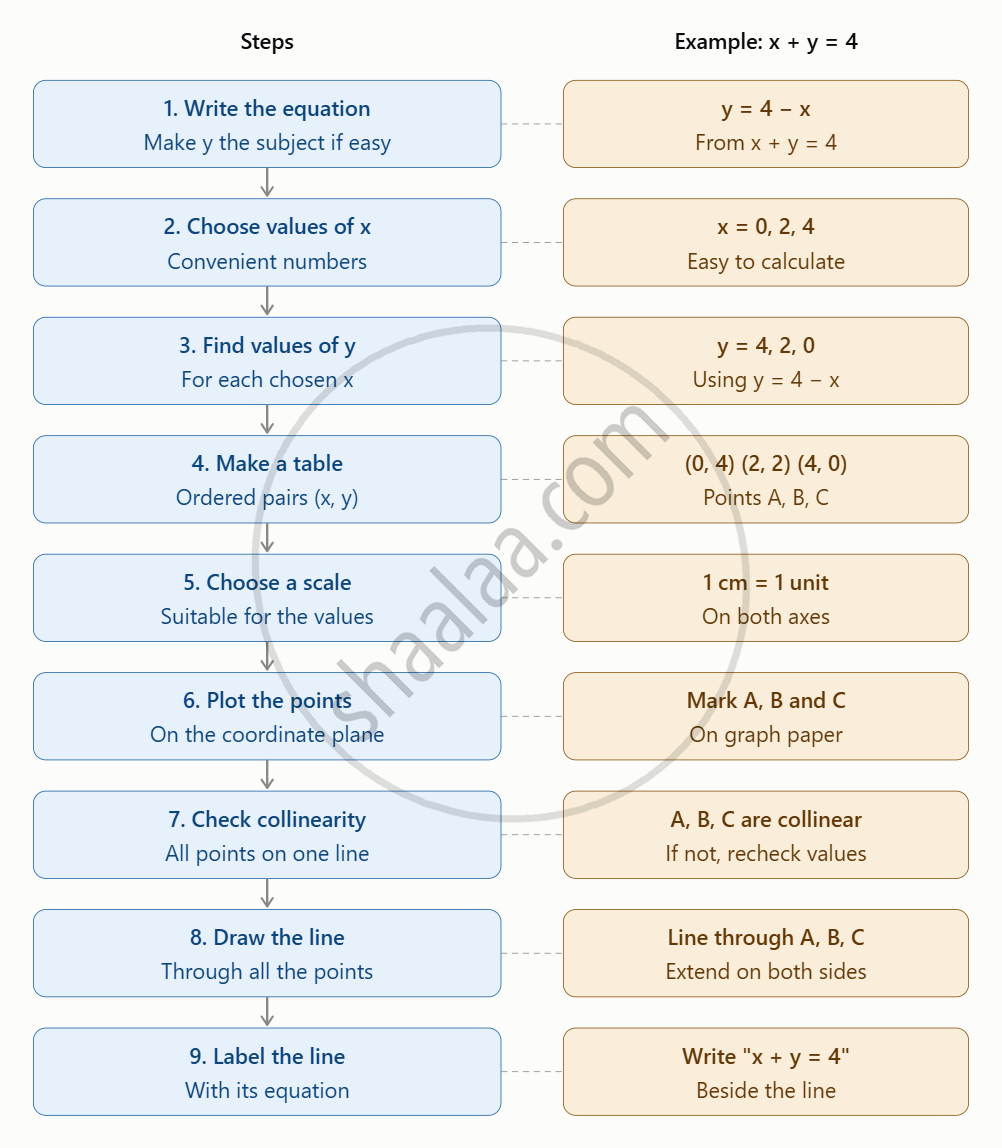
Steps to Draw the Graph
Example
Equation:
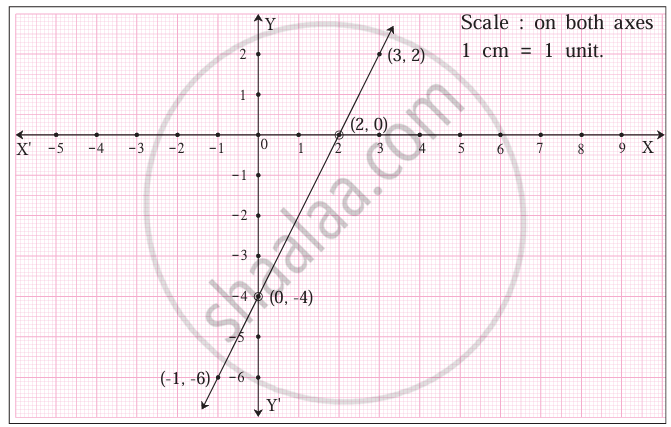
\[ 2x - y = 4 \implies y = 2x - 4 \]
Step-by-Step Solution:
Step 1: Write the equation and make \[ y \] the subject
\[ y = 2x - 4 \]
Step 2: Choose values of \[ x \] and find corresponding values of \[ y \]
If \[ x = 0, \] then \[ y = 2(0) - 4 = -4 \rightarrow \] Point: \[ (0, -4) \]
If \[ x = 2, \] then \[ y = 2(2) - 4 = 0 \rightarrow \] Point: \[ (2, 0) \]
If \[ x = 3, \] then \[ y = 2(3) - 4 = 2 \rightarrow \] Point: \[ (3, 2) \]
If \[ x = -1, \] then \[ y = 2(-1) - 4 = -6 \rightarrow \] Point: \[ (-1, -6) \]
Step 3: Make the Table of Ordered Pairs
\[ \begin{array}{|c|c|c|c|c|} \hline x & 0 & 2 & 3 & -1 \\ \hline y & -4 & 0 & 2 & -6 \\ \hline (x, y) & (0, -4) & (2, 0) & (3, 2) & (-1, -6) \\ \hline \end{array} \]
Step 4:
Choose a scale: On both axes, \[ 1 \text{ cm} = 1 \text{ unit}. \]
Plot the ordered pairs \[ (0, -4), (2, 0), (3, 2), \] and \[ (-1, -6) \] on the coordinate plane.
Draw a straight line passing through all the points, extending it on both sides.
Importance of Plotting Four Points
-
Although mathematically two points are sufficient to determine a line, four points are utilized to ensure calculation accuracy.
-
Plotting four points serves as a built-in verification method to detect any potential plotting or calculation errors.
-
If all points lie on a single straight line, it confirms that the calculations are correct.
Key Points: Graph of a Linear Equation in Two Variables
- A linear equation in two variables has the form \[ ax + by + c = 0, \] where \[ a \] and \[ b \] are not both zero.
- Its graph is always a straight line.
- Every solution is an ordered pair \[ (x, y). \]
- Prepare a table of values before plotting.
- Plot at least three points to verify accuracy.
- \[ y = k \] is a horizontal line parallel to the X-axis.
- \[ x = k \] is a vertical line parallel to the Y-axis.
- A line through the origin has the form \[ ax + by = 0. \]
