Topics
Linear Equations in Two Variables
- Foundation of Linear Equations in Two Variables
- Simultaneous Linear Equations
- Graph of a Linear Equation in Two Variables
- Methods of Solving Linear Equations in Two Variables > Graphical Method
- Methods of Solving Linear Equations in Two Variables > Determinant method (Cramer’s Rule)
- Equations Reducible to Linear Equations
- Application of Simultaneous Equations
Quadratic Equations
- Concept of Quadratic Equations
- Factorisation Method
- Completing the Square Method
- Quadratic Formula (Shreedharacharya's Rule)
- Nature of Roots of a Quadratic Equation
- Relation Between Zeroes (Roots) and Coefficients of a Quadratic Equation
- Formation of a Quadratic Equation with Given Roots
- Application of Quadratic Equation
Arithmetic Progression
- Patterns and Sequences
- Arithmetic Progression (A.P.)
- General Term (nth) of an Arithmetic Progression
- Sum of First ‘n’ Terms of an Arithmetic Progressions
- Application of an Arithmetic Progression (A.P)
Financial Planning
Probability
Statistics
Introduction
Quadratic equations are among the most useful mathematical tools for solving real-life problems. They arise when a quantity depends on the square of an unknown value, such as the area of a rectangle, the diagonal of a field, the time taken during a journey, or the relationship between speed and distance.
Essential Formulae
\[ \begin{array}{|l|l|} \hline \textbf{Concept} & \textbf{Formula} \\ \hline \text{Standard quadratic equation} & ax^{2} + bx + c = 0 \\[4pt] \hline \text{Quadratic formula} & x = \dfrac{-b \pm \sqrt{b^{2} - 4ac}}{2a} \\[8pt] \hline \text{Discriminant} & D = b^{2} - 4ac \\[4pt] \hline \text{Pythagoras theorem} & \text{Hypotenuse}^{2} = \text{Base}^{2} + \text{Height}^{2} \\[4pt] \hline \text{Speed} & \text{Speed} = \dfrac{\text{Distance}}{\text{Time}} \\[8pt] \hline \text{Time} & \text{Time} = \dfrac{\text{Distance}}{\text{Speed}} \\[8pt] \hline \end{array} \]
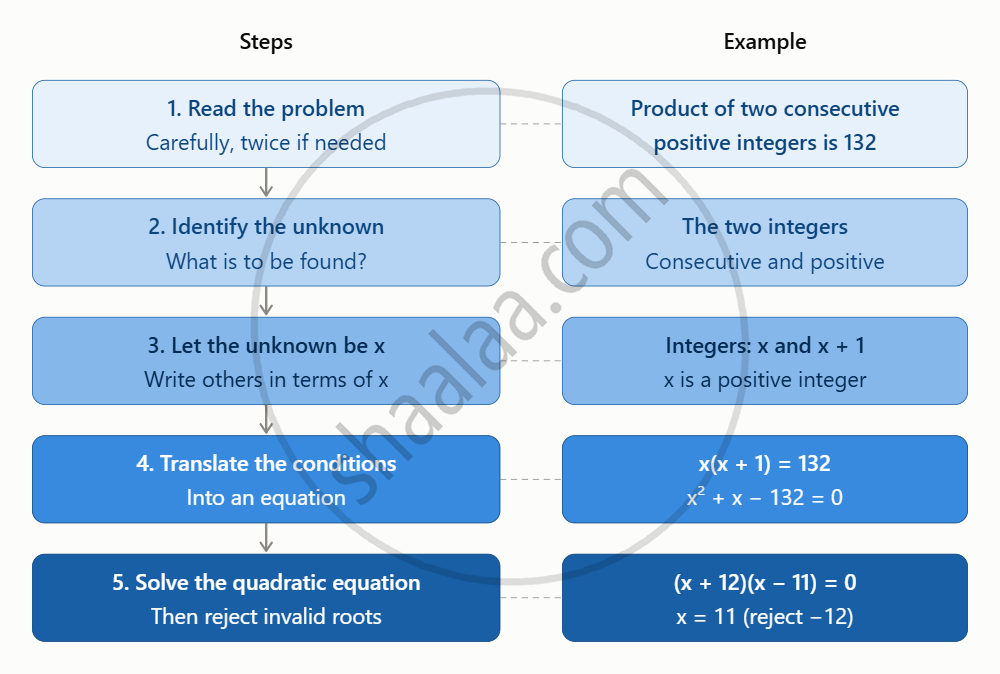
General Method for Word Problems
Example 1
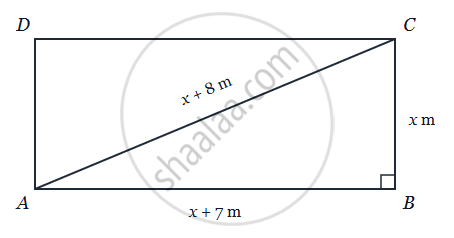
Question: There is a rectangular onion storehouse in the farm of Mr. Ratnakarrao at Tivasa. The length of rectangular base is more than its breadth by 7 m and diagonal is more than length by 1 m. Find length and breadth of the storehouse.
Solution:
Given Information
Let the breadth be \[ x \text{ m}. \]
Then:
Breadth \[ = x \text{ m} \]
Length \[ = x + 7 \text{ m} \]
Diagonal \[ = x + 8 \text{ m} \]
Forming the Equation
Since \[ ABC \] is a right-angled triangle, by Pythagoras theorem:
\[ (x + 8)^{2} = x^{2} + (x + 7)^{2} \]
Expanding:
\[ x^{2} + 16x + 64 = x^{2} + x^{2} + 14x + 49 \]
\[ x^{2} + 16x + 64 = 2x^{2} + 14x + 49 \]
\[ 0 = x^{2} - 2x - 15 \]
\[ x^{2} - 2x - 15 = 0 \]
Solving by Factorisation
\[ x^{2} - 5x + 3x - 15 = 0 \]
\[ x(x - 5) + 3(x - 5) = 0 \]
\[ (x - 5)(x + 3) = 0 \]
\[ x = 5 \quad \text{or} \quad x = -3 \]
Checking Validity
Since breadth cannot be negative: \[ x = -3 \text{ is rejected} \]
Therefore: \[ x = 5 \]
Final Answer
Breadth \[ = 5 \text{ m} \]
Length \[ = 5 + 7 = 12 \text{ m} \]
Diagonal \[ = 5 + 8 = 13 \text{ m} \]
Answer: The breadth of the storehouse is 5 m and the length is 12 m.
Example 2
Question: A train travels 360km at a uniform speed. If the speed had been 5km/h more, it would have taken 48 minutes less to cover the same distance. Find the original speed of the train.
Solution:
Given Information
Let the original speed be \[ x \text{ km/h}. \]
Then:
\[ \begin{array}{|l|l|l|} \hline \textbf{Quantity} & \textbf{Original Journey} & \textbf{Faster Journey} \\ \hline \text{Distance} & 360 \text{ km} & 360 \text{ km} \\[4pt] \hline \text{Speed} & x \text{ km/h} & x + 5 \text{ km/h} \\[4pt] \hline \text{Time} & \dfrac{360}{x} \text{ h} & \dfrac{360}{x + 5} \text{ h} \\[8pt] \hline \end{array} \]
The time saved is 48 minutes:
\[ 48 \text{ minutes} = \frac{48}{60} = \frac{4}{5} \text{ hour} \]
Forming the Equation
\[ \frac{360}{x} - \frac{360}{x + 5} = \frac{4}{5} \]
Taking LCM:
\[ \frac{360(x + 5) - 360x}{x(x + 5)} = \frac{4}{5} \]
\[ \frac{1800}{x(x + 5)} = \frac{4}{5} \]
Cross-multiplying:
\[ 1800 \times 5 = 4x(x + 5) \]
\[ 9000 = 4x^{2} + 20x \]
\[ 4x^{2} + 20x - 9000 = 0 \]
Dividing by 4:
\[ x^{2} + 5x - 2250 = 0 \]
Solving the Equation
\[ x^{2} + 50x - 45x - 2250 = 0 \]
\[ x(x + 50) - 45(x + 50) = 0 \]
\[ (x + 50)(x - 45) = 0 \]
\[ x = -50 \quad \text{or} \quad x = 45 \]
Checking Validity
Speed cannot be negative, so: \[ x = -50 \text{ is rejected} \]
Therefore: \[ x = 45 \]
Final Answer:
The original speed of the train is 45 km/h.
