Topics
Linear Equations in Two Variables
- Foundation of Linear Equations in Two Variables
- Simultaneous Linear Equations
- Graph of a Linear Equation in Two Variables
- Methods of Solving Linear Equations in Two Variables > Graphical Method
- Methods of Solving Linear Equations in Two Variables > Determinant method (Cramer’s Rule)
- Equations Reducible to Linear Equations
- Application of Simultaneous Equations
Quadratic Equations
- Concept of Quadratic Equations
- Factorisation Method
- Completing the Square Method
- Quadratic Formula (Shreedharacharya's Rule)
- Nature of Roots of a Quadratic Equation
- Relation Between Zeroes (Roots) and Coefficients of a Quadratic Equation
- Formation of a Quadratic Equation with Given Roots
- Application of Quadratic Equation
Arithmetic Progression
Financial Planning
Probability
Statistics
Formation of Quadratic Equation
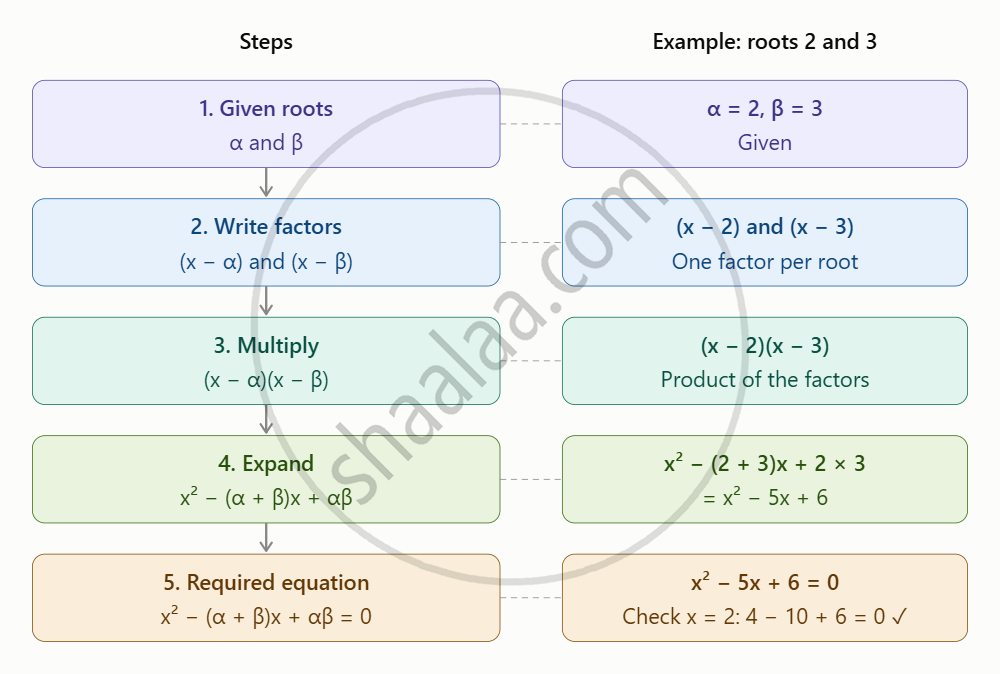
Therefore, the required quadratic equation is:
\[ \boxed{x^{2} - (\alpha + \beta)x + \alpha\beta = 0} \]
Remember:
Coefficient of \[ x \] = \[ -(\text{sum of roots}) \]
Constant term = \[ +(\text{product of roots}) \]
Formula: Quadratic Equation with Given Roots
For roots \[ \alpha \] and \[ \beta: \]
\[ \boxed{x^{2} - (\alpha + \beta)x + \alpha\beta = 0} \]
If the equation is not required to be monic, then for any non-zero constant \[ k: \]
\[ \boxed{k\left[x^{2} - (\alpha + \beta)x + \alpha\beta\right] = 0} \]
All such equations have the same roots \[ \alpha \] and \[ \beta. \]
Activity
Activity (I)
Given: Addition of the roots = \[ 10, \] Product of the roots = \[ 9 \]
Completed Equation:
\[ \therefore\; \text{Quadratic equation} : x^{2} - 10x + 9 = 0 \]
Activity (II)
Given: \[ \alpha = 2, \beta = 5 \]
Completed Steps:
It can be written as \[ x^{2} - (2 + 5)x + 2 \times 5 = 0. \]
That is \[ 1x^{2} - 7x + 10 = 0. \]
Key Points: Formation of a Quadratic Equation with Given Roots
- If roots are \[ \alpha \] and \[ \beta, \] the equation is \[ x^{2} - (\alpha + \beta)x + \alpha\beta = 0. \]
- The middle-term coefficient is always negative of the sum of roots.
- The constant term is the product of roots.
- Multiplying the whole equation by any non-zero constant keeps the roots unchanged.
