Advertisements
Chapters
1: Integers
2: Rational Numbers
3: Fractions (Including Problems)
4: Decimal Fractions (Decimals)
5: Exponents (Including Laws of Exponents)
Chapter 6: Set Concepts
Theme 2: Commercial Arithmetic
7: Ratio and Proportion (Including Sharing in a Ratio)
8: Unitary Method (Including Time and Work)
9: Percent and Percentage
10: Profit, Loss and Discount
11: Simple Interest
Chapter 12: Speed, Distance and Time
Theme 3: Algebra
13: Fundamental Concepts (Including Fundamental Operations)
14: Simple Linear Equations (Including Word Problems)
Chapter 15: Inequalities (Solution in One Variable)
Theme 4: Geometry
▶ 16: Lines and Angles (Including Construction of angles)
17: Triangles
18: Pythagoras Theorem
19: Symmetry (Including Reflection and Rotation)
20: Recognition of Solids (Representing 3-D in 2-D)
21: Congruency: Congruent Triangles
Chapter 22: Constructions
23: Mensuration (Perimeter and Area of Plane Figures)
Theme 5: Data Handling (Statistics)
24: Data Handling
25: Probability
![R.K. Bansal solutions for कन्साइस मैथमैटिक्स [अंग्रेजी] कक्षा ७ आईसीएसई chapter 16 - Lines and Angles (Including Construction of angles) - Shaalaa.com](/images/concise-mathematics-english-class-7-icse_6:df70494835ef4afc8f7edda497a9fa9d.jpg "R.K. Bansal solutions for कन्साइस मैथमैटिक्स [अंग्रेजी] कक्षा ७ आईसीएसई chapter 16 - Lines and Angles (Including Construction of angles)")
Advertisements
Solutions for Chapter 16: Lines and Angles (Including Construction of angles)
Below listed, you can find solutions for Chapter 16 of CISCE R.K. Bansal for कन्साइस मैथमैटिक्स [अंग्रेजी] कक्षा ७ आईसीएसई.
R.K. Bansal solutions for कन्साइस मैथमैटिक्स [अंग्रेजी] कक्षा ७ आईसीएसई 16 Lines and Angles (Including Construction of angles) Exercise 14 (A)
State, true or false:
A line segment 4 cm long can have only 2000 points in it.
True
False
State, true or false:
A ray has one endpoint and a line segment has two end-points.
True
False
State, true or false:
A line segment is the shortest distance between any two given points.
True
False
State, true or false:
An infinite number of straight lines can be drawn through a given point.
True
False
Write the number of endpoints in
(a) a line segment AB
(b) a ray AB
(c) a line AB
out of \[\overleftrightarrow{AB},\overrightarrow{AB},\overleftarrow{AB}\] and `overline(AB)` which one has a fixed length?
How many rays can be drawn through a fixed point O?
How many lines can be drawn through three
(a) collinear points?
(b) non-collinear points?
State, true or false:
Is 40° the complement of 60°?
True
False
State, true or false:
Is 45° the supplement of 45°?
True
False
In the following figure, ∠AOB and ∠AOC are adjacent angles? Give the reason for your answer.
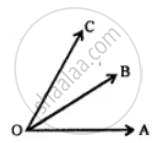
In the following figure, ∠AOB and ∠AOC are adjacent angles? Give the reason for your answer.
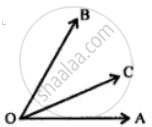
In the following figure, ∠AOB and ∠AOC are adjacent angles? Give the reason for your answer.
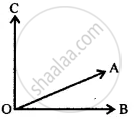
In the following figure, ∠AOB and ∠AOC are adjacent angles? Give the reason for your answer.
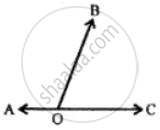
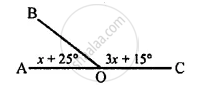
In the given figure, BAC is a straight line.
Find:
(i) x
(ii) ∠AOB
(iii) ∠BOC
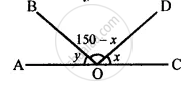
Find y in the given figure.
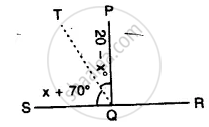
In the given figure, find ∠PQR.
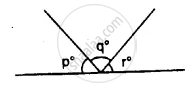
In the given figure. p° = q° = r°, find each.
In the given figure, if x = 2y, find x and y
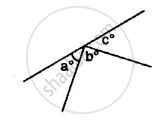
In the adjoining figure, if b° = a° + c°, find b.
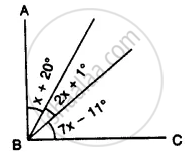
In the given figure, AB is perpendicular to BC at B.
Find:
(i) the value of x.
(ii) the complement of angle x.
Write the complement of 25°
Write the complement of 90°
Write the complement of a°
Write the complement of (x + 5)°
Write the complement of (30 − a)°
Write the complement of `1/2` of a right angle
Write the complement of `1/3` of 180°
Write the complement of 21° 17'
Write the supplement of 100°
Write the supplement of 0°
Write the supplement of x°
Write the supplement of (x + 35)°
Write the supplement of (90 + a + b)°
Write the supplement of (110 – x – 2y)°
Write the supplement of `1/5` of a right angle
Write the supplement of 80° 49′ 25″
Are the following pairs of angles complementary?
10° and 80°
Are the following pairs of angles complementary?
37° 28′ and 52° 33′
Are the following pairs of angles complementary?
(x + 16)° and (74 − x)°
Are the following pairs of angles complementary?
54° and `2/5` of a right angle.
Are the following pairs of angles supplementary?
139° and 39°.
Are the following pairs of angles supplementary?
26° 59′ and 153° 1′.
Are the following pairs of angles supplementary?
`3/10` of a right angle and `4/15` of two right angles.
Are the following pairs of angles supplementary?
2x° + 65° and 115°− 2x°
If 3x + 18° and 2x + 25° are supplementary, find the value of x.
If two complementary angles are in the ratio 1 : 5, find them.
If two supplementary angles are in the ratio 2 : 7, find them.
Three angles which add up to 180° are in the ratio 2 : 3 : 7. Find them.
20% of an angle is the supplement of 60°. Find the angle.
10% of x° is the complement of 40% of 2x°. Find x
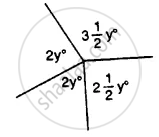
Use the adjacent figure, to find angle x and its supplement.
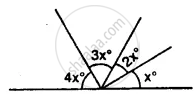
Find K in the given figure.
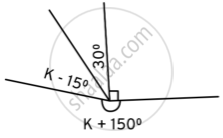
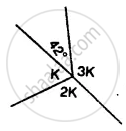
Find k of the given figure.
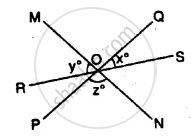
In the given figure, lines PQ, MN, and RS intersect at O. If x : y = 1 : 2 and z = 90°, find ∠ROM and ∠POR.
In the given figure, find ∠AOB and ∠BOC.
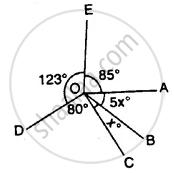
Find each angle shown in the diagram.
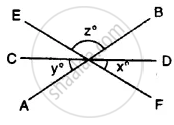
AB, CD and EF are three lines intersecting at the same point.
(i) Find x, if y = 45° and z = 90°.
(ii) Find a, if x = 3a, y = 5x and r = 6x.
R.K. Bansal solutions for कन्साइस मैथमैटिक्स [अंग्रेजी] कक्षा ७ आईसीएसई 16 Lines and Angles (Including Construction of angles) Exercise 14 (B)
Identify the given pair of angles as ∠3 and ∠6
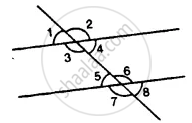
corresponding angles
interior alternate angles
exterior alternate angles
adjacent angles
vertically opposite angles
allied angles
Identify the given pair of angles as ∠2 and ∠4
corresponding angles
interior alternate angles
exterior alternate angles
adjacent angles
vertically opposite angles
allied angles
Identify the given pair of angles as ∠3 and ∠7
corresponding angles
interior alternate angles
exterior alternate angles
adjacent angles
vertically opposite angles
allied angles
Identify the given pair of angles as ∠2 and ∠7
corresponding angles
interior alternate angles
exterior alternate angles
adjacent angles
vertically opposite angles
allied angles
Identify the given pair of angles as ∠4 and ∠6
corresponding angles
interior alternate angles
exterior alternate angles
adjacent angles
vertically opposite angles
allied or co-interior angles
Identify the given pair of angles as ∠1 and ∠8
corresponding angles
interior alternate angles
exterior alternate angles
adjacent angles
vertically opposite angles
allied angles
Identify the given pair of angles as ∠1 and ∠5
corresponding angles
interior alternate angles
exterior alternate angles
adjacent angles
vertically opposite angles
allied angles
Identify the given pair of angles as ∠1 and ∠4
corresponding angles
interior alternate angles
exterior alternate angles
adjacent angles
vertically opposite angles
allied angles
Identify the given pair of angles as ∠5 and ∠7
corresponding angles
interior alternate angles
exterior alternate angles
adjacent angles
vertically opposite angles
allied angles
Identify the given pair of angles as ∠1 and ∠4
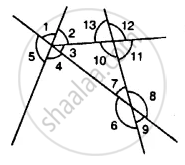
corresponding angles
interior alternate angles
exterior alternate angles
adjacent angles
vertically opposite angles
allied angles
Identify the given pair of angles as ∠4 and ∠7
corresponding angles
interior alternate angles
exterior alternate angles
adjacent angles
vertically opposite angles
allied angles
Identify the given pair of angles as ∠10 and ∠12
corresponding angles
interior alternate angles
exterior alternate angles
adjacent angles
vertically opposite angles
allied angles
Identify the given pair of angles as ∠7 and ∠13
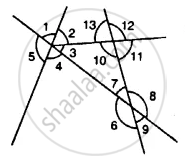
corresponding angles
interior alternate angles
exterior alternate angles
adjacent angles
vertically opposite angles
allied angles
Identify the given pair of angles as ∠6 and ∠8
corresponding angles
interior alternate angles
exterior alternate angles
adjacent angles
vertically opposite angles
allied angles
Identify the given pair of angles as ∠11 and ∠8
corresponding angles
interior alternate angles
exterior alternate angles
adjacent angles
vertically opposite angles
allied or co-interior angles
Identify the given pair of angles as ∠7 and ∠9
corresponding angles
interior alternate angles
exterior alternate angles
adjacent angles
vertically opposite angles
allied angles
Identify the given pair of angles as ∠4 and ∠5
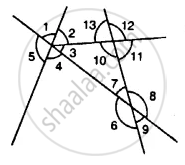
corresponding angles
interior alternate angles
exterior alternate angles
adjacent angles
vertically opposite angles
allied angles
Identify the given pair of angles as ∠4 and ∠6
corresponding angles
interior alternate angles
exterior alternate angles
adjacent angles
vertically opposite angles
allied or co-interior angles
Identify the given pair of angles as ∠6 and ∠7
corresponding angles
interior alternate angles
exterior alternate angles
adjacent angles
vertically opposite angles
allied angles
Identify the given pair of angles as ∠2 and ∠13
corresponding angles
interior alternate angles
exterior alternate angles
adjacent angles
vertically opposite angles
allied or co-interior angles
In the given figure, the arrows indicate parallel lines. State which angles are equal. Give a reason.
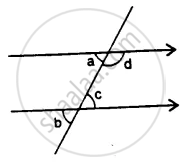
In the given figure, the arrows indicate parallel lines. State which angles are equal. Give a reason.
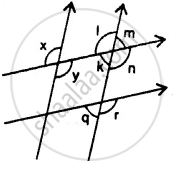
In the given figure, find the measure of the unknown angles:
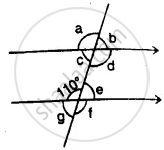
Which pair of the dotted line, segments, in the following figure, are parallel. Give reason:
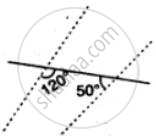
Which pair of the dotted line, segments, in the following figure, are parallel. Give reason:
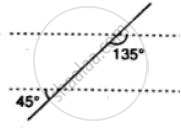
Which pair of the dotted line, segments, in the following figure, are parallel. Give reason:
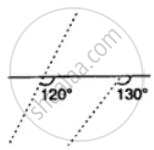
Which pair of the dotted line, segments, in the following figure, are parallel. Give reason:
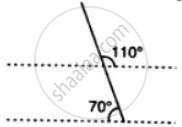
Which pair of the dotted line, segments, in the following figure, are parallel. Give reason:
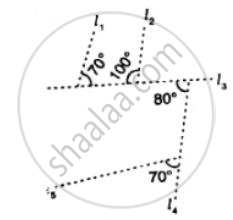
Which pair of the dotted line, segments, in the following figure, are parallel. Give reason:
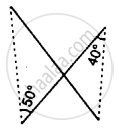
In the given figure, the directed lines are parallel to each other. Find the unknown angles.
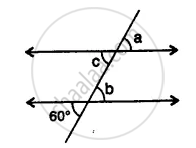
In the given figure, the directed lines are parallel to each other. Find the unknown angles.
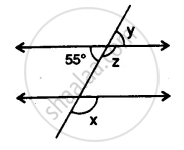
In the given figure, the directed lines are parallel to each other. Find the unknown angles.
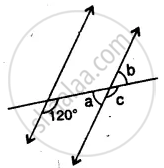
In the given figure, the directed lines are parallel to each other. Find the unknown angles.
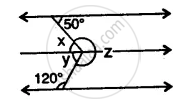
In the given figure, the directed lines are parallel to each other. Find the unknown angles.
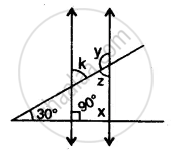
In the given figure, the directed lines are parallel to each other. Find the unknown angles.
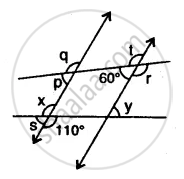
In the given figure, the directed lines are parallel to each other. Find the unknown angles.
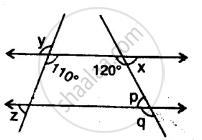
In the given figure, the directed lines are parallel to each other. Find the unknown angles.
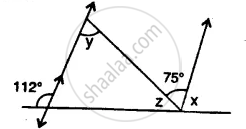
In the given figure, the directed lines are parallel to each other. Find the unknown angles.
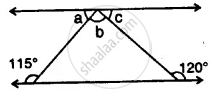
In the given figure, the directed lines are parallel to each other. Find the unknown angles.
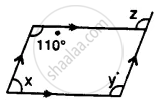
In the given figure, the directed lines are parallel to each other. Find the unknown angles.
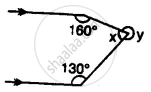
In the given figure, the directed lines are parallel to each other. Find the unknown angles.
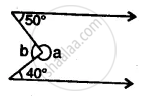
Find x, y and p is the given figure
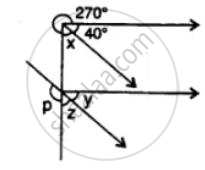
Find x, y and p is the given figure
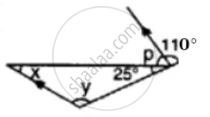
Find x in the following case:
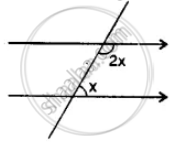
Find x in the following case:
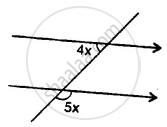
Find x in the following case:
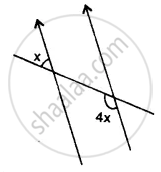
Find x in the following case:
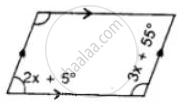
Find x in the following case:
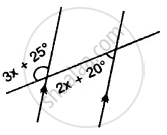
Find x in the following case:
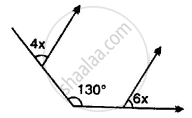
R.K. Bansal solutions for कन्साइस मैथमैटिक्स [अंग्रेजी] कक्षा ७ आईसीएसई 16 Lines and Angles (Including Construction of angles) Exercise 14 (C)
Using ruler and compasses, construct the following angle:
30°
Using ruler and compasses, construct the following angle:
15°
Using ruler and compasses, construct the following angle:
75°
Using ruler and compasses, construct the following angle:
180°
Using ruler and compasses, construct the following angle:
165°
Using ruler and compasses, construct the following angle:
22.5°
Using ruler and compasses, construct the following angle:
37.5°
Using ruler and compasses, construct the following angle:
67.5°
Draw ∠ABC = 120°. Bisect the angle using ruler and compasses only. Measure each 1 angle so obtained and check whether the angles obtained on bisecting ∠ABC are equal or not.
Draw a line segment PQ = 6 cm. Mark a point A in PQ so that AP = 2 cm. At point A, construct angle QAR = 60°.
Draw a line segment AB = 8 cm. Mark a point P in AB so that AP = 5 cm. At P, construct angle APQ = 30°.
Construct an angle of 75° and then bisect it.
Draw a line segment of length 6.4 cm. Draw its perpendicular bisector.
Draw a line segment AB = 5.8 cm. Mark a point P in AB such that PB = 3.6 cm. At P, draw a perpendicular to AB.
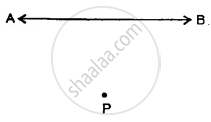
In the case, given below, draw a line through point P and parallel to AB:
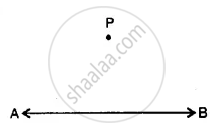
In the case, given below, draw a line through point P and parallel to AB:
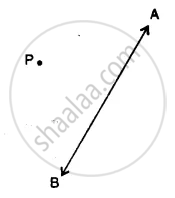
In the case, given below, draw a line through point P and parallel to AB:
Solutions for 16: Lines and Angles (Including Construction of angles)
R.K. Bansal solutions for कन्साइस मैथमैटिक्स [अंग्रेजी] कक्षा ७ आईसीएसई chapter 16 - Lines and Angles (Including Construction of angles)
Shaalaa.com has the CISCE Mathematics कन्साइस मैथमैटिक्स [अंग्रेजी] कक्षा ७ आईसीएसई CISCE solutions in a manner that help students grasp basic concepts better and faster. The detailed, step-by-step solutions will help you understand the concepts better and clarify any confusion. R.K. Bansal solutions for Mathematics कन्साइस मैथमैटिक्स [अंग्रेजी] कक्षा ७ आईसीएसई CISCE 16 (Lines and Angles (Including Construction of angles)) include all questions with answers and detailed explanations. This will clear students' doubts about questions and improve their application skills while preparing for board exams.
Further, we at Shaalaa.com provide such solutions so students can prepare for written exams. R.K. Bansal textbook solutions can be a core help for self-study and provide excellent self-help guidance for students.
Concepts covered in कन्साइस मैथमैटिक्स [अंग्रेजी] कक्षा ७ आईसीएसई chapter 16 Lines and Angles (Including Construction of angles) are Concept of Pairs of Angles, Construction of a Line Parallel to a Given Line from a Point Outside It ., Introduction to Lines and Angles, Parallel Lines, Concept of Pairs of Angles, Construction of a Line Parallel to a Given Line from a Point Outside It ., Introduction to Lines and Angles, Parallel Lines.
Using R.K. Bansal कन्साइस मैथमैटिक्स [अंग्रेजी] कक्षा ७ आईसीएसई solutions Lines and Angles (Including Construction of angles) exercise by students is an easy way to prepare for the exams, as they involve solutions arranged chapter-wise and also page-wise. The questions involved in R.K. Bansal Solutions are essential questions that can be asked in the final exam. Maximum CISCE कन्साइस मैथमैटिक्स [अंग्रेजी] कक्षा ७ आईसीएसई students prefer R.K. Bansal Textbook Solutions to score more in exams.
Get the free view of Chapter 16, Lines and Angles (Including Construction of angles) कन्साइस मैथमैटिक्स [अंग्रेजी] कक्षा ७ आईसीएसई additional questions for Mathematics कन्साइस मैथमैटिक्स [अंग्रेजी] कक्षा ७ आईसीएसई CISCE, and you can use Shaalaa.com to keep it handy for your exam preparation.
