Advertisements
Online Mock Tests
Chapters
▶ 2: Polynomials
3: Pair of Linear Equations in Two Variables
4: Quadratic Equations
5: Arithmetic Progressions
6: Co-ordinate Geometry
7: Triangles
8: Circles
9: Constructions
10: Trigonometric Ratios
11: Trigonometric Identities
12: Heights and Distances
13: Areas Related to Circles
14: Surface Areas and Volumes
15: Statistics
16: Probability
![R.D. Sharma solutions for मैथमैटिक्स [अंग्रेजी] कक्षा १० chapter 2 - Polynomials - Shaalaa.com](/images/mathematics-english-class-10_6:df8cedf76b7f4149972b35ec991c0c9d.jpg "R.D. Sharma solutions for मैथमैटिक्स [अंग्रेजी] कक्षा १० chapter 2 - Polynomials")
Advertisements
Solutions for Chapter 2: Polynomials
Below listed, you can find solutions for Chapter 2 of CBSE, Karnataka Board R.D. Sharma for मैथमैटिक्स [अंग्रेजी] कक्षा १०.
R.D. Sharma solutions for मैथमैटिक्स [अंग्रेजी] कक्षा १० 2 Polynomials EXERCISE 2.1 [Pages 2.25 - 2.26]
BASIC
Find the zeros of the following quadratic polynomial and verify the relationship between the zeros and the coefficients:
f(x) = x2 – 2x – 8
Find the zeros of the following quadratic polynomial and verify the relationship between the zeros and the coefficients:
g(s) = 4s2 – 4s + 1
Find the zeros of the following quadratic polynomial and verify the relationship between the zeros and the coefficients:
h(t) = t2 – 15
Find the zeros of the following quadratic polynomial and verify the relationship between the zeros and the coefficients:
f(x) = 6x2 – 3 – 7x
Find the zeros of the following quadratic polynomial and verify the relationship between the zeros and the coefficients:
`q(y) = 7y^2 - 11/3y - 2/3`
Find the zeros of the following quadratic polynomial and verify the relationship between the zeros and the coefficients:
`phi(x) = 2x^2 + 7/2x + 3/4`
Find the zeros of the following quadratic polynomial and verify the relationship between the zeros and the coefficients:
`p(x) = x^2 + 4/3x - 4/3`
For the following, find a quadratic polynomial whose sum and product respectively of the zeroes are as given. Also, find the zeroes of these polynomials by factorization.
`-8/3, 4/3`
For the following, find a quadratic polynomial whose sum and product respectively of the zeroes are as given. Also, find the zeroes of these polynomials by factorization.
`21/8, 5/16`
If α and β are the zeros of the quadratic polynomial f(x) = x2 – 5x + 4, find the value of `1/α + 1/β - 2αβ`.
If α and β are the zeros of the quadratic polynomial p(y) = 5y2 – 7y + 1, find the value of `1/α + 1/β`.
If one zero of the quadratic polynomial f(x) = 4x2 – 8kx – 9 is negative of the other, find the value of k.
If the sum of the zeros of the quadratic polynomial f(t) = kt2 + 2t + 3k is equal to their product, find the value of k.
BASED ON LOTS
Find the zeros of the following quadratic polynomial and verify the relationship between the zeros and the coefficients:
`p(x) = x^2 + 2sqrt(2)x - 6`
Find the zeros of the following quadratic polynomial and verify the relationship between the zeros and the coefficients:
`q(x) = sqrt(3)x^2 + 10x + 7sqrt(3)`
Find the zeros of the following quadratic polynomial and verify the relationship between the zeros and the coefficients:
`f(x) = x^2 - (sqrt(3) + 1)x + sqrt(3)`
Find the zeros of the following quadratic polynomial and verify the relationship between the zeros and the coefficients:
g(x) = a(x2 + 1) – x(a2 + 1)
Find the zeros of the following quadratic polynomial and verify the relationship between the zeros and the coefficients:
`h(s) = 2s^2 - (1 + 2sqrt(2))s + sqrt(2)`
Find the zeros of the following quadratic polynomial and verify the relationship between the zeros and the coefficients:
`f(v) = v^2 + 4sqrt(3)v - 15`
Find the zeros of the following quadratic polynomial and verify the relationship between the zeros and the coefficients:
`p(y) = y^2 + (3sqrt(5))/2 y - 5`
Find the zeros of the following quadratic polynomial and verify the relationship between the zeros and the coefficients:
`phi(x) = 4x^2 + 5sqrt(2)x - 3`
Find the zeros of the following quadratic polynomial and verify the relationship between the zeros and the coefficients:
f(x) = 4x2 + 4x – 3
Find a quadratic polynomial whose sum and product respectively of the zeros are given. Also, find the zeros of these polynomials.
`-2sqrt(3), -9`
Find a quadratic polynomial whose sum and product respectively of the zeros are given. Also, find the zeros of these polynomials.
`-3/(2sqrt(5)), -1/2`
If α and β are the zeros of the quadratic polynomial p(x) = 4x2 – 5x – 1, find the value of α2β + αβ2.
If α and β are the zeros of the quadratic polynomial f(x) = 6x2 + x – 2, find the value of `alpha/beta + beta/alpha`.
If α and β are the zeros of the quadratic polynomial f(x) = x2 – p(x + 1) – c, show that (α + 1)(β + 1) = 1 – c.
If α and β are the zeros of a quadratic polynomial such that α + β = 24 and α – β = 8, find a quadratic polynomial having α and β as its zeros.
Find a quadratic polynomial whose zeros are negative of the zeros of the polynomial px2 + qx + r.
If α and β are zeroes of a quadratic polynomial px2 + qx + 1. Form a quadratic polynomial whose zeroes are `2/α` and `2/β`.
If α and β are the zeroes of the polynomial ax2 – x + c. Obtain a polynomial whose zeroes are α – 3 and β – 3.
Obtain the zeroes of the polynomial 7x2 + 18x – 9. Hence, write a polynomial each of whose zeroes is twice the zeroes of the given polynomial.
Obtain the zeroes of the polynomial p(x) = 2x2 – 5x – 3. Hence, obtain a polynomial each of whose zeroes is one less than each of the zero of p(x).
Find the zeroes of the polynomial p(x) = 3x2 – 4x – 4. Hence, write a polynomial whose each of the zero is 2 more than zeroes of p(x).
Find the zeroes of the polynomial q(x) = 8x2 – 2x – 3. Hence, find a polynomial whose zeroes are 2 less than the zeroes of q(x).
Find the zeroes of the polynomial r(x) = 4x2 + 3x – 1. Hence, write a polynomial whose zeroes are reciprocal of the zeroes of polynomial r(x).
BASED ON HOTS
If α and β are the zeros of the quadratic polynomial f(x) = x2 – 1, find a quadratic polynomial whose zeros are `(2alpha)/beta` and `(2beta)/alpha`.
If the squared difference of the zeros of the quadratic polynomial f(x) = x2 + px + 45 is equal to 144, find the value of p.
If α and β are the zeros of the quadratic polynomial f(x) = x2 – px + q, prove that `alpha^2/beta^2 + beta^2/alpha^2 = p^4/q^2 - (4p^2)/q + 2`.
If α and β are the zeroes of the quadratic polynomial f(x) = ax2 + bx + c, then evaluate `1/(aalpha + b) + 1/(abeta + b)`.
If α and β are the zeros of the quadratic polynomial f(x) = ax2 + bx + c, then evaluate `beta/(aalpha + b) + alpha/(abeta + b)`.
If α and β are the zeros of the quadratic polynomial f(x) = ax2 + bx + c, then evaluate `a(α^2/β + β^2/α) + b(α/β + β/α)`.
If a and b are the zeros of the quadratic polynomial f(x) = x2 + x – 2, find the value of `α/β + β/α`.
If a and b are the zeros of the quadratic polynomial f(x) = x2 + x – 2, find the value of `1/α - 1/β`.
R.D. Sharma solutions for मैथमैटिक्स [अंग्रेजी] कक्षा १० 2 Polynomials EXERCISE 2.2 [Page 2.33]
BASIC
Verify that the numbers given along side of the cubic polynomials are their zeroes. Also, verify the relationship between the zeros and the coefficients.
`f(x) = 2x^3 + x^2 - 5x + 2 ; 1/2, 1, - 2`
Verify that the numbers given along side of the cubic polynomials below are their zeroes. Also verify the relationship between the zeros and the coefficients.
g(x) = x3 – 4x2 + 5x – 2; 2, 1, 1
Find a cubic polynomial with the sum, sum of the product of its zeros taken two at a time, and product of its zeros as 3, –1 and –3 respectively.
BASED ON HOTS
If the zeros of the polynomial f(x) = 2x3 – 15x2 + 37x – 30 are in A.P., find them.
Find the condition that the zeros of the polynomial f(x) = x3 + 3px2 + 3qx + r may be in A.P.
If the zeros of the polynomial f(x) = ax3 + 3bx2 + 3cx + d are in A.P., prove that 2b3 – 3abc + a2d = 0.
If the zeros of the polynomial f(x) = x3 – 12x2 + 39x + k are in A.P., find the value of k.
If 4 is a zero of the cubic polynomial x3 – 3x2 – 10x + 24, find its other two zeros.
R.D. Sharma solutions for मैथमैटिक्स [अंग्रेजी] कक्षा १० 2 Polynomials EXERCISE 2.3 [Page 2.48]
BASIC
Check whether the first polynomial is a factor of the second polynomial by dividing the second polynomial by the first polynomial.
t2 – 3, 2t4 + 3t3 – 2t2 – 9t – 12
Check whether the first polynomial is a factor of the second polynomial by dividing the second polynomial by the first polynomial.
x3 – 3x + 1, x5 – 4x3 + x2 + 3x + 1
Check whether the first polynomial is a factor of the second polynomial by applying the division algorithm:
g(x) = 2x2 – x + 3, f(x) = 6x5 – x4 + 4x3 – 5x2 – x – 15
Obtain all zeros of f(x) = x3 + 13x2 + 32x + 20, if one of its zeros is –2.
Obtain all zeros of the polynomial f(x) = 2x4 + x3 – 14x2 – 19x – 6, if two of its zeros are –2 and –1.
Find all the zeros of the polynomial x4 + x3 – 34x2 – 4x + 120, if two of its zeros are 2 and –2.
For what value of k, is the polynomial f(x) = 3x4 – 9x3 + x2 + 15x + k completely divisible by 3x2 – 5?
BASED ON LOTS
Find all the zeros of the polynomial 2x3 + x2 – 6x – 3, if two of its zeros are `-sqrt(3)` and `sqrt(3)`.
Find all the zeros of the polynomial x3 + 3x2 – 2x – 6, if two of its zeros are `-sqrt(2)` and `sqrt(2)`.
Find all zeros of the polynomial f(x) = 2x4 – 2x3 – 7x2 + 3x + 6, if its two zeros are `-sqrt(3/2)` and `sqrt(3/2)`.
Find all zeros of the polynomial 2x4 + 7x3 – 19x2 – 14x + 30, if two of its zeros are `sqrt(2)` and `-sqrt(2)`.
Given that `x - sqrt(5)` is a factor of the cubic polynomial `x^3 - 3sqrt(5)x^2 + 13x - 3sqrt(5)`, find all the zeroes of the polynomial.
What must be added to the polynomial f(x) = x4 + 2x3 – 2x2 + x – 1 so that the resulting polynomial is exactly divisible by x2 + 2x – 3?
BASED ON HOTS
Apply division algorithm to find the quotient q(x) and remainder r(x) on dividing f(x) by g(x) in the following:
f(x) = x3 – 6x2 + 11x – 6, g(x) = x2 + x + 1
Apply division algorithm to find the quotient q(x) and remainder r(x) on dividing f(x) by g(x) in the following:
f(x) = 10x4 + 17x3 – 62x2 + 30x – 3, g(x) = 2x2 + 7x + 1
Apply division algorithm to find the quotient q(x) and remainder r(x) on dividing f(x) by g(x) in the following:
f(x) = 4x3 + 8x + 8x2 + 7, g(x) = 2x2 – x + 1
Apply division algorithm to find the quotient q(x) and remainder r(x) on dividing f(x) by g(x) in the following:
f(x) = 15x3 – 20x2 + 13x – 12, g(x) = 2 – 2x + x2
R.D. Sharma solutions for मैथमैटिक्स [अंग्रेजी] कक्षा १० 2 Polynomials VERY SHORT ANSWER TYPE QUESTIONS (VSAQS) [Pages 2.49 - 2.51]
Answer each of the following questions in one word or one sentence or as per the exact requirement of the questions:
BASIC
Define a polynomial with real coefficients.
Define degree of a polynomial.
Write the standard form of a linear polynomial with real coefficients.
Write the standard form of a quadratic polynomial with real coefficients.
Write the standard form of a cubic polynomial with real coefficients.
Define value of polynomial at a point.
Define zero of a polynomial.
The sum and product of the zeros of a quadratic polynomial are \[- \frac{1}{2}\] and –3 respectively. What is the quadratic polynomial.
Write the family of quadratic polynomials having \[- \frac{1}{4}\] and 1 as its zeros.
Find a quadratic polynomial whose zeroes are 2 and `-7/5`.
If the product of zeros of the quadratic polynomial f(x) = x2 – 4x + k is 3, find the value of k.
If the sum of the zeros of the quadratic polynomial f(x) = kx2 – 3x + 5 is 1, write the value of k.
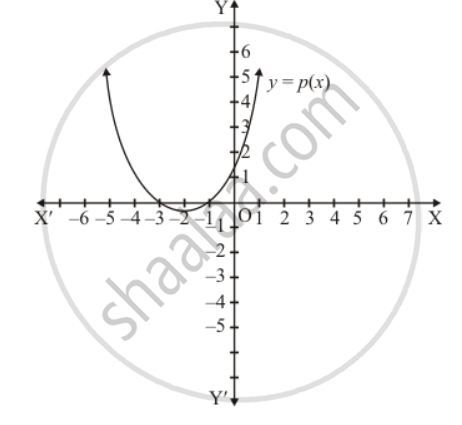
In figure, the graph of a polynomial p(x) is given. Find the zeros of the polynomial.
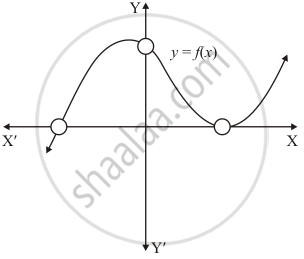
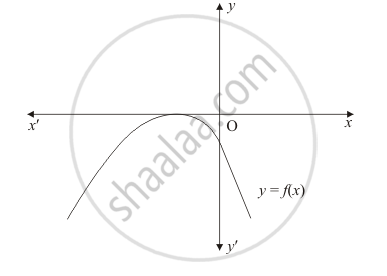
The graph of a polynomial y = f(x), shown in figure. Find the number of real zeros of f(x).
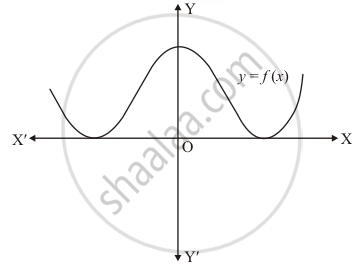
The graph of a polynomial f(x) is as shown in figure. Write the number of real zeros of f(x).
If x = 1 is a zero of the polynomial f(x) = x3 – 2x2 + 4x + k, write the value of k.
Write a quadratic polynomial, sum of whose zeros is \[2\sqrt{3}\] and their product is 2.
Write the coefficient of the polynomial p(z) = z5 – 2z2 + 4.
Write the zeros of the polynomial x2 – x – 6.
If α, β are the zeros of a polynomial such that α + β = −6 and αβ = −4, then write the polynomial.
For what value of k, is 3 a zero of the polynomial 2x2 + x + k?
For what value of k, is –3 a zero of the polynomial x2 + 11x + k?
For what value of k, is –2 a zero of the polynomial 3x2 + 4x + 2k?
If α, β are zeroes of the polynomial p(x) = 5x2 – 6x + 1, then find the value of α + β + αβ.
BASED ON LOTS
If (x + a) is a factor of 2x2 + 2ax + 5x + 10, find a.
For what value of k, –4 is a zero of the polynomial x2 – x – (2k + 2)?
If 1 is a zero of the polynomial p(x) = ax2 – 3(a – 1) x – 1, then find the value of a.
If α, β are the zeros of the polynomial 2y2 + 7y + 5, write the value of α + β + αβ.
If α and β are zeroes of the polynomial p(x) = x2 – 2x – 1, then find the value of `1/(2α) + 1/(2β) + 3αβ`.
If the sum of the zeroes of the polynomial p(x) = (p + 1)x2 + (2p + 3)x + (3p + 4) is –1, then find the value of p.
Find a quadratic polynomial whose zeroes are 2 and `-7/5`.
If a quadratic polynomial f(x) is factorizable into linear distinct factors, then what is the total number of real and distinct zeros of f(x)?
If a quadratic polynomial f(x) is a square of a linear polynomial, then its two zeroes are coincident. (True/False).
If a quadratic polynomial f(x) is not factorizable into linear factors, then it has no real zero. (True/False)
BASED ON HOTS
If the graph of quadratic polynomial ax2 + bx + c cuts negative direction of y-axis, then what is the sign of c?
If graph of quadratic polynomial ax2 + bx + c cuts positive direction of y-axis, then what is the sign of c?
If f(x) is a polynomial such that f(a) f(b) < 0, then what is the number of zeros lying between a and b?
If x3 + x2 – ax + b is divisible by (x2 – x), write the values of a and b.
If fourth degree polynomial is divided by a quadratic polynomial, write the degree of the remainder.
The graph of the polynomial f(x) = ax2 + bx + c is as shown below. Write the signs of 'a' and b2 – 4ac.
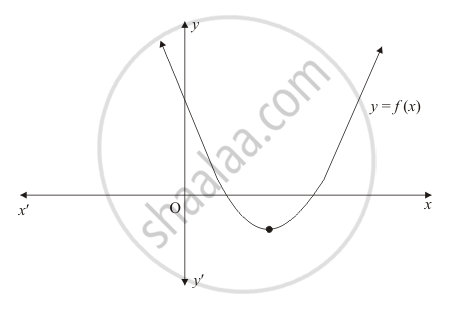
The graph of the polynomial f(x) = ax2 + bx + c is as shown in figure. Write the value of b2 – 4ac and the number of real zeros of f(x).
In Q. No. 36, write the sign of c.
In Q. No. 37, write the sign of c.
R.D. Sharma solutions for मैथमैटिक्स [अंग्रेजी] कक्षा १० 2 Polynomials FILL IN THE BLANK TYPE QUESTIONS (FBQs) [Pages 2.51 - 2.52]
BASIC
Quadratic polynomials, whose zeroes are – 4 and 3 are given by ______.
The number of quadratic polynomials whose zeroes are 2 and – 3, is ______.
The zeroes of the quadratic polynomial x2 + x – 6 are ______.
The quadratic polynomials, the sum and product of whose zeroes are 7 and 12 are given by ______.
If x + 1 is a factor of the polynomial 2x3 + ax2 + 4x + 1, then a = ______.
The graph of a quadratic polynomial intersects the x-axis at the most at ______ points.
If – 4 is a zero of the polynomial x2 – x – (2k + 2), then k = ______.
If 4x2 – 6x – m is divisible by x – 3, then m = ______.
If one zero of the quadratic polynomial 2x2 – 6kx + 6x – 7 is negative of the other, then k = ______.
The sum of the zeros of the quadratic polynomial 2x2 – 3k is ______.
BASED ON LOTS
Quadratic polynomials with rational coefficients having `sqrt(3)` as a zero are given by ______.
If x + α is a factor of the polynomial 2x2 + 2αx + 4x + 12, then α = ______.
If the product of the zeroes of the quadratic polynomial x2 – 3ax + 2a2 – 1 is 7, then a = ______.
The maximum number of zeros which a quadratic polynomial can have is ______.
BASED ON HOTS
If a + b + c = 0, then a zero of the polynomial ax2 + bx + c, is ______.
If a + c = b, then a zero of the polynomial ax2 + bx + c, is ______.
If two of the zeroes of a cubic polynomial are zero, then it does not have ______ and ______ terms.
If all the zeroes of cubic polynomial x3 + ax2 + bx + c are negative then a, b and c all have ______ sign.
If the zeroes of the quadratic polynomial ax2 + x + a are equal, then a = ______.
If the zeroes of the quadratic polynomial ax2 + bx + c are both negative, then a, b and c all have the ______ sign.
If a, a + b, a + 2b are zeroes of the cubic polynomial x3 – 6x2 + 3x + 10, then a + b = ______.
The parabola representing a quadratic polynomial f(x) = ax2 + bx + c opens upward when ______.
The parabola representing a quadratic polynomial f(x) = ax2 + bx + c opens downward when ______.
If the parabola represented by f(x) = ax2 + bx + c cuts x-axis at two distinct points, then the polynomial ax2 + bx + c has ______ real zeroes.
Solutions for 2: Polynomials
R.D. Sharma solutions for मैथमैटिक्स [अंग्रेजी] कक्षा १० chapter 2 - Polynomials
Shaalaa.com has the CBSE, Karnataka Board Mathematics मैथमैटिक्स [अंग्रेजी] कक्षा १० CBSE, Karnataka Board solutions in a manner that help students grasp basic concepts better and faster. The detailed, step-by-step solutions will help you understand the concepts better and clarify any confusion. R.D. Sharma solutions for Mathematics मैथमैटिक्स [अंग्रेजी] कक्षा १० CBSE, Karnataka Board 2 (Polynomials) include all questions with answers and detailed explanations. This will clear students' doubts about questions and improve their application skills while preparing for board exams.
Further, we at Shaalaa.com provide such solutions so students can prepare for written exams. R.D. Sharma textbook solutions can be a core help for self-study and provide excellent self-help guidance for students.
Concepts covered in मैथमैटिक्स [अंग्रेजी] कक्षा १० chapter 2 Polynomials are .
Using R.D. Sharma मैथमैटिक्स [अंग्रेजी] कक्षा १० solutions Polynomials exercise by students is an easy way to prepare for the exams, as they involve solutions arranged chapter-wise and also page-wise. The questions involved in R.D. Sharma Solutions are essential questions that can be asked in the final exam. Maximum CBSE, Karnataka Board मैथमैटिक्स [अंग्रेजी] कक्षा १० students prefer R.D. Sharma Textbook Solutions to score more in exams.
Get the free view of Chapter 2, Polynomials मैथमैटिक्स [अंग्रेजी] कक्षा १० additional questions for Mathematics मैथमैटिक्स [अंग्रेजी] कक्षा १० CBSE, Karnataka Board, and you can use Shaalaa.com to keep it handy for your exam preparation.
