Advertisements
Advertisements
प्रश्न
If the zeros of the polynomial f(x) = x3 − 12x2 + 39x + k are in A.P., find the value of k.
Advertisements
उत्तर
Let a - d, a and a + d be the zeros of the polynomial f(x). Then,
Sum of the zeroes `=("coefficient of "x^2)/("coefficient of "x^3)`
`a-d+a+a+d=(-(-12))/1`
`a-d+a+a+d=12`
`3a=12`
`a=12/3=4`
Since 'a' is a zero of the polynomial f(x).
f(x) = x3 − 12x2 + 39x + k
f(a) = 0
f(a) = 43 − 12(4)2 + 39(4) + k
0 = 64 - 192 + 156 + k
0 = 220 - 192 + k
0 = 28 + k
-28 = k
Hence, the value of k is -28.
APPEARS IN
संबंधित प्रश्न
Find a quadratic polynomial with the given numbers as the sum and product of its zeroes respectively.
`0, sqrt5`
Find a quadratic polynomial with the given numbers as the sum and product of its zeroes respectively.
1, 1
Find a cubic polynomial with the sum, sum of the product of its zeroes taken two at a time, and the product of its zeroes as 2, − 7, − 14 respectively
If two zeroes of the polynomial x4 – 6x3 – 26x2 + 138x – 35 are 2 ± `sqrt3` , find other zeroes
If a and are the zeros of the quadratic polynomial f(x) = 𝑥2 − 𝑥 − 4, find the value of `1/alpha+1/beta-alphabeta`
If 𝛼 and 𝛽 are the zeros of the quadratic polynomial p(x) = 4x2 − 5x −1, find the value of α2β + αβ2.
If α and β are the zeros of the quadratic polynomial f(t) = t2 − 4t + 3, find the value of α4β3 + α3β4.
If α and β are the zeros of the quadratic polynomial p(s) = 3s2 − 6s + 4, find the value of `alpha/beta+beta/alpha+2[1/alpha+1/beta]+3alphabeta`
If If α and β are the zeros of the quadratic polynomial f(x) = x2 – 2x + 3, find a polynomial whose roots are α + 2, β + 2.
Find the zeroes of the polynomial f(x) = `2sqrt(3)x^2 - 5x + sqrt(3)` and verify the relation between its zeroes and coefficients.
Find the zeroes of the quadratic polynomial 2x2 – 11x + 15 and verify the relation between the zeroes and the coefficients.
Verify that 5, –2 and `1/3` are the zeroes of the cubic polynomial p(x) = (3x3 – 10x2 – 27x + 10) and verify the relation between its zeros and coefficients.
The product of the zeros of x3 + 4x2 + x − 6 is
Check whether g(x) is a factor of p(x) by dividing polynomial p(x) by polynomial g(x),
where p(x) = x5 − 4x3 + x2 + 3x +1, g(x) = x3 − 3x + 1
If 2 and `1/2` are the zeros of px2 + 5x + r, then ______.
Case Study -1
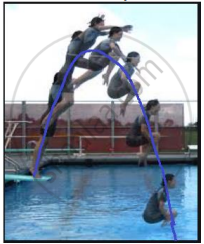
The figure given alongside shows the path of a diver, when she takes a jump from the diving board. Clearly it is a parabola.
Annie was standing on a diving board, 48 feet above the water level. She took a dive into the pool. Her height (in feet) above the water level at any time ‘t’ in seconds is given by the polynomial h(t) such that h(t) = -16t2 + 8t + k.
The zeroes of the polynomial r(t) = -12t2 + (k - 3)t + 48 are negative of each other. Then k is ______.
The below picture are few natural examples of parabolic shape which is represented by a quadratic polynomial. A parabolic arch is an arch in the shape of a parabola. In structures, their curve represents an efficient method of load, and so can be found in bridges and in architecture in a variety of forms.


If the sum of the roots is –p and the product of the roots is `-1/"p"`, then the quadratic polynomial is:
An asana is a body posture, originally and still a general term for a sitting meditation pose, and later extended in hatha yoga and modern yoga as exercise, to any type of pose or position, adding reclining, standing, inverted, twisting, and balancing poses. In the figure, one can observe that poses can be related to representation of quadratic polynomial.


The zeroes of the quadratic polynomial `4sqrt3"x"^2 + 5"x" - 2sqrt3` are:
If p(x) = x2 + 5x + 6, then p(– 2) is ______.
