Advertisements
Chapters
2: Units and Measurements
▶ 3: Motion in a Straight Line
4: Motion in a Plane
5: Laws of Motion
6: Work, Energy and Power
7: System of Particles and Rotational Motion
8: Gravitation
9: Mechanical Properties of Solids
10: Mechanical Properties of Fluids
11: Thermal Properties of Matter
12: Thermodynamics
13: Kinetic Theory
14: Oscillations
15: Waves
![NCERT solutions for Physics [English] Class 11 chapter 3 - Motion in a Straight Line - Shaalaa.com](/images/physics-english-class-11_6:2794bb7b99ab415dafd9ba0a905d4f01.jpg "NCERT solutions for Physics [English] Class 11 chapter 3 - Motion in a Straight Line")
Advertisements
Solutions for Chapter 3: Motion in a Straight Line
Below listed, you can find solutions for Chapter 3 of CBSE, Karnataka Board PUC NCERT for Physics [English] Class 11.
NCERT solutions for Physics [English] Class 11 3 Motion in a Straight Line Exercises
In the following examples of motion, can the body be considered approximately a point object:
A railway carriage moving without jerks between two stations.
In the following example of motion, can the body be considered approximately a point object:
A monkey sitting on top of a man cycling smoothly on a circular track.
In the following example of motion, can the body be considered approximately a point object:
A spinning cricket ball that turns sharply on hitting the ground.
In the following example of motion, can the body be considered approximately a point object:
A tumbling beaker that has slipped off the edge of a table.
The position-time (x-t) graphs for two children A and B returning from their school O to their homes P and Q respectively, are shown in the figure. Choose the correct entries in the brackets below;

- (A/B) lives closer to the school than (B/A)
- (A/B) starts from the school earlier than (B/A)
- (A/B) walks faster than (B/A)
- A and B reach home at the (same/different) time
- (A/B) overtakes (B/A) on the road (once/twice).
A woman starts from her home at 9.00 am, walks with a speed of 5 km h–1 on a straight road up to her office 2.5 km away, stays at the office up to 5.00 pm, and returns home by an auto with a speed of 25 km h–1. Choose suitable scales and plot the x-t graph of her motion.
A drunkard walking in a narrow lane takes 5 steps forward and 3 steps backward, followed again by 5 steps forward and 3 steps backward, and so on. Each step is 1 m long and requires 1 s. Plot the x-t graph of his motion. Determine graphically and otherwise how long the drunkard takes to fall in a pit 13 m away from the start.
A jet airplane travelling at the speed of 500 km h–1 ejects its products of combustion at the speed of 1500 km h–1 relative to the jet plane. What is the speed of the latter with respect to an observer on ground?
A car moving along a straight highway with a speed of 126 km h–1 is brought to a stop within a distance of 200 m. What is the retardation of the car (assumed uniform), and how long does it take for the car to stop?
Two trains A and B of length 400 m each are moving on two parallel tracks with a uniform speed of 72 km h–1 in the same direction, with A ahead of B. The driver of B decides to overtake A and accelerates by 1 m/s2. If after 50 s, the guard of B just brushes past the driver of A, what was the original distance between them?
On a two-lane road, car A is travelling with a speed of 36 km h–1. Two cars B and C approach car A in opposite directions with a speed of 54 km h–1 each. At a certain instant, when the distance AB is equal to AC, both being 1 km, B decides to overtake A before C does. What minimum acceleration of car B is required to avoid an accident?
Two towns A and B are connected by a regular bus service with a bus leaving in either direction every T minutes. A man cycling with a speed of 20 km h–1 in the direction A to B notices that a bus goes past him every 18 min in the direction of his motion, and every 6 min in the opposite direction. What is the period T of the bus service and with what speed (assumed constant) do the buses ply on the road?
A player throws a ball upwards with an initial speed of 29.4 m s–1.
- What is the direction of acceleration during the upward motion of the ball?
- What are the velocity and acceleration of the ball at the highest point of its motion?
- Choose the x = 0 m and t = 0 s to be the location and time of the ball at its highest point, vertically downward direction to be the positive direction of x-axis, and give the signs of position, velocity and acceleration of the ball during its upward and downward motion.
- To what height does the ball rise and after how long does the ball return to the player’s hands? (Take g = 9.8 m s–2 and neglect air resistance).
Read the statement below carefully and state, with reason and example, if it is true or false:
A particle in one-dimensional motion with zero speed at an instant may have non-zero acceleration at that instant
True
False
Read the statement below carefully and state, with reason and example, if it is true or false:
A particle in one-dimensional motion with zero speed may have non-zero velocity.
True
False
Read the statement below carefully and state, with reason and example, if it is true or false:
A particle in one-dimensional motion with constant speed must have zero acceleration.
True
False
Read the statement below carefully and state, with reason and example, if it is true or false:
A particle in one-dimensional motion with positive value of acceleration must be speeding up.
True
False
A ball is dropped from a height of 90 m on a floor. At each collision with the floor, the ball loses one tenth of its speed. Plot the speed-time graph of its motion between t = 0 to 12 s.
Explain clearly, with examples, the distinction between:
- magnitude of displacement (sometimes called distance) over an interval of time, and the total length of path covered by a particle over the same interval.
- magnitude of average velocity over an interval of time, and the average speed over the same interval. [Average speed of a particle over an interval of time is defined as the total path length divided by the time interval]. Show in both (a) and (b) that the second quantity is either greater than or equal to the first. When is the equality sign true ? [For simplicity, consider one-dimensional motion only].
A man walks on a straight road from his home to a market 2.5 km away with a speed of 5 km h –1. Finding the market closed, he instantly turns and walks back home with a speed of 7.5 km h–1. What is the
- magnitude of average velocity, and
- average speed of the man over the interval of time
- 0 to 30 min,
- 0 to 50 min,
- 0 to 40 min?
[Note: You will appreciate from this exercise why it is better to define average speed as total path length divided by time, and not as magnitude of average velocity. You would not like to tell the tired man on his return home that his average speed was zero!]
In Exercise, we have carefully distinguished between average speed and magnitude of average velocity. No such distinction is necessary when we consider instantaneous speed and magnitude of velocity. The instantaneous speed is always equal to the magnitude of instantaneous velocity. Why?
Look at the graph carefully and state, with reason, that this cannot possibly represent the one-dimensional motion of a particle.

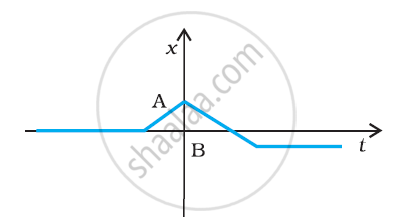
The figure shows the x-t plot of one-dimensional motion of a particle. Is it correct to say from the graph that the particle moves in a straight line for t < 0 and on a parabolic path for t > 0? If not, suggest a suitable physical context for this graph.

A police van moving on a highway with a speed of 30 km h–1 fires a bullet at a thief’s car speeding away in the same direction with a speed of 192 km h–1. If the muzzle speed of the bullet is 150 m s–1, with what speed does the bullet hit the thief’s car? (Note: Obtain that speed which is relevant for damaging the thief’s car).
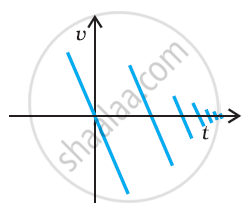
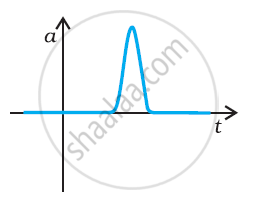
Suggest a suitable physical situation for the following graphs:
Suggest a suitable physical situation for the following graph:
Suggest a suitable physical situation for the following graph:
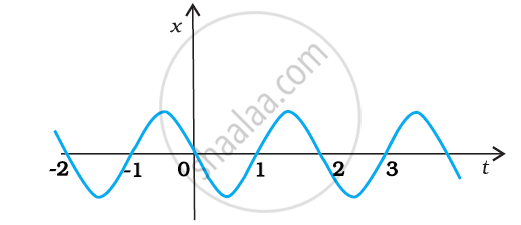
The following figure gives the x-t plot of a particle executing one-dimensional simple harmonic motion. Give the signs of position, velocity and acceleration variables of the particle at t = 0.3 s, 1.2 s, – 1.2 s.
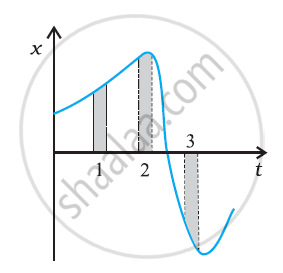
The following figure gives the x-t plot of a particle in one-dimensional motion. Three different equal intervals of time are shown. In which interval is the average speed greatest, and in which is it the least? Give the sign of average velocity for each interval.
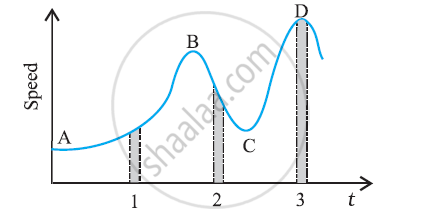
The given figure gives a speed-time graph of a particle in motion along a constant direction. Three equal intervals of time are shown. In which interval is the average acceleration greatest in magnitude? In which interval is the average speed greatest? Choosing the positive direction as the constant direction of motion, give the signs of v and a in the three intervals. What are the accelerations at the points A, B, C and D?
A three-wheeler starts from rest, accelerates uniformly with 1 m s–2 on a straight road for 10 s, and then moves with uniform velocity. Plot the distance covered by the vehicle during the nth second (n = 1,2,3….) versus n. What do you expect this plot to be during accelerated motion: a straight line or a parabola?
A boy standing on a stationary lift (open from above) throws a ball upwards with the maximum initial speed he can, equal to 49 m/s. How much time does the ball take to return to his hands? If the lift starts moving up with a uniform speed of 5 m/s and the boy again throws the ball up with the maximum speed he can, how long does the ball take to return to his hands?
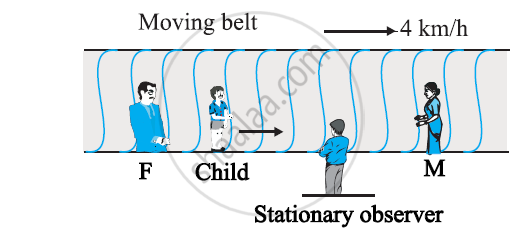
On a long horizontally moving belt (Fig. 3.26), a child runs to and fro with a speed 9 km h–1 (with respect to the belt) between his father and mother located 50 m apart on the moving belt. The belt moves with a speed of 4 km h–1. For an observer on a stationary platform outside, what is the
(a) speed of the child running in the direction of motion of the belt ?.
(b) speed of the child running opposite to the direction of motion of the belt ?
(c) time taken by the child in (a) and (b) ?
Which of the answers alter if motion is viewed by one of the parents?
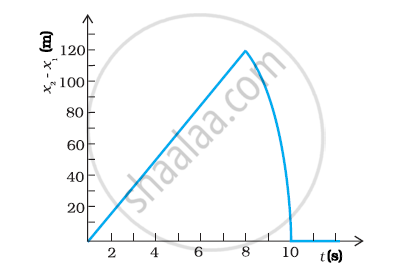
Two stones are thrown up simultaneously from the edge of a cliff 200 m high with initial speeds of 15 m/s and 30 m/s. Verify that the graph shown in Fig. 3.27 correctly represents the time variation of the relative position of the second stone with respect to the first. Neglect air resistance and assume that the stones do not rebound after hitting the ground. Take g = 10 m/s2. Give the equations for the linear and curved parts of the plot.
The speed-time graph of a particle moving along a fixed direction is shown in Fig. 3.28. Obtain the distance traversed by the particle between (a) t = 0 s to 10 s, (b) t = 2 s to 6 s.
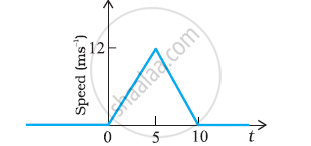
What is the average speed of the particle over the intervals in (a) and (b)
The velocity-time graph of a particle in one-dimensional motion is shown in Figure
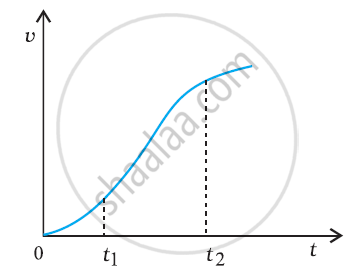
Which of the following formulae are correct for describing the motion of the particle over the time-interval t2 to t1?
(a) x(t2) = x(t1) + v(t1)(t2–t1) + (1/2)a(t2–t1)2
(b) v(t2)= v(t1) + a(t2–t1)
(c) vAverage = (x(t2) – x(t1)) / (t2 – t1)
(d) aAverage = (v(t2) – v(t1)) / (t2 – t1)
(e) x(t2) = x(t1) + vAverage(t2 – t1) + (1/2)aAverage(t2 – t1)2
(f) x(t2) – x(t1) = area under the v–t curve bounded by the t-axis and the dotted line shown.
Fill in the blank by suitable conversion of unit:
1 m =______ ly
State the number of significant figures in the following:
2.64 × 1024 kg
Solutions for 3: Motion in a Straight Line
NCERT solutions for Physics [English] Class 11 chapter 3 - Motion in a Straight Line
Shaalaa.com has the CBSE, Karnataka Board PUC Mathematics Physics [English] Class 11 CBSE, Karnataka Board PUC solutions in a manner that help students grasp basic concepts better and faster. The detailed, step-by-step solutions will help you understand the concepts better and clarify any confusion. NCERT solutions for Mathematics Physics [English] Class 11 CBSE, Karnataka Board PUC 3 (Motion in a Straight Line) include all questions with answers and detailed explanations. This will clear students' doubts about questions and improve their application skills while preparing for board exams.
Further, we at Shaalaa.com provide such solutions so students can prepare for written exams. NCERT textbook solutions can be a core help for self-study and provide excellent self-help guidance for students.
Concepts covered in Physics [English] Class 11 chapter 3 Motion in a Straight Line are Acceleration in Linear Motion, Kinematic Equations for Uniformly Accelerated Motion, Elementary Concept of Differentiation and Integration for Describing Motion, Instantaneous Velocity, Position, Path Length and Displacement, Average Velocity, Uniformly Accelerated Motion, Position-time, Velocity-time and Acceleration-time Graphs, Position - Time Graph, Instantaneous Speed, Uniform and Non-uniform Motion, Relations for Uniformly Accelerated Motion (Graphical Treatment), Introduction of Motion in One Dimension, Motion in a Straight Line, Acceleration in Linear Motion, Kinematic Equations for Uniformly Accelerated Motion, Elementary Concept of Differentiation and Integration for Describing Motion, Instantaneous Velocity, Position, Path Length and Displacement, Average Velocity, Uniformly Accelerated Motion, Position-time, Velocity-time and Acceleration-time Graphs, Position - Time Graph, Instantaneous Speed, Uniform and Non-uniform Motion, Relations for Uniformly Accelerated Motion (Graphical Treatment), Introduction of Motion in One Dimension, Motion in a Straight Line.
Using NCERT Physics [English] Class 11 solutions Motion in a Straight Line exercise by students is an easy way to prepare for the exams, as they involve solutions arranged chapter-wise and also page-wise. The questions involved in NCERT Solutions are essential questions that can be asked in the final exam. Maximum CBSE, Karnataka Board PUC Physics [English] Class 11 students prefer NCERT Textbook Solutions to score more in exams.
Get the free view of Chapter 3, Motion in a Straight Line Physics [English] Class 11 additional questions for Mathematics Physics [English] Class 11 CBSE, Karnataka Board PUC, and you can use Shaalaa.com to keep it handy for your exam preparation.
