Advertisements
Advertisements
प्रश्न
In the following example of motion, can the body be considered approximately a point object:
A spinning cricket ball that turns sharply on hitting the ground.
Advertisements
उत्तर
APPEARS IN
संबंधित प्रश्न
In the following examples of motion, can the body be considered approximately a point object:
A railway carriage moving without jerks between two stations.
A drunkard walking in a narrow lane takes 5 steps forward and 3 steps backward, followed again by 5 steps forward and 3 steps backward, and so on. Each step is 1 m long and requires 1 s. Plot the x-t graph of his motion. Determine graphically and otherwise how long the drunkard takes to fall in a pit 13 m away from the start.
Read the statement below carefully and state, with reason and example, if it is true or false:
A particle in one-dimensional motion with zero speed at an instant may have non-zero acceleration at that instant
Explain clearly, with examples, the distinction between:
- magnitude of displacement (sometimes called distance) over an interval of time, and the total length of path covered by a particle over the same interval.
- magnitude of average velocity over an interval of time, and the average speed over the same interval. [Average speed of a particle over an interval of time is defined as the total path length divided by the time interval]. Show in both (a) and (b) that the second quantity is either greater than or equal to the first. When is the equality sign true ? [For simplicity, consider one-dimensional motion only].
Look at the graph carefully and state, with reason, that this cannot possibly represent the one-dimensional motion of a particle.

Assertion: If distance travelled by a body is not zero, then displacement of a body will be a non-zero.
Reason: Displacement of a body is the shortest distance between initial and final positions.
The numerical ratio of distance to displacement is ______.
An athlete completes one round of a circular track of radius R in 80 sec. What will be his displacement at the end of 4 min 60 seconds?
In the following example of motion, can the body be considered approximately a point object:
A tumbling beaker that has slipped off the edge of a table.
Look at the graph carefully and state, with reason, that this cannot possibly represent the one-dimensional motion of a particle.
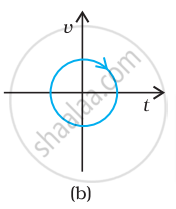
Look at the graph carefully and state, with reason, that this cannot possibly represent the one-dimensional motion of a particle.

