Advertisements
Chapters
1: Introduction to Economics
2: Basic Economic Entities in an Economy
▶ 3: Basic Concepts of Economics
Unit 2: Types of Economies
4: Types of Economies
Unit 3: Problems of an Economy
5: Basic Problems of An Economy
Unit 4: The Indian Economy – A Study
6: Main Sectors of the Indian Economy
7: Primary Sector : Agriculture
8: Secondary Sector : Industry
9: Tertiary Sector
Unit 5: Major Problems of the Indian Economy
10: Poverty in India
11: Problem of Unemployment in India
Unit 6: Major Reforms and Emerging Trends in the Indian Economy
12: LPG Model (or New Economic Policy)
13: Emerging Trends in the Indian Economy
Chapter *: Picture Based Questions
Chapter *: Value Based Questions
![J. P. Goel and Kaushal Goel solutions for इकॉनॉमिक्स [अंग्रेजी] कक्षा ९ आयसीएसई chapter 3 - Basic Concepts of Economics - Shaalaa.com](/images/economics-english-class-9-icse_6:758c58b2835a4d55adef468ed1a1dc76.jpg "J. P. Goel and Kaushal Goel solutions for इकॉनॉमिक्स [अंग्रेजी] कक्षा ९ आयसीएसई chapter 3 - Basic Concepts of Economics")
Advertisements
Solutions for Chapter 3: Basic Concepts of Economics
Below listed, you can find solutions for Chapter 3 of CISCE J. P. Goel and Kaushal Goel for इकॉनॉमिक्स [अंग्रेजी] कक्षा ९ आयसीएसई.
J. P. Goel and Kaushal Goel solutions for इकॉनॉमिक्स [अंग्रेजी] कक्षा ९ आयसीएसई 3 Basic Concepts of Economics QUESTIONS [Pages 47 - 50]
MULTIPLE CHOICE QUESTIONS
Utility means ______.
power to satisfy a want
usefulness
willingness of a person
pleasure
Economic goods are ______.
useful to people but scarce in relation to their demand
not scarce and are available as desired
not freely available
Both useful to people but scarce in relation to their demand and not freely available
______ is a single use consumer good.
Television
Crockery
Milk
Sugarcane purchased by a sugar mill
Clothes, food and shelter are examples of ______.
Collective wants
Necessaries
Comforts
Luxuries
Human wants are ______.
Endless
differ in intensity
recurring
All of these
For a commodity to be called wealth, must possess ______.
utility
value
transferability
All of these
Which of the following is not considered wealth?
Property
Stocks
Ornaments
Skills of a person
Steel is an example of ______.
floating capital
sunk capital
fixed capital
working capital
______ is that capital which is used again and again in the production process.
Sunk capital
Floating capital
Fixed capital
Remunerative capital
Which of the following is/are considered as factor of production?
Land
Labour
Capital
All of these
Capital as a factor of production is ______ in nature.
Durable
Perishable
Immobile
Limited
Land as a factor of production is ______ in nature.
mobile
limited
active
perishable
Which of the following options is not a characteristic of land?
Supply of land is fixed
Land is a free gift of nature
Land is an active factor of production
Land is immobile
Lack of divisibility is a problem of ______ system of exchange.
Trade
Barter
Money
Capital
Labour is a/an ______ factor of production.
Passive
Active
Limited
Direct
Immobile
______ possesses general acceptability.
Cheque
Money
Bank draft
Bond
Saving in an economy can be made by ______.
households only
firms/producers only
government only
households, firms and government
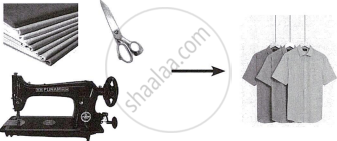
Read the above image and identify the type of utility created.
Possession utility
Place utility
Form utility
Time utility
Identify intermediate goods from the following:
- Soft drinks purchased by the school canteen.
- Machine purchased by a firm.
- Seeds purchased by a farmer to grow wheat.
- Electricity consumption in a business.
(ii), (iii)
(i), (ii), (iii)
(i), (iv)
(i), (iii) and (iv)
ASSERTION-REASON BASED QUESTIONS Read the following statements-Assertion(A) and Reason(R). Choose one of the correct alternatives given below:
Assertion (A): Economic goods are limited in supply.
Reason (R): Air sunlight and sea water are economic goods.
Both Assertion (A) and Reason (R) are true and Reason (R) is the correct explanation of Assertion (A).
Both Assertion (A) and Reason (R) are true and Reason (R) is not the correct explanation of Assertion (A).
Assertion (A) is true but Reason (R) is false.
Assertion (A) is false but Reason (R) is true.
Assertion (A): Public goods are freely available to all members of society.
Reason (R): Road is a public good.
Both Assertion (A) and Reason (R) are true and Reason (R) is the correct explanation of Assertion (A).
Both Assertion (A) and Reason (R) are true and Reason (R) is not the correct explanation of Assertion (A).
Assertion (A) is true but Reason (R) is false.
Assertion (A) is false but Reason (R) is true.
Statement (1): Capital goods are used by producers.
Statement (2): Salt used by baker is a capital good.
Both statements are true.
Both statements are false.
Statement 1 is true, Statement 2 is false.
Statement 2 is true, Statement 1 is false.
Statement (1): Wealth can’t be transferred from one person to another.
Statement (2): Wealth has power to satisfy human wants.
Both statements are true.
Both statements are false.
Statement 1 is true, Statement 2 is false.
Statement 2 is true, Statement 1 is false.
Assertion (A): Income earned by lending money is called profit.
Reason (R): Income earned from a rental property is called passive income.
Both Assertion (A) and Reason (R) are true and Reason (R) is the correct explanation of Assertion (A).
Both Assertion (A) and Reason (R) are true and Reason (R) is not the correct explanation of Assertion (A).
Assertion (A) is true but Reason (R) is false.
Assertion (A) is false but Reason (R) is true.
SHORT ANSWER TYPE QUESTIONS
What is meant by ‘goods’ in economics?
Define services.
OR
What are services?
Explain the term utility.
Give two characteristics of utility.
Is the following statement true or false?
Air does not possess utility.
Is the following statement true or false?
Utility is synonymous with pleasure.
Is the following statement true or false?
Utility and satisfaction mean the same thing.
Is the following statement true or false?
Wine is injurious to health, but at the same time possesses utility.
Define the following term.
Value
Define the following term.
Price
Define the following term.
Wealth
Define the following term.
Capital
Mention the characteristics of wealth.
Mention two characteristics of wants.
How would you classify the following - as sunk capital or floating capital? Give reasons.
Printing Machine
How would you classify the following - as sunk capital or floating capital? Give reasons.
Raw material
Indicate whether the following statement is true or false:
All capital is wealth
Indicate whether the following statement is true or false:
All wealth is capital
Indicate whether the following statement is true or false:
B.A. degree is wealth
Indicate whether the following statement is true or false:
Wealth and capital mean the same thing
Define production.
What do you mean by labour as a factor of production?
Define consumption.
What are economic goods?
What are public goods?
LONG ANSWER TYPE QUESTIONS
Explain the concept of marginal utility with the help of an example.
Point out the main characteristics of utility.
Distinguish between value and price.
Define capital.
Distinguish between remunerative and auxiliary capital.
Distinguish between productive capital and consumption capital.
Define utility.
How is utility created?
Explain the relationship between wealth and welfare?
Describe the basic characteristics of wealth.
Define goods.
Explain ‘free goods’ and ‘economic goods’ with examples.
What is welfare?
Describe briefly economic welfare and non-economic welfare.
Define wealth.
Write any two points of differences between wealth and capital.
What are the two characteristics that differentiate private goods from public goods?
What are four characteristics that differentiate services from goods?
J. P. Goel and Kaushal Goel solutions for इकॉनॉमिक्स [अंग्रेजी] कक्षा ९ आयसीएसई 3 Basic Concepts of Economics QUESTION BANK [Pages 51 - 52]
What do you mean by human want?
What do you understand by goods?
What are services?
Define final goods.
Define intermediate goods. Give two examples.
Define capital goods. Give two examples.
Define consumption goods. Give two examples.
Distinguish between consumer goods and capital goods. Which of these are final goods?
Define the term utility.
What do you mean by total utility?
Explain marginal utility.
Define the term production.
What do you mean by factors of production? Name them.
Define the term land.
Give two characteristics of land.
Define the term labour as a factor of production.
Give two characteristics of labour.
Define capital.
State two features of capital.
Define the term consumption.
Explain the concept of sustainable consumption.
Define the term market.
What do you understand by the term saving?
State three characteristics of human wants.
Define the term wealth.
Write any two points of differences between wealth and capital.
Give three features of wealth.
What is the main difference between public goods and private goods?
Solutions for 3: Basic Concepts of Economics
J. P. Goel and Kaushal Goel solutions for इकॉनॉमिक्स [अंग्रेजी] कक्षा ९ आयसीएसई chapter 3 - Basic Concepts of Economics
Shaalaa.com has the CISCE Mathematics इकॉनॉमिक्स [अंग्रेजी] कक्षा ९ आयसीएसई CISCE solutions in a manner that help students grasp basic concepts better and faster. The detailed, step-by-step solutions will help you understand the concepts better and clarify any confusion. J. P. Goel and Kaushal Goel solutions for Mathematics इकॉनॉमिक्स [अंग्रेजी] कक्षा ९ आयसीएसई CISCE 3 (Basic Concepts of Economics) include all questions with answers and detailed explanations. This will clear students' doubts about questions and improve their application skills while preparing for board exams.
Further, we at Shaalaa.com provide such solutions so students can prepare for written exams. J. P. Goel and Kaushal Goel textbook solutions can be a core help for self-study and provide excellent self-help guidance for students.
Concepts covered in इकॉनॉमिक्स [अंग्रेजी] कक्षा ९ आयसीएसई chapter 3 Basic Concepts of Economics are .
Using J. P. Goel and Kaushal Goel इकॉनॉमिक्स [अंग्रेजी] कक्षा ९ आयसीएसई solutions Basic Concepts of Economics exercise by students is an easy way to prepare for the exams, as they involve solutions arranged chapter-wise and also page-wise. The questions involved in J. P. Goel and Kaushal Goel Solutions are essential questions that can be asked in the final exam. Maximum CISCE इकॉनॉमिक्स [अंग्रेजी] कक्षा ९ आयसीएसई students prefer J. P. Goel and Kaushal Goel Textbook Solutions to score more in exams.
Get the free view of Chapter 3, Basic Concepts of Economics इकॉनॉमिक्स [अंग्रेजी] कक्षा ९ आयसीएसई additional questions for Mathematics इकॉनॉमिक्स [अंग्रेजी] कक्षा ९ आयसीएसई CISCE, and you can use Shaalaa.com to keep it handy for your exam preparation.
