Advertisements
Online Mock Tests
Chapters
2: Unit-2: Children and Women in Sports
3: Unit-3: Yoga as Preventive Measure for Lifestyle Disease
4: Unit-4: Physical Education and Sports for CWSN
5: Unit-5: Sports and Nutrition
6: Unit-6: Test and Measurement in Sports
7: Unit-7: Physiology and Injuries in Sports
▶ 8: Unit-8: Biomechanics and Sports
9: Unit-9: Psychology and Sports
Chapter 10: Unit-10: Training in Sports
Advertisements
Solutions for Chapter 8: Unit-8: Biomechanics and Sports
Below listed, you can find solutions for Chapter 8 of CBSE Dr. Manu Sood for फिज़िकल एजुकेशन [अंग्रेजी] कक्षा १२.
Dr. Manu Sood solutions for फिज़िकल एजुकेशन [अंग्रेजी] कक्षा १२ 8 Unit-8: Biomechanics and Sports MULTIPLE CHOICE QUESTIONS [Pages 261 - 266]
The term 'biomechanics' to describe the application of mechanical principles in the study of living organism was adopted in ______.
early 1970s
late 1970s
1970
early 1980s
Sports biomechanics can be described as:
mechanics of sports
kinesiology
physics of sports
sports dynamics
The study of forces & their effects on living systems is called ______.
Biochemistry
Anatomy
Biomechanics
None of the above
Use of biomechanics in sports:
Enhances performance
Improves technique
Helps in developing better sports equipment
All of the above
Which of the following is/are lever/levers?
See-saw
Scissors
Wheel barrow
All of the above
Levers are of ______ types.
2
3
4
5
Most of the levers used in sports are ______ class levers.
First
Second
Third
None of the above
Study of internal & external forces acting on athlete/player is called:
Sports Biomechanics
Biomechanics
Biochemistry
Kinesiology
More the force exerted by a person on the downward bounce, the higher the ball bounces into the air. It is in accordance with:
Newton's 1st law
Newton's 2nd law
Newton's 3rd law
Law of gravitation
A high jumper can jump higher off a solid surface because it pushes up his or her body with as much force as he or she is able to generate. It is in accordance with:
Law of conservation of energy
Law of inertia
Law of action & reaction
Newton's law of gravitation
Newton's second law of motion is also known as ______.
Law of inertia
Law of action and reaction
Law of momentum/acceleration
Law of gravitation
Newton's first law of motion is also called ______.
Law of inertia
Law of acceleration
Law of action and reaction
Law of gravitation
According to Newton's Second Law of Motion, greater the momentum imparted to an object:
More will be its acceleration
Lesser will it resist the external forces acting on it
Lesser will be its acceleration
None of the above
According to Newton's Second Law of Motion, force is the product of mass and ______.
Velocity
Distance
Acceleration
None of the above
Acceleration due to an external force acting on a moving object is technically defined as change in ______ of the object.
location
direction
velocity
movement
The acceleration of an object is directly proportional to the net force acting on it and inversely proportional to its ______.
weight
height
mass
density
Newton's third law of motion is also called ______.
Law of action and reaction
Law of conservation of energy
Law of inertia
Law of transference of momentum
Acceleration of an object will increase as the net force acting on it increases depending on its:
Density
Mass
Shape
Volume
An object in motion remains in motion and an object at rest remains at rest until acted upon by an external force. It is in accordance with Newtons:
Third Law of motion
Second Law of motion
First Law of motion
None of the above
Newton's laws of motion were given by:
Isaac Newton
John Newton
Boris Newton
Eric Newton
Example of Newton's Third Law is:
A ball remains at rest until the force is applied on it
In relay races while exchanging batons in exchange zone
In swimming, a swimmer pushes the water backward and in return gets pushed forward
All of the above
Which is not the Newton's law of motion?
Law of conservation of energy
Law of action and reaction
Law of acceleration
Law of inertia
Which of the following is one of the Newton's laws of motion?
Law of inertia
Law of conservation of energy
Law of conservation of momentum
Law of gravitation
Thrust exerted by water in swimming is an example of Newton's ______ law.
First
Second
Third
None of these
Acceleration produced in a body depends upon:
Its mass
Force acting on it
Both Its mass as well as Force acting on it
None of these
Mathematical form of Newton's second law of motion is ______.
Momentum = mass × volume
Force = mass × acceleration
Velocity = acceleration × time
Speed = distance divided by time
How is friction due to air reduced?
Streamlining
Lubrication
By using ball bearings
By polishing
Friction can be increased by:
Using air cushion
Lubricant
Using sand
Using ball bearings
Friction is a ______.
Magnetic Force
Non-contact Force
Contact Force
Couple Force
The measurement of the amount of friction a surface will generate is called the ______ of friction.
Calibration
Coefficient
Smoothness
Description
The force of friction depends upon ______.
Nature of surface of contact
Material of objects in contact
Both nature of surface of contact and material of objects in contact
None of the above
The body will move only when:
Force of friction = applied force
Force of friction < applied force
Force of friction > applied force
All of the above
It is difficult to walk on a wet floor because:
Floor gets spoiled
There is more resistance
Force of friction is high
Force of friction is very less
Which of the following is/are projectile/projectiles?
Javelin
Hammer in hammer-throw
Swimmer mid-dive
All of the above
The curved trajectory of a projectile is a ______.
Circle
Parabola
Ellipse
Hyperbola
Which of the following affects/affect the projectile trajectory?
Gravity
Angle of release
Air resistance
All of the above
Tyres are treaded to:
Look good
Increase longevity
Increase friction
Increase weight of tyres
Lubricants are used to:
Increase friction
Decrease friction
To light fire
To put off fire
Which of the following methods is used to increase friction?
Using magnesium carbonate
Lubrication
Smoothening both surfaces
Streamlining
Movement of wheel shows which type of friction?
Rolling friction
Sliding friction
Static friction
None of the above
Mechanical analysis of Javelin thrown by Neeraj Chopra will be done under:
Biology
Biomechanics
Physiology
Anatomy
Which Newton's law of motion is depicted through the picture?
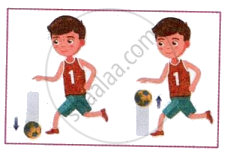
Newton's 3rd law
Newton's 2nd law
Newton's 1st law
Newton's 1st & 2nd law
Kicking off a stationary ball is an example of:
Law of Action and Reaction
Law of Acceleration
Law of Inertia
Both Law of Action and Reaction and Law of Acceleration
Newton's 3rd law of motion is known as ______.
Law of Action and reaction
Law of Inertia
Law of Acceleration
Law of Gravity
Which Newton's law is applied while swimming?
Law of Inertia
Law of Acceleration
Law of Action and Reaction
Both Law of Inertia and Law of Acceleration
Physical education teacher of XYZ school explained how Newton's laws of motion are used in sports. She explained while dribbling in Basket ball how the laws can be helpful.
Which law of motion is shown in picture?
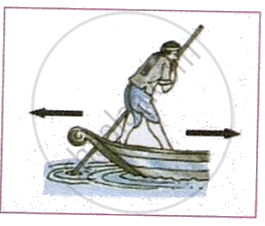
Law of Inertia
Law of Acceleration
Law of Action and reaction
Both Law of Inertia and Law of Acceleration
Application of Newton's laws at motion is very useful in sports. In this context. Acceleration is related to:
Newton's first law of motion
Newton's third law of motion
Newton's second law of motion
Both Newton's first law of motion and Newton's third law of motion
In general sports biomechanics is a quantitative based study and analysis of professional athletes and sports activities. It explains how and why the human body moves in the way that it does.
Following are the importance of biomechanics, except:
Improvement in training
Improvement in equipment
Improvement in performance
Improvement in aesthetic
Which balance is required by the body when it is moving?
Static equilibrium
Dynamic equilibrium
Both
None
When the sum of forces acting upon the object and sum of the movements acting upon the body is both equal to zero then the body is said to be in:
Equilibrium
Static equilibrium
Dynamic equilibrium
Zero force
The position of the centre of gravity changes depending upon the:
position of force
position of the body
position of the intersection of force
position of stability
Factors that bring air resistance into play:
Larger the surface area
Rough surface
Smaller the mass
All of the above
The motion of a projectile is due to two separates simultaneously occurring components of motion and they are:
One along the vertical
One along the horizontal
both One along the vertical and One along the horizontal
none of above
According to Professor John Fontanella, the ideal angles from the free throw line will vary from ______ to ______ with shorter players.
48.7 degrees to 52.2 degrees
45.6 degrees and 50.2 degrees
No specific degree
Any degree
Which of the following is NOT the factor affecting projectile trajectory?
Gravity
Angle of Release
Buoyant Force
Air Resistance
Centre of Gravity is the average location of an object's ______.
Weight
Force
Resistance
Velocity
What type of lever is depicted in the picture?
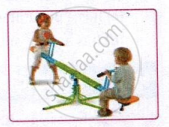
1st Class lever
2nd Class lever
3rd Class lever
None of the above
In the human body, the most common class of lever .........
1st Class lever
2nd Class lever
3rd Class lever
None of the above
The Friction force acts in a/an ______ direction to the direction of motion of an object.
Opposite
Same
Downwards
Diagonal
Identify the given below

First Law of Motion
Second Law of Motion
Third Law of Motion
Law of Effects
If a ball is hit and it is stop by gravitational force, this is an example of which law of Motion.
Law of Inertia
Law of acceleration
Law of action and reaction
Both the law of Inertia and law of acceleration
Identify the factor which decreases equilibrium.
Larger base
Greater weight
Lower centre of gravity
Higher centre of gravity
In which of the following sport friction play the least important role?
Car race
Football
Ice skating
Hockey
What type of lever has the load resistance between the fulcrum and the force?
First class lever
Second class lever
Both first class lever and second class lever
Third class lever
“The golf ball remains at rest until it is struck by a golf club.” This statement indicates ______.
Law of Inertia
Law of Acceleration
Law of Gravity
Law of Reaction
Identify the picture:
Newton's law depicted in the figure is:
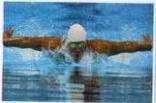
First
Second
Third
None of these
Which of the following helps with ice skating?
Rolling friction
Sliding friction
Static friction
Gliding friction
Which of the following is NOT the factor affecting projectile trajectory?
Gravity
Angle of Release
Buoyant Force
Air Resistance
Which of the following statements is correct regarding the lever’s fulcrum?
It is a point at which the force is applied.
It is a point at which the load is located.
It is a point at which the lever rotates.
It is a point at which efforts are made.
Dr. Manu Sood solutions for फिज़िकल एजुकेशन [अंग्रेजी] कक्षा १२ 8 Unit-8: Biomechanics and Sports MATCH THE COLUMN [Pages 266 - 267]
Match List – I with List – II and select the correct answer from the code given below:
| LIST - I | LIST - II |
| (i) Law of inertia | 1. Gives a measure of force |
| (ii) Newton's second law | 2. Newton's third law |
| (iii) SI unit of force | 3. Newton's first law |
| (iv) The law of reciprocal action force | 4. Newton |
(i) - 1, (ii) - 3, (iii) - 2, (iv) - 4
(i) - 2, (ii) - 4, (iii) - 1, (iv) - 3
(i) - 3, (ii) - 1, (iii) - 4, (iv) - 2
(i) - 4, (ii) - 2, (iii) - 3, (iv) - 1
Match the following:
| Column I | Column II |
| I. Sliding Friction | 1. Cycling |
| II. Fluid Friction | 2. Ice skating |
| III. Rolling Friction | 3. Try to push heavy object |
| IV. Static Friction | 4. Swimming |
I - 2, II - 1, III - 3, IV - 4
I - 2, II - 1, III - 4, IV - 3
I - 2, II - 4, III - 1, IV - 3
I - 4, II - 2, III - 3, IV - 1
Given below are examples of friction shown in List-I with their respective types of friction in List-II.
| List-I (Example of friction) |
List-II (Types of friction) |
||
| (a) | Pushing a chair | (i) | Sliding friction |
| (b) | Sea waves | (ii) | Rolling friction |
| (c) | Moving heavy (stationary) objects | (iii) | Fluid friction |
| (d) | Skating | (iv) | Static friction |
Which of the following options correctly matches the items of list (I) with those in list (II)?
(a) - (i), (b) - (iii) (c) - (ii), (d) - (iv)
(a) - (iv), (b) - (ii) (c) - (i), (d) - (iii)
(a) - (i), (b) - (iii) (c) - (iv), (d) - (ii)
(a) - (ii), (b) - (i) (c) - (iv), (d) - (iii)
Dr. Manu Sood solutions for फिज़िकल एजुकेशन [अंग्रेजी] कक्षा १२ 8 Unit-8: Biomechanics and Sports CASE STUDY [Pages 267 - 268]
Sir Isaac Newton (1642 - 1727) was an English scientist who made great contributions to physics, optics, maths and astronomy. He is known for his Three Laws of Motion and the Universal Law of Gravitation.
1. According to Newton's first law of motion, a moving object that is not acted on by an unbalanced force will:
- Remain in uniform motion
- Eventually come to a stop
- Change its momentum
- None of the above
2. When a swimmer moves her hands in the backward direction, her body goes forward. It is in accordance with:
- Newton's 1st Law
- Newton's 2nd Law
- Newton's 3rd Law
- The law of acceleration
3. A force applied in a direction opposite to the direction of motion of an object will cause the object to:
- speed up
- slow down
- turn
- None of these
4. Which of the following sports activities best demonstrates Newton's First Law of Motion (law of inertia)?
- A football stops after rolling due to friction
- A sprinter pushes the starting blocks to begin running
- A moving hockey ball continues to roll on a smooth surface
- A javelin changes direction after hitting the ground
The Physical Education, teacher told the students that Newton's laws of motion are also applicable in sports also. A particular law of motion is very useful in games like hammer throw and shot put while another law is useful in understanding swimming.
1. Which of the Newton's is useful for athletes competing in hammer throw?
- Law of Inertia
- Law of Acceleration
- Law of Reaction
- Law of Gravitation
2. Which of these laws is useful for swimmers?
- Law of Inertia
- Law of Acceleration
- Law of action and Reaction
- Law of Gravitation
3. What is the other name of Law of Inertia?
- First law of motion
- Second law of motion
- Third law of motion
- None of these
4. Which of the following situations in sports best illustrates Newton's Second Law of Motion (Law of Acceleration)?
- A gymnast maintaining balance on the beam
- A footballer kicking the ball harder to make it travel faster
- A swimmer pushing water backward with constant speed
- A hockey puck remaining at rest until struck
Ram and Lakshman were playing the game of carrom. The striker was sliding slowly, so Ram sprinkled some powder over the carrom board and then they played the game smoothly.
1. What was the reason of slow motion of striker?
- Increased friction
- Decreased friction
- No friction
2. Which method reduces the friction?
- Pressing the two surfaces together
- Removing lubrication between two surfaces
- Lubrication of two surface
3. Which type of friction occurred between the striker and carrom board?
- Static friction
- Sliding friction
- Rolling friction
4. Why does sprinkling powder on the carrom board help the striker move smoothly?
- It increases friction between the striker and board
- It converts static friction into rolling friction
- It reduces friction by acting as a lubricant
- It increases the weight of the striker
Read the given situations and write which of Newton's Laws of Motion applies to it.
| S.No. | Sports situation | Law of motion |
| 1. | A ball moves in the direction of the applied force, and greater force gives it greater speed. | |
| 2. | A skater continues at the same speed and in the same direction unless an external force acts. | |
| 3. | The force on the ball is matched by an equal and opposite force on the racket. | |
| 4. | A cue ball hits another billiards ball. | |
| 5. | Force is applied to the arrow in archery to make it move towards the target. |
During her gymnastics practice, Zoya was finding it difficult to maintain her balance on the balancing beam. Her coach tried to explain to her about basic principles of equilibrium.
According to the principles of equilibrium Centre of gravity plays a very important role.
- ______ C.G helps in increasing stability.
- ______ base more stability.
- There are two types of equilibrium namely ______ and ______.
While explaining how to release basketball at a correct angle to successfully score points the basketball coach showed students this picture.
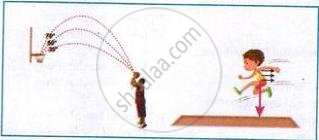
Basketball players wanted to know more about projectiles therefore the coach explained to them the factors affecting flight of an object.
- An object covers less distance when the projected path is at ______ degrees.
- If the initial velocity is low the object will cover ______ distance.
- If the weight of the object is more the impact of gravity will be ______.
Dr. Manu Sood solutions for फिज़िकल एजुकेशन [अंग्रेजी] कक्षा १२ 8 Unit-8: Biomechanics and Sports REASONING QUESTIONS [Page 269]
Given below are two statements labelled Assertion (A) and Reason (R).
Assertion (A): The major goal of biomechanics in sports & physical exercise is to improve performance.
Reason (R): By using biomechanics, we can use proper technique & equipment more effectively.
In the context of the above two statements, which one of the following is correct.
Both (A) and (R) are true and (R) is the correct explanation of (A).
Both (A) and (R) are true, but (R) is not the correct explanation of (A).
(A) is true, but (R) is false.
(A) is false, but (R) is true.
Given below are two statements labelled Assertion (A) and Reason (R).
Assertion (A): Mass is a measure of inertia of the body in linear motion.
Reason (R): Greater the mass, greater is the force required to change its state of rest or of uniform motion in a straight line.
In the context of above two statements, which one of the following is correct?
Both (A) and (R) are true and (R) is the correct explanation of (A).
Both (A) and (R) are true, but (R) is not the correct explanation of (A).
(A) is true, but (R) is false.
(A) is false, but (R) is true.
Assertion (A): Newton's third law of motion concludes that forces occur in pairs of action and reaction.
Reason (R): The action force is more than the reaction force.
In the context of above two statements, which one of the following is correct?
Both (A) and (R) are true and (R) is the correct explanation of (A).
Both (A) and (R) are true, but (R) is not the correct explanation of (A).
(A) is true, but (R) is false.
(A) is false, but (R) is true.
Assertion (A): When an object or body is moving at a constant velocity, with no changes in speed or direction, it is dynamic equilibrium.
Reason (R): A cyclist in motion or the body position maintained by as printer on the track while running are examples of dynamic equilibrium.
In the context of the above two statements, which one of the following is correct?
Both Assertion (A) and Reason (R) are true, and Reason (R) is the correct explanation of the Assertion (A).
Both Assertion (A) and Reason (R) are true, but Reason (R) is not the correct explanation of the Assertion (A).
Assertion (A) is true, but Reason (R) is false.
Assertion (A) is false, but Reason (R) is true.
Dr. Manu Sood solutions for फिज़िकल एजुकेशन [अंग्रेजी] कक्षा १२ 8 Unit-8: Biomechanics and Sports FIGURE/PICTURE BASED QUESTIONS [Page 270]
Study the pictures given below:
 |
 |
| (A) | (B) |
| Stationary Ball | Moving Ball |
Based on your above study and your knowledge, answer the following questions:
- Which law of motion will be applied to initiate motion of the ball as depicted in illustration (A)?
- In illustration (B) which force is acting upon the ball to slow it down?
- Which law of motion will determine the quality of bounce?
- ____ of an object directly depends upon the mass of the object and net force applied on it.
OR
"When a cricket ball is moving with a certain velocity, the player has to apply retarding force to bring the ball at rest in his hands." Which Newton's Law is applied in this illustration?
During her gymnastics practice, Zoya was finding it difficult to maintain her balance on the balancing beam. Her coach tried to explain to her about basic principles of equilibrium.

According to the principles of equilibrium Centre of gravity plays a very important role.
- The nearer the Center of Gravity to the Center of the base of support the more will be the ______.
- The position of the centre of gravity changes depending upon the ______.
- The sum of all the vertical and horizontal forces acting on the body must be ______.
- Centre of gravity is the average location of an object’s ______.
OR
d. When the sum of force acting upon the object and sum of the movement acting upon the body is both equal to zero then the body is said to be in ______.
During a swimming competition, Asheet executes a forceful push-off from the pool wall to gain momentum. As he exerts force against the wall, an equal and opposite force is generated, propelling him forward through the water while also causing the wall to exert a force backward.
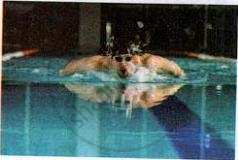
- The above example is based on Newton's ______ law of motion.
- For every action, there is an equal and ______ reaction.
- When a swimmer pushes against the water with his arms and legs, the water exerts an equal and opposite reaction force ______.
- Newton's second law of motion is an expression of the interrelationship among force, ______ and acceleration.
Or
The acceleration of an object depends directly upon the net force acting ______ upon the object, and upon the mass of the object.
Dr. Manu Sood solutions for फिज़िकल एजुकेशन [अंग्रेजी] कक्षा १२ 8 Unit-8: Biomechanics and Sports VERY SHORT ANSWER TYPE QUESTIONS [Page 272]
What do you mean by biomechanics?
State Newton's First law of motion.
How does a swimmer move forward in water? Which law explains this movement?
What is a lever?
How many classes of levers are there?
What do you mean by projectile?
What is Newton's Second law of motion?
State Newton's third law of motion.
Answer in one sentence.
Define friction.
Answer in one sentence.
Define friction.
Name types of friction.
What do you understand by projectile trajectory?
Explain, what is "Dynamic Friction"?
Define Gravity.
What do you understand by air resistance?
Name the factors affecting Projectile Trajectory.
To cover the maximum distance at what angle an object should be released?
What are the different types of equilibrium?
Mention any two types of friction by giving suitable examples from sports.
Describe the second class lever with suitable example from sports.
In the examples given below, which of the Newton’s Law of Motion will apply? Justify your answer.
- When a Swimmer pushes the water backwards.
- When a cricket and tennis ball are thrown with the same force, the tennis ball moves with greater acceleration.
Dr. Manu Sood solutions for फिज़िकल एजुकेशन [अंग्रेजी] कक्षा १२ 8 Unit-8: Biomechanics and Sports SHORT ANSWER TYPE QUESTIONS [Pages 272 - 273]
Friction is categorized into how many types? Explain them in brief.
Write the methods of reducing and increasing friction.
What is a lever?
What are different classes of levers?
Give one example of each of the three classes of levers.
Name the four components of a lever system.
Friction is a necessary evil - Explain.
With the help of suitable examples, discuss the application of Newton’s Laws of Motion in sports.
With the help of suitable examples, discuss the application of Newton’s Laws of Motion in sports.
With the help of suitable examples, discuss the application of Newton’s Laws of Motion in sports.
Explain Newton's First law of Motion.
State and explain Newton’s second law of motion.
What is the effect of gravity on the trajectory of a projectile ?
How the height at which a projectile is released related to angle of release?
Explain why the angles of release for shotput, javelin & discuss throw different?
What do you mean by dynamic equilibrium? Give one example.
What do you mean by static equilibrium? Give one example.
Why do wrestlers spread their arms, knees and legs on the mat when they fall?
With the help of suitable examples, discuss the application of 1st class lever in sports.
Elucidate any three factors, affecting projectile trajectory.
With the help of suitable examples, discuss the application of Newton’s Laws of Motion in sports.
A gymnast maintains a handstand position on the balance beam, then performs a flip. Differentiate between the types of equilibrium shown and explain how they help in performance.
Dr. Manu Sood solutions for फिज़िकल एजुकेशन [अंग्रेजी] कक्षा १२ 8 Unit-8: Biomechanics and Sports LONG ANSWER TYPE QUESTIONS [Page 273]
Answer in one sentence.
Define friction.
What are the various types of friction?
Write the advantages and disadvantages of friction by giving suitable examples from sports.
Write the advantages and disadvantages of friction by giving suitable examples from sports.
What strategies sportspersons adopt to minimise the friction? Give suitable examples from sports?
What are the various types of friction?
Write the advantages and disadvantages of friction by giving suitable examples from sports.
What are the various types of friction?
With the help of suitable example explain why friction is necessary in sports.
What is Friction?
Write the advantages and disadvantages of friction by giving suitable examples from sports.
What is a lever?
Discuss the application of lever in sports.
Explain Newton's Laws of Motion.
With the help of suitable examples, discuss the application of Newton’s Laws of Motion in sports.
With the help of suitable examples, discuss the application of Newton’s Laws of Motion in sports.
What do you mean by Equilibrium?
Explain the types of equilibrium.
Explain principles of equilibrium with suitable examples.
Define Equilibrium.
Explain Static and Dynamic Equilibrium by giving suitable examples from sports.
What do you mean by Equilibrium?
Explain how Equilibrium increases with the influence of various factors by giving suitable examples from sports.
What do you understand by projectile trajectory?
Explain the factors affecting projectile trajectory in sports.
Solutions for 8: Unit-8: Biomechanics and Sports
Dr. Manu Sood solutions for फिज़िकल एजुकेशन [अंग्रेजी] कक्षा १२ chapter 8 - Unit-8: Biomechanics and Sports
Shaalaa.com has the CBSE Mathematics फिज़िकल एजुकेशन [अंग्रेजी] कक्षा १२ CBSE solutions in a manner that help students grasp basic concepts better and faster. The detailed, step-by-step solutions will help you understand the concepts better and clarify any confusion. Dr. Manu Sood solutions for Mathematics फिज़िकल एजुकेशन [अंग्रेजी] कक्षा १२ CBSE 8 (Unit-8: Biomechanics and Sports) include all questions with answers and detailed explanations. This will clear students' doubts about questions and improve their application skills while preparing for board exams.
Further, we at Shaalaa.com provide such solutions so students can prepare for written exams. Dr. Manu Sood textbook solutions can be a core help for self-study and provide excellent self-help guidance for students.
Concepts covered in फिज़िकल एजुकेशन [अंग्रेजी] कक्षा १२ chapter 8 Unit-8: Biomechanics and Sports are The Impossible Kick, Biomechanics, Application of Newton's First Law of Motion (Law of Inertia) in Sports, Application of Newton's Second Law of Motion (Law of Momentum) in Sports, Application of Newton's Third Law of Motion (Law of Reaction) in Sports, Levers and Its Components Used in Sports, Types of Levers Used in Sports, Application of Human Leverage System in Sports, Equilibrium and Its Types in Sports, Factors Increasing Equilibrium in Sports, Centre of Gravity and Its Application in Sports, Friction and Its Types in Sports, Methods of Reducing Friction, Advantages and Disadvantages of Friction in the Field of Sports, Projectile in Sports, Factors Affecting Projectile Trajectory/ Flight Path in Sports, Application of Projectile in Sports.
Using Dr. Manu Sood फिज़िकल एजुकेशन [अंग्रेजी] कक्षा १२ solutions Unit-8: Biomechanics and Sports exercise by students is an easy way to prepare for the exams, as they involve solutions arranged chapter-wise and also page-wise. The questions involved in Dr. Manu Sood Solutions are essential questions that can be asked in the final exam. Maximum CBSE फिज़िकल एजुकेशन [अंग्रेजी] कक्षा १२ students prefer Dr. Manu Sood Textbook Solutions to score more in exams.
Get the free view of Chapter 8, Unit-8: Biomechanics and Sports फिज़िकल एजुकेशन [अंग्रेजी] कक्षा १२ additional questions for Mathematics फिज़िकल एजुकेशन [अंग्रेजी] कक्षा १२ CBSE, and you can use Shaalaa.com to keep it handy for your exam preparation.
