Advertisements
Advertisements
Explain refraction of light on the basis of wave theory. Hence prove the laws of refraction
Concept: undefined >> undefined
Why is it useful to define the radius of gyration?
Concept: undefined >> undefined
Advertisements
Discuss the necessity of radius of gyration.
Concept: undefined >> undefined
Answer in brief:
State the conditions under which the theorems of parallel axes and perpendicular axes are applicable. State the respective mathematical expressions.
Concept: undefined >> undefined
If a = 0.72 and r = 0.24, then the value of tr is ______.
Concept: undefined >> undefined
Answer in brief:
What will happen to the mean square speed of the molecules of a gas if the temperature of the gas increases?
Concept: undefined >> undefined
Answer in brief:
A gas in a cylinder is at pressure P. If the masses of all the molecules are made one-third of their original value and their speeds are doubled, then find the resultant pressure.
Concept: undefined >> undefined
Answer in brief:
Show that rms velocity of an oxygen molecule is `sqrt2` times that of a sulfur dioxide molecule at S.T.P.
Concept: undefined >> undefined
At what temperature will oxygen molecules have same rms speed as helium molecules at S.T.P.? (Molecular masses of oxygen and helium are 32 and 4 respectively).
Concept: undefined >> undefined
Compare the rms speed of hydrogen molecules at 127°C with rms speed of oxygen molecules at 27ºC given that molecular masses of hydrogen and oxygen are 2 and 32 respectively.
Concept: undefined >> undefined
Choose the correct option:
The graph shows variation of displacement of a particle performing S.H.M. with time t. Which of the following statements is correct from the graph?
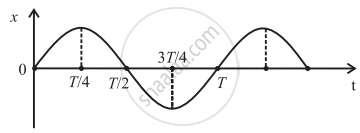
Concept: undefined >> undefined
Answer in brief:
State the characteristics of stationary waves.
Concept: undefined >> undefined
An electron, a proton, an α-particle, and a hydrogen atom are moving with the same kinetic energy. The associated de Broglie wavelength will be longest for ______.
Concept: undefined >> undefined
State the importance of Davisson and Germer experiment.
Concept: undefined >> undefined
What is the speed of a proton having de Broglie wavelength of 0.08 Å?
Concept: undefined >> undefined
In an ideal gas, the molecules possess ______.
Concept: undefined >> undefined
If the density of oxygen is 1.44 kg/m3 at a pressure of 105 N/m2, find the root mean square velocity of oxygen molecules.
Concept: undefined >> undefined
When a gas is heated, its temperature increases. Explain this phenomenon on the basis of the kinetic theory of gases.
Concept: undefined >> undefined
Explain, on the basis of the kinetic theory of gases, how the pressure of a gas changes if its volume is reduced at a constant temperature.
Concept: undefined >> undefined
Calculate the ratio of the mean square speeds of molecules of a gas at 30 K and 120 K.
Concept: undefined >> undefined
