Please select a subject first
Advertisements
Advertisements
Write two factors that affect the rate of reaction.
Concept: undefined >> undefined
For a reaction A + B ⟶ P, the rate is given by
Rate = k [A] [B]2
How is the rate of reaction affected if the concentration of B is doubled?
Concept: undefined >> undefined
Advertisements
For a reaction A + B ⟶ P, the rate is given by
Rate = k [A] [B]2
What is the overall order of reaction if A is present in large excess?
Concept: undefined >> undefined
For a reaction : 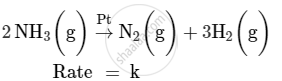
(i) Write the order and molecularity of this reaction.
(ii) Write the unit of k.
Concept: undefined >> undefined
Account for the following : Nitrogen does not form pentahalide.
Concept: undefined >> undefined
For the hydrolysis of methyl acetate in aqueous solution, the following results were obtained :
| t/s | 0 | 30 | 60 |
| [CH3COOCH3] / mol L–1 | 0.60 | 0.30 | 0.15 |
(i) Show that it follows pseudo first order reaction, as the concentration of water remains constant.
(ii) Calculate the average rate of reaction between the time interval 30 to 60 seconds.
(Given log 2 = 0.3010, log 4 = 0.6021)
Concept: undefined >> undefined
The following data were obtained during the first order thermal decomposition of SO2Cl2 at a constant volume :
SO2Cl2 (g) → SO2 (g) + Cl2 (g)
| Experiment | Time/s–1 | Total pressure/atm |
| 1 | 0 | 0.4 |
| 2 | 100 | 0.7 |
Calculate the rate constant.
(Given : log 4 = 0.6021, log 2 = 0.3010)
Concept: undefined >> undefined
Define the following term:
Essential amino acids
Concept: undefined >> undefined
MnO2 and Ca3(PO4)2 present in iron ore get reduced to Mn and P in the zone of _______.
(A) combustion
(B) reduction
(C) fusion
(D) slag formation
Concept: undefined >> undefined
Explain the given terms: Homopolymers
Concept: undefined >> undefined
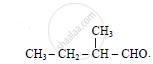
Give IUPAC name of :
Concept: undefined >> undefined
Write the different oxidation states of iron
Concept: undefined >> undefined
Distinguish between isothermal process and adiabatic process.
Concept: undefined >> undefined
Explain, why lanthanum (Z = 57) forms La3+ ion, while cerium (Z = 58) forms Ce4+ ion?
Concept: undefined >> undefined
Which one of the following oxidation state of Manganese is unstable?
(a) + 2
(b) + 4
(c) + 5
(d) + 7
Concept: undefined >> undefined
What are the sources of Vitamin C and Vitamin K?
Concept: undefined >> undefined
How are the following conversions carried out?
2-methylbutan-1-ol into 2 -methylbutanoic acid.
Concept: undefined >> undefined
Write two uses of formaldehyde
Concept: undefined >> undefined
When KOH solution is added to potassium dichromate solution the colour of solution
changes to yellow, because _______
(A) chromate ion changes to dichromate ion
(B) dichromate ion changes to chromate ion
(C) oxidation number of chromium changes from + 6 to + 4
(D) oxidation number of chromium changes from + 4 to +6
Concept: undefined >> undefined
