Advertisements
Advertisements
The perpendicular distance between the pair of opposite sides of a parallelogram are 3 cm and 4 cm, and one of its angles measures 60o. Using a ruler and compasses only,
construct the parallelogram.
Concept: undefined >> undefined
Construct a parallelogram ABCD, when:
AB = 5.8 cm, diagonal AC = 8.2 cm and diagonal BD = 6.2 cm.
Concept: undefined >> undefined
Advertisements
Construct a parallelogram ABCD, when:
AB = 6.0 cm, AD = 5.0 cm and ∠A = 45°.
Concept: undefined >> undefined
Using ruler and compasses only, construct a parallelogram ABCD using the following data: AB = 6 cm, AD = 3 cm and ∠DAB = 45o. If the bisector of ∠DAB meets DC at P,
prove that ∠APB is a right angle.
Concept: undefined >> undefined
Construct a parallelogram ABCD, when:
Base AB = 6.5 cm, BC = 4 cm and the altitude corresponding to AB = 3.1 cm.
Concept: undefined >> undefined
Construct a parallelogram ABCD, when:
AB = 4.5 cm, ∠B = 120° and the distance between AB and DC = 3.0 cm.
Concept: undefined >> undefined
Construct a parallelogram ABCD, when:
Base BC = 5.6 cm, diagonal BD = 6.5 cm and altitude = 3.2 cm.
Concept: undefined >> undefined
In the given figure, if the area of triangle ADE is 60 cm2, state, given reason, the area of :
(i) Parallelogram ABED;
(ii) Rectangle ABCF;
(iii) Triangle ABE.
Concept: undefined >> undefined
The given figure shows the parallelograms ABCD and APQR.
Show that these parallelograms are equal in the area.
[ Join B and R ]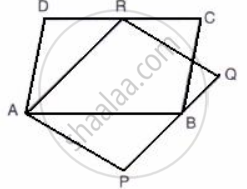
Concept: undefined >> undefined
The given figure shows a rectangle ABDC and a parallelogram ABEF; drawn on opposite sides of AB.
Prove that:
(i) Quadrilateral CDEF is a parallelogram;
(ii) Area of the quad. CDEF
= Area of rect. ABDC + Area of // gm. ABEF.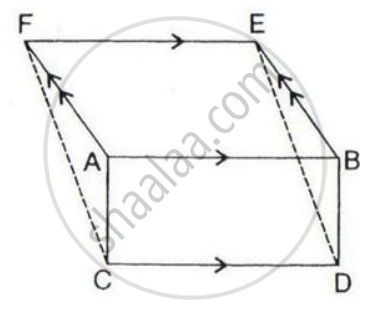
Concept: undefined >> undefined
In the given figure, ABCD is a parallelogram; BC is produced to point X.
Prove that: area ( Δ ABX ) = area (`square`ACXD )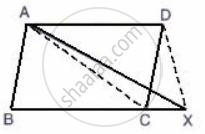
Concept: undefined >> undefined
In the given figure, AD // BE // CF.
Prove that area (ΔAEC) = area (ΔDBF)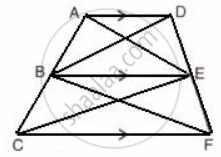
Concept: undefined >> undefined
ABCD is a trapezium with AB // DC. A line parallel to AC intersects AB at point M and BC at point N.
Prove that: area of Δ ADM = area of Δ ACN.
Concept: undefined >> undefined
In the following, AC // PS // QR and PQ // DB // SR.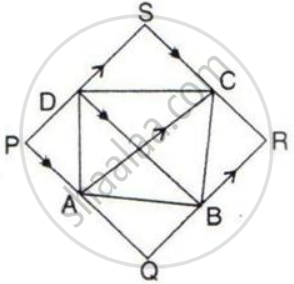
Prove that: Area of quadrilateral PQRS = 2 x Area of the quad. ABCD.
Concept: undefined >> undefined
In the given figure, D is mid-point of side AB of ΔABC and BDEC is a parallelogram.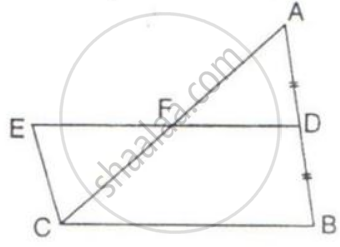
Prove that: Area of ABC = Area of // gm BDEC.
Concept: undefined >> undefined
ABCD and BCFE are parallelograms. If area of triangle EBC = 480 cm2; AB = 30 cm and BC = 40 cm.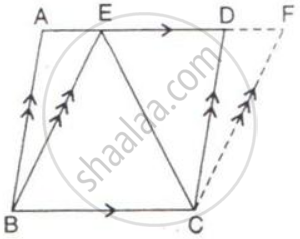
Calculate :
(i) Area of parallelogram ABCD;
(ii) Area of the parallelogram BCFE;
(iii) Length of altitude from A on CD;
(iv) Area of triangle ECF.
Concept: undefined >> undefined
In the given figure, diagonals PR and QS of the parallelogram PQRS intersect at point O and LM is parallel to PS. Show that: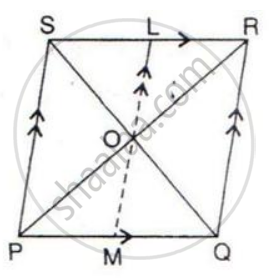
(i) 2 Area (POS) = Area (// gm PMLS)
(ii) Area (POS) + Area (QOR) = Area (// gm PQRS)
(iii) Area (POS) + Area (QOR) = Area (POQ) + Area (SOR).
Concept: undefined >> undefined
In parallelogram ABCD, P is a point on side AB and Q is a point on side BC.
Prove that:
(i) ΔCPD and ΔAQD are equal in the area.
(ii) Area (ΔAQD) = Area (ΔAPD) + Area (ΔCPB)
Concept: undefined >> undefined
In the following figure, DE is parallel to BC.
Show that:
(i) Area ( ΔADC ) = Area( ΔAEB ).
(ii) Area ( ΔBOD ) = Area( ΔCOE ).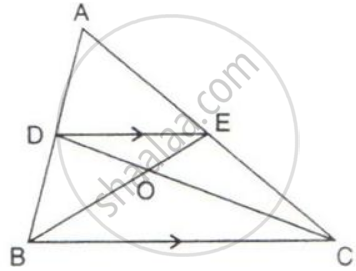
Concept: undefined >> undefined
In the given figure, M and N are the mid-points of the sides DC and AB respectively of the parallelogram ABCD.
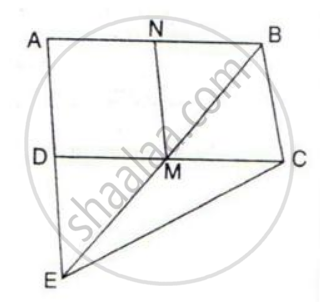
If the area of parallelogram ABCD is 48 cm2;
(i) State the area of the triangle BEC.
(ii) Name the parallelogram which is equal in area to the triangle BEC.
Concept: undefined >> undefined
