Advertisements
Advertisements
Advertisements
Draw a ray diagram to show that a convex mirror has a wider field of view.
Concept: undefined >> undefined
A concave mirror can be used to produce a parallel beam of light. Draw a ray to illustrate this.
Concept: undefined >> undefined
An object 10 cm high is placed at a distance of 20 cm in front of a spherical mirror of focal length 25 cm. By scale drawing find the nature, position, and magnification of the image in the following case:
Concave mirror
Concept: undefined >> undefined
An object 10 cm high is placed at a distance of 20 cm in front of a spherical mirror of focal length 25 cm. By scale drawing find the nature, position, and magnification of the image in the following case:
Convex mirror
Concept: undefined >> undefined
An object is placed in front of a concave mirror as shown in the following figure. By scale drawing, find the nature of the image. Given f = 10 cm, v = 30 cm.
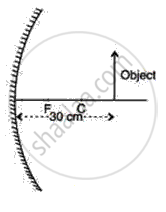
Concept: undefined >> undefined
Concept: undefined >> undefined
The following Figure shows a concave mirror MM' on which a ray of light incident from a point P gets reflected to meet the principle axis at O.
(a) Find, by construction, the position of the centre of curvature of the concave mirror.
(b) Write down the value for the radius of curvature of the mirror.
(c) Calculate the focal length of the mirror.
(d ) Which relation is used in deducing the focal length from the radius of curvature?
Concept: undefined >> undefined
The diagram below shows the parallel rays incident on a convex mirror. C is the centre of the curvature of the mirror. By drawing the paths of the reflected rays, label the focus F and hence find the focal length of the mirror.
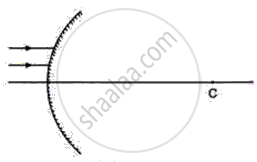
Concept: undefined >> undefined
Concept: undefined >> undefined
Complete the following diagrams shown in the following figures by drawing the reflected rays.
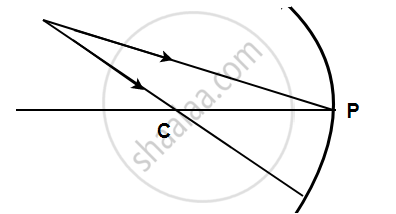
Concept: undefined >> undefined
Complete the following diagrams shown in the below figure by drawing the reflected ray for each incident ray.
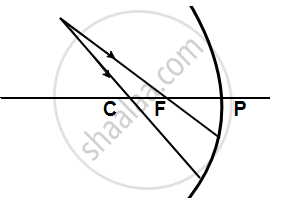
Concept: undefined >> undefined
The separation between two masses is reduced to half. How is the magnitude of gravitational force between them affected?
Concept: undefined >> undefined
What is the C.G.S. unit of force? How is it defined?
Concept: undefined >> undefined
Name the S.I. and C.G.S. units of force. How are they related?
Concept: undefined >> undefined
Why does a glass vessel break when it falls on a hard floor, but it does not break when it falls on a carpet?
Concept: undefined >> undefined
A body of mass 500 g, initially at rest, is acted upon by a force which causes it to move a distance of 4 m in 2 s, Calculate the force applied.
Concept: undefined >> undefined
A car of mass 480 kg moving at a speed of 54 km h-1 is stopped by applying brakes in 10 s . Calculate the force applied by the brakes .
Concept: undefined >> undefined
A light ball falling on ground, after striking the ground rises upwards. Explain the reason.
Concept: undefined >> undefined
