Advertisements
Advertisements
What should be the gear ration of a car : equal to 1, less than 1 or greater than 1, while gaining speed on the road ?
Concept: undefined >> undefined
What should be the gear ration of a car : equal to 1, less than 1 or greater than 1, while ascending a hill ?
Concept: undefined >> undefined
Advertisements
In a gear system, the gear ration of the driving wheel A and driven wheel B is 10:1. To rotate the driven wheel B in the direction of driving wheel A, the driving wheel A is engaged with other wheel C. what should be the gear ratio of the wheels A and C?
Concept: undefined >> undefined
What is a single movable pulley? What is its mechanical advantage in the ideal case?
Concept: undefined >> undefined
Name the type of single pulley that can act as a force multiplier. Draw a labelled diagram of the pulley mentioned by you.
Concept: undefined >> undefined
Give two reasons why the efficiency of a single movable pulley system is not 100%.
Concept: undefined >> undefined
In which direction does the force need to applied, when a single pulley is used with a mechanical advantage greater than one? How can you change the direction of force applied without altering its mechanical advantage? Draw a labelled diagram of the system.
Concept: undefined >> undefined
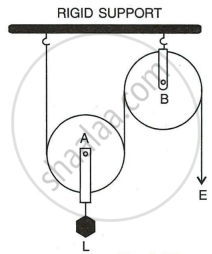
The diagram below shows a pulley arrangement.
- Name the pulleys A and B.
- In the diagram, mark the direction of tension on each strand of string.
- What is the purpose of the pulley B?
- If the tension is T, deduce the relation between
- T and E, and
- E and L.
- What is the velocity ratio of the arrangement?
- Assuming that the efficiency of the system is 100%, what is the mechanical advantage?
Concept: undefined >> undefined
Differentiate between a single fixed pulley and a single movable pulley.
Concept: undefined >> undefined
The diagram below shows an arrangement of three pulleys A, B, and C. The load is marked as L and the effort as E.
- Name the Pulleys A, B, and C.
- Mark in the diagram the directions of load (L), effort (E) and tension T1 and T2 in the two strings.
- How are the magnitudes of L and E related to the tension T1?
- Calculate the mechanical advantage and velocity ratio of the arrangement.
- What assumptions have you made in parts (c) and (d)?

Concept: undefined >> undefined
Draw a diagram of a combination of three movable pulleys and one fixed pulley to lift up a load. In the diagram, show the directions of load, effort and tension in each strand. Find:
- mechanical advantage,
- Velocity ratio and
- efficiency of the combination in ideal situation.
Concept: undefined >> undefined
What is a block and tackle system of pulleys?
Concept: undefined >> undefined
A block and tackle pulley system has a velocity ratio 5. Draw a labelled diagram of this system. In your diagram, indicate clearly the points of application and the directions of the load and effort.
Concept: undefined >> undefined
Give reason for the following:
In a single fixed pulley, the velocity ratio is always more than the mechanical advantage.
Concept: undefined >> undefined
Give reason for the following:
In case of a block and tackle arrangement, the mechanical advantage increases with the increase in the number of pulleys.
Concept: undefined >> undefined
What is the purpose of a switch in a circuit?
Concept: undefined >> undefined
Give reason for the following:
The lower block of a block and tackle pulley system must be of negligible weight
Concept: undefined >> undefined
A switch is not touched with wet hands while putting it on or off. Give a reason for your answer.
Concept: undefined >> undefined
The mechanical advantage of an ideal single movable pulley is ______.
Concept: undefined >> undefined
The following diagram shows three lamps and three switches 1, 2 and 3 connected with two cells.
- Name the switch / switches to be closed so as to light all the three lamps.
- How are the lamps connected: in series or in parallel?

Concept: undefined >> undefined
