Please select a subject first
Advertisements
Advertisements
A proton projected in a magnetic field of 0.020 T travels along a helical path of radius 5.0 cm and pitch 20 cm. Find the components of the velocity of the proton along and perpendicular to the magnetic field. Take the mass of the proton = 1.6 × 10⁻²⁷ kg
Concept: undefined >> undefined
A particle of mass m and charge q is released from the origin in a region in which the electric field and magnetic field are given by
`vecB = -B_0 vecj and vecE = E_0 vecK `
Find the speed of the particle as a function of its z-coordinate.
Concept: undefined >> undefined
Advertisements
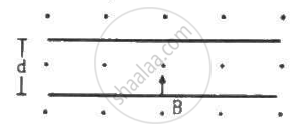
An electron is emitted with negligible speed from the negative plate of a parallel-plate capacitor charged to a potential difference V. The separation between the plates is dand a magnetic field B exists in the space, as shown in the figure. Show that the electron will fail to strike the upper plates if `d > ((2m_eV)/(eB_0^2))^(1/2)`
Concept: undefined >> undefined
A long, straight wire carrying a current of 30 A is placed in an external, uniform magnetic field of 4.0 × 10⁻⁴ T parallel to the current. Find the magnitude of the resultant magnetic field at a point 2.0 cm away from the wire.
Concept: undefined >> undefined
An ideal diode should pass a current freely in one direction and should stop it completely in the opposite direction. Which is closer to ideal-vacuum diode or a p-njunction diode?
Concept: undefined >> undefined
The plate resistance of a triode is 8 kΩ and the transconductance is 2.5 millimho. (a) If the plate voltage is increased by 48 V and the grid voltage is kept constant, what will be the increase in the plate current? (b) With plate voltage kept constant at this increased value, by how much should the grid voltage be decreased in order to bring the plate current back to its initial value?
Concept: undefined >> undefined
Explain how a potential barrier is developed in a p-n junction diode.
Concept: undefined >> undefined
Draw the circuit arrangement for studying the V-I characteristics of a p-n junction diode in reverse bias. Plot the V-I characteristics in this case.
Concept: undefined >> undefined
Write the important considerations which are to be taken into account while fabricating a p-n junction diode to be used as a Light Emitting Diode (LED). What should be the order of band gap of an LED, if it is required to emit light in the visible range? Draw a circuit diagram and explain its action.
Concept: undefined >> undefined
Draw the V-I characteristics of an LED. State two advantages of LED lamps over convertional incandescent lamps.
Concept: undefined >> undefined
Define the dielectric constant of a medium. What is its S.I unit?
Concept: undefined >> undefined
Write the important considerations which are to be taken into account while fabricating a p-n junction diode to be used as a Light Emitting Diode (LED). What should be the order of the band gap of an LED, if it is required to emit light in the visible range? Draw a circuit diagram and explain its action.
Concept: undefined >> undefined
In Young's double-slit experiment, the two slits are separated by a distance of 1.5 mm, and the screen is placed 1 m away from the plane of the slits. A beam of light consisting of two wavelengths of 650 nm and 520 nm is used to obtain interference fringes.
Find the least distance from the central maximum where the bright fringes due to both the wavelengths coincide.
Concept: undefined >> undefined
Two parallel uniformly charged infinite plane sheets, '1' and '2', have charge densities + `sigma and -2sigma `respectively. Give the magnitude and direction of the net electric field at a point.
(i) in between the two sheets and
(ii) outside near the sheet '1'.
Concept: undefined >> undefined
The wavelength and intensity of light emitted by a LED depend upon ______.
Concept: undefined >> undefined
What is a solar cell?
Concept: undefined >> undefined
Explain the three processes involved in the working of a solar cell.
Concept: undefined >> undefined
A uniform magnetic field of 1.5 T exists in a cylindrical region of radius 10.0 cm, its direction parallel to the axis along east to west. A wire carrying current of 7.0 A in the north to south direction passes through this region. What is the magnitude and direction of the force on the wire if,
(a) the wire intersects the axis,
(b) the wire is turned from N-S to northeast-northwest direction,
(c) the wire in the N-S direction is lowered from the axis by a distance of 6.0 cm?
Concept: undefined >> undefined
Concept: undefined >> undefined
Concept: undefined >> undefined
