Please select a subject first
Advertisements
Advertisements
An electron in a hydrogen atom makes transitions from orbits of higher energies to orbits of lower energies.
- When will such transitions result in (a) Lyman (b) Balmer series?
- Find the ratio of the longest wavelength in the Lyman series to the shortest wavelength in the Balmer series.
Concept: undefined >> undefined
The work function of a metal is 4.50 eV. Find the frequency of light to be used to eject electrons from the metal surface with a maximum kinetic energy of 6.06 × 10⁻¹⁹ J.
Concept: undefined >> undefined
Advertisements
Monochromatic light of wavelength 600 nm is incident from the air on a water surface. The refractive index of water is 1.33. Find the
- wavelength,
- frequency and
- speed, of reflected and refracted light.
Concept: undefined >> undefined
A ray of monochromatic light propagating in the air is incident on the surface of the water. Which of the following will be the same for the reflected and refracted rays?
Concept: undefined >> undefined
Two cells of emf E1 and E2 and internal resistances r1 and r2 are connected in parallel, with their terminals of the same polarity connected together. Obtain an expression for the equivalent emf of the combination.
Concept: undefined >> undefined
An electric dipole of dipole moment 2 × 10⁻⁸ C-m in a uniform electric field experiences a maximum torque of 6 × 10⁻⁴ N-m. The magnitude of the electric field is ______.
Concept: undefined >> undefined
An electric dipole of length 2 cm is placed at an angle of 30° with an electric field 2 × 10⁵ N/C. If the dipole experiences a torque of 8 × 10⁻³ Nm, the magnitude of either charge of the dipole is ______.
Concept: undefined >> undefined
An infinite line charge produces a field of 9 × 10⁴ N/C at a distance of 2 cm. Calculate the linear charge density.
Concept: undefined >> undefined
Draw a schematic ray diagram of a reflecting telescope showing how rays coming from a distant object are received at the eyepiece.
Concept: undefined >> undefined
Draw a labeled ray diagram to obtain the real image formed by an astronomical telescope in normal adjustment position. Define its magnifying power.
Concept: undefined >> undefined
Three identical polaroid sheets P1, P2 and P3 are oriented so that the pass axis of P2 and P3 are inclined at angles of 60° and 90° respectively with the pass axis of P1. A monochromatic source S of unpolarised light of intensity I0 is kept in front of the polaroid sheet P1 as shown in the figure. Determine the intensities of light as observed by the observer at O, when polaroid P3 is rotated with respect to P2 at angles θ = 30° and 60°.
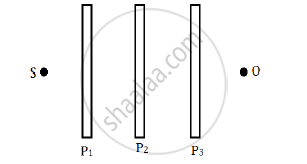
Concept: undefined >> undefined
State the two Kirchhoff’s rules used in electric networks. How are there rules justified?
Concept: undefined >> undefined
What dose a polaroid consist of?
Concept: undefined >> undefined
Show, using a simple polaroid, that light waves are transverse in nature. Intensity of light coming out of a polaroid does not change irrespective of the orientation of the pass axis of the polaroid. Explain why.
Concept: undefined >> undefined
State and explain Gauss’s law.
Concept: undefined >> undefined
Why does an unpolarised light incident on a polaroid get linearly polarised ?
Concept: undefined >> undefined
A proton and an α-particle have the same de-Broglie wavelength Determine the ratio of their speeds.
Concept: undefined >> undefined
Find an expression for intensity of transmitted light when a polaroid sheet is rotated between two crossed polaroids. In which position of the polaroid sheet will the transmitted intensity be maximum?
Concept: undefined >> undefined
Use Kirchhoff's rules to obtain conditions for the balance condition in a Wheatstone bridge.
Concept: undefined >> undefined
How does one demonstrate, using a suitable diagram, that unpolarised light when passed through a Polaroid gets polarised?
Concept: undefined >> undefined
