Please select a subject first
Advertisements
Advertisements
A steel wire of length 4.7 m and cross-sectional area 3.0 × 10⁻⁵ m2 stretches by the same amount as a copper wire of length 3.5 m and cross-sectional area of 4.0 × 10⁻⁵ m2 under a given load. What is the ratio of Young’s modulus of steel to that of copper?
Concept: undefined >> undefined
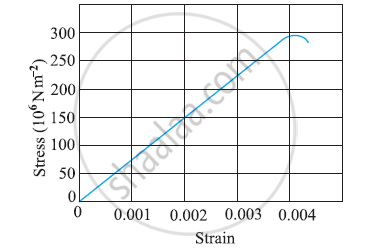
The figure shows the strain-stress curve for a given material. What are (a) Young’s modulus and (b) approximate yield strength for this material?
Concept: undefined >> undefined
Advertisements
The stress-strain graphs for materials A and B are shown in Figure
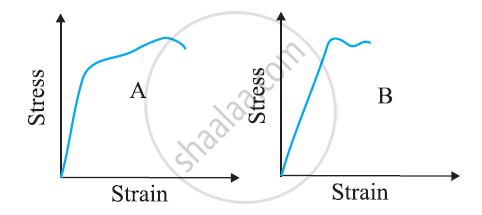
The graphs are drawn to the same scale.
(a) Which of the materials has the greater Young’s modulus?
(b) Which of the two is the stronger material?
Concept: undefined >> undefined
Read the following statements below carefully and state, with reasons, if it is true or false
The Young’s modulus of rubber is greater than that of steel;
Concept: undefined >> undefined
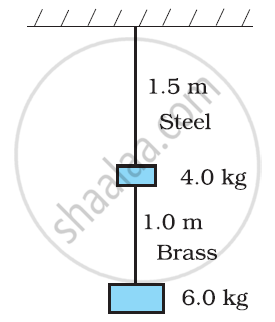
Two wires of diameter 0.25 cm, one made of steel and the other made of brass are loaded as shown in Fig. 9.13. The unloaded length of steel wire is 1.5 m and that of brass wire is 1.0 m. Compute the elongations of the steel and the brass wires.
Concept: undefined >> undefined
Four identical hollow cylindrical columns of mild steel support a big structure of mass 50,000 kg. The inner and outer radii of each column are 30 cm and 60 cm respectively. Assuming the load distribution to be uniform, calculate the compressional strain of each column.
Concept: undefined >> undefined
A 14.5 kg mass, fastened to the end of a steel wire of unstretched length 1.0 m, is whirled in a vertical circle with an angular velocity of 2 rev/s at the bottom of the circle. The cross-sectional area of the wire is 0.065 cm2. Calculate the elongation of the wire when the mass is at the lowest point of its path.
Concept: undefined >> undefined
Fill in the blanks using the word(s) from the list appended with each statement:
For a fluid in a steady flow, the increase in flow speed at a constriction follows (conservation of mass / Bernoulli’s principle)
Concept: undefined >> undefined
Explain why When we try to close a water tap with our fingers, fast jets of water gush through the openings between our fingers
Concept: undefined >> undefined
A particle is in linear simple harmonic motion between two points, A and B, 10 cm apart. Take the direction from A to B as the positive direction and give the signs of velocity, acceleration and force on the particle when it is
(a) at the end A,
(b) at the end B,
(c) at the mid-point of AB going towards A,
(d) at 2 cm away from B going towards A,
(e) at 3 cm away from A going towards B, and
(f) at 4 cm away from B going towards A.
Concept: undefined >> undefined
A pipe 20 cm long is closed at one end. Which harmonic mode of the pipe is resonantly excited by a 430 Hz source? Will the same source be in resonance with the pipe if both ends are open? (Speed of sound in air is 340 m s–1).
Concept: undefined >> undefined
Explain why (or how) In a sound wave, a displacement node is a pressure antinode and vice versa,
Concept: undefined >> undefined
A bat is flitting about in a cave, navigating via ultrasonic beeps. Assume that the sound emission frequency of the bat is 40 kHz. During one fast swoop directly toward a flat wall surface, the bat is moving at 0.03 times the speed of sound in air. What frequency does the bat hear reflected off the wall?
Concept: undefined >> undefined
The normal duration of I.Sc. Physics practical period in Indian colleges is 100 minutes. Express this period in microcenturies. 1 microcentury = 10−6 × 100 years. How many microcenturies did you sleep yesterday?
Concept: undefined >> undefined
The frequency of vibration of a string depends on the length L between the nodes, the tension F in the string and its mass per unit length m. Guess the expression for its frequency from dimensional analysis.
Concept: undefined >> undefined
Can we have physical quantities having magnitude and direction which are not vectors?
Concept: undefined >> undefined
If a particle is accelerating, it is either speeding up or speeding down. Do you agree with this statement?
Concept: undefined >> undefined
Give example where the velocity of a particle is zero but its acceleration is not zero.
Concept: undefined >> undefined
Give example where the velocity is opposite in direction to the acceleration.
Concept: undefined >> undefined
Give example where the velocity is perpendicular to the acceleration.
Concept: undefined >> undefined
