Advertisements
Advertisements
Which of the following statement is incorrect?
Concept: undefined >> undefined
If a round, green seeded pea plant (RR yy) is crossed with wrinkled, yellow seeded pea plant, (rr YY) the seeds produced in F1 generation are
Concept: undefined >> undefined
Advertisements
In human males all the chromosomes are paired perfectly except one. This/these unpaired chromosome is/are
- large chromosome
- small chromosome
- Y-chromosome
- X-chromosome
Concept: undefined >> undefined
The danger signals installed at the top of tall buildings are red in colour. These can be easily seen from a distance because among all other colours, the red light
Concept: undefined >> undefined
When light rays enter the eye, most of the refraction occurs at the
Concept: undefined >> undefined
How are we able to see nearby and also the distant objects clearly?
Concept: undefined >> undefined
If a tall pea plant is crossed with a pure dwarf pea plant then, what percentage of F1 and F2 generation respectively will be tall?
Concept: undefined >> undefined
In the following figure showing a germinating gram seed, name the parts labelled as A, B and C:

Why is Part 'B' considered to be important during germination?
Concept: undefined >> undefined
A cross between pea plant with white flowers (vv) and pea plant with violet flowers (VV) resulted in F2 progeny in which ratio of violet (VV) and white (vv) flowers will be ______.
Concept: undefined >> undefined
Figures (a) to (d) given below represent the type of ear lobes present in a family consisting of 2 children - Rahul, Nisha and their parents.
|
(a) Rahul's Father |
(b) Rahul |
(c) Rahul's Mother |
(d) Rahul's sister Nisha |
|
(e) |
(f) |
||
| Types of ear lobes | |||


Excited by his observation of different types of ear lobes present in his family, Rahul conducted a survey of the type of ear lobes found {Figure (e) and (f)} in his classmates. He found two types of ear lobes in his classmates as per the frequency given below:
| Sex | Free | Attached |
| Male | 36 | 14 |
| Female | 31 | 19 |
On the basis of the above data answer the following questions.
- Which of the two characteristics - ‘free ear lobe’ or ‘attached ear lobe’ appears to be dominant in this case? Why?
- Is the inheritance of the free ear lobe linked with the sex of the individual? Give a reason for your answer.
- What type of ear lobe is present in father, mother, Rahul and his sister Nisha? Write the genetic constitution of each of these family members which explains the inheritance of this character in this family.
(Gene for the Free ear lobe is represented by F and the gene for the attached ear lobe is represented by f for writing the genetic constitution).
OR
Suresh’s parents have attached ear lobes. What type of ear lobe can be seen in Suresh and his sister Siya? Explain by giving the genetic composition of all.
Concept: undefined >> undefined
Mendel crossed pea plants with two pairs of contrasting characters.
| RRYY | × |
rryy |
| Round, Yellow | Wrinkled, Green |
He observed 4 types of combinations in F2 generation. Which of the combinations were new? Write the conclusion drawn by this experiment.
Concept: undefined >> undefined
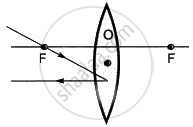
Which of the following ray diagrams is correct for the ray of light incident on a lens shown in figure?

 |
 |
| A | B |
 |
 |
| C | D |
Concept: undefined >> undefined
Which position of the object will produce a magnified virtual image, if a concave mirror of focal length 15 cm is being used?
Concept: undefined >> undefined
A ray of light is travelling in a direction perpendicular to the boundary of a parallel glass slab. The ray of light ______.
Concept: undefined >> undefined
Which of the following can make a parallel beam of light when light from a point source is incident on it?
Concept: undefined >> undefined
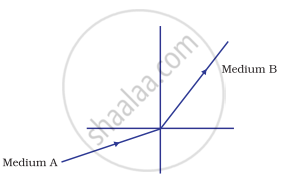
Figure shows a ray of light as it travels from medium A to medium B. Refractive index of the medium B relative to medium A is

Concept: undefined >> undefined
A light ray enters from medium A to medium B as shown in Figure 10.2. The refractive index of medium B relative to A will be
Concept: undefined >> undefined
Beams of light are incident through the holes A and B and emerge out of box through the holes C and D respectively as shown in the Figure Which of the following could be inside the box?

Concept: undefined >> undefined
A beam of light is incident through the holes on side A and emerges out of the holes on the other face of the box as shown in the Figure. Which of the following could be inside the box?

Concept: undefined >> undefined
Why does a light ray incident on a rectangular glass slab immersed in any medium emerges parallel to itself? Explain using a diagram.
Concept: undefined >> undefined
