Please select a subject first
Advertisements
Advertisements
A converging lens has a focal length of 50 cm. The power of this lens is:
Concept: undefined >> undefined
A diverging lens has a focal length of 0.10 m. The power of this lens will be:
Concept: undefined >> undefined
Advertisements
The power of a lens is +2.0D. Its focal length should be :
Concept: undefined >> undefined
Name the type of lens whose power is positive.
The image of an object formed by a lens is real, inverted and of the same size as the object. If the image is at a distance of 40 cm from the lens, what is the nature and power of the lens ? Draw ray diagram to justify your answer.
Concept: undefined >> undefined
Mohan obtained a sharp inverted image of a distant tree on the screen placed behind the lens. He then moved the screen and tried to look through the lens in the direction of the object. He would see:
(1) a blurred image on the wall of the laboratory.
(2) an erect image of the tree on the lens.
(3) no image as the screen has been removed
(4) an inverted image of the tree at the focus of the lens.
Concept: undefined >> undefined
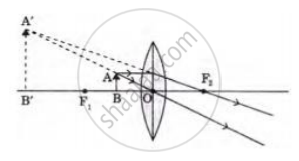
The above lens has a focal length of 10 cm. The object of height 2 mm is placed at a distance of 5 cm from the pole. Find the height of the image.
Concept: undefined >> undefined
Define power of a lens. What is its unit? One student uses a lens of focal length 50 cm and another of –50 cm. What is the nature of the lens and its power used by each of them?
Concept: undefined >> undefined
An object is kept at a distance of 1m from a lens of power +2D:
- Identify the type of lens.
- Calculate its focal length and distance of the image formed.
Concept: undefined >> undefined
A student was asked to observe and identify the various parts of an embryo of a red kidney bean seed. He identified the parts and listed them as under:
I. Tegmen
II. Testa
III. Cotyledon
IV. Radicle
V. Plumule
The correctly identified parts among these are
(A) I, II and III
(B) II, III and IV
(C) III, IV and V
(D) I, III, IV and V
Concept: undefined >> undefined
Name the parts A, B and C shown in the diagram and write their functions.

Concept: undefined >> undefined
Name the parts labelled as A, B, C and D in the diagram given below:-

Concept: undefined >> undefined
What is pollination?
Concept: undefined >> undefined
How does fertilisation occur in flowers? Name the parts of the flower that develop into (i) seed, and (ii) fruit after fertilisation.
Concept: undefined >> undefined
In the following diagram showing the structure of embryo of a dicot seed, what are the parts marked I, II and III sequentially?

Concept: undefined >> undefined

(i) Name the part marked 'A' in the diagram.
(ii) How dose 'A' reachese part 'B'?
(iii) State the importance of the part 'C'.
(iv) What happens to the part marked 'D' after fertilisation is over?
Concept: undefined >> undefined
A student while observing an embryo of a pea seed in the laboratory listed various parts of the embryo as given below:
Testa, Tegmen, Radicle, Plumule, Micropyle, Cotyledon.
On examining the list the teacher remarked that only three parts are correct. Select three correct parts from the above list:
(a) Testa, Radicle, Cotyleddon
(b) Tegmen, Radicle, Micropyle
(c) Cotyledon, Plumule, Testa
(d) Radicle, Cotyledon, Plumule
Concept: undefined >> undefined
Name the parts A, B and C shown in the following diagram and state one function of each.

Concept: undefined >> undefined
A student has to perform the experiment "To identify the different parts of an embryo of a dicot seed." Select from the following an appropriate group of seeds:
(a) Pea, gram, wheat
(b) Red kidney bean, maize, gram
(c) Maize, wheat, red kidney bean
(d) Red kidney bean, pea, gram
Concept: undefined >> undefined
State significance of pollination.
Concept: undefined >> undefined
Name and differentiate between the two modes of pollination in flowering plants.
Concept: undefined >> undefined
