Please select a subject first
Advertisements
Advertisements
In the figure given alongside, the various trophic levels are shown in the form of a pyramid. At which trophic level the maximum energy is available?
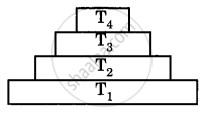
Concept: undefined >> undefined
One of the following is not a consumer. This one is :
(a) giraffe
(b) antelope
(c) algae
(d) alligator
Concept: undefined >> undefined
Advertisements
Which of the following is not a producer?
(a) grass
(b) zooplankton
(c) phytoplankton
(d) paddy
Concept: undefined >> undefined
One of the following is a micro-consumer. This one is :
(a) ant
(b) lice
(c) fungi
(d) mosquito
Concept: undefined >> undefined
In the food chain comprising of a snake, grass, insect, and frog, the secondary consumer is :
(a) insect
(b) snake
(c) frog
(d) grass
Concept: undefined >> undefined
The sea water contains water beetles, tadpole, fish and weeds.
- Write a food chain comprising all the given organisms.
- Which organisms in the food chain are (i) herbivore, and (ii) carnivores?
- Which organisms are (i) predators, and (ii) prey?
- Which organisms can trap solar energy to make food?
- Which organism is a secondary consumer?
Concept: undefined >> undefined
The sea water contains water beetles, tadpole, fish and weeds.
Which organisms in the food chain are herbivore, and carnivores?
Concept: undefined >> undefined
The sea water contains water beetles, tadpole, fish and weeds.
Which organisms are (i) predators, and (ii) prey?
Concept: undefined >> undefined
The sea water contains water beetles, tadpole, fish and weeds.
Which organisms can trap solar energy to make food?
Concept: undefined >> undefined
The sea water contains water beetles, tadpole, fish and weeds.
Which organism is a secondary consumer?
Concept: undefined >> undefined
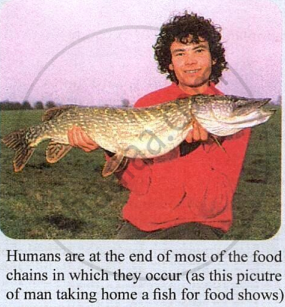
| The following is a food chain that ends with human: plants → bee → human |
- Explain how plants provide food for bees.
- How do bees provide food for humans?
- How does this food chain differ from a usual food chain involving human such as: plants → goat → human?
- Do you think that the food chain given in this question can really be regarded as a food chain? Explain your answer.
Concept: undefined >> undefined
The following is a food chain that ends with human :
plants → bee → human
How do bees provide food for humans?
Concept: undefined >> undefined
The following is a food chain that ends with human :
How does this food chain differ form a usual food chain involving human such as : plants → goat → human?
Concept: undefined >> undefined
The following is a food chain that ends with human :
Do you think that the food chain given in this question can really be regarded as a food chain? Explain your answer.
Concept: undefined >> undefined
|
A food chain occurring in the sea which provides food for many people can be written as: phytoplankton → zooplankton → X → Y |
- Name one phytoplankton.
- Name two zooplanktons.
- What could be Х?
- Name the organism which Y could be.
- Which organism in the above food chain is a (i) primary consumer, and (ii) tertiary consumer?
Concept: undefined >> undefined
A food chain occurring in the sea which provides food for many people can be written as :
phytoplankton → zooplankton → X → Y
Name two zooplanktons.
Concept: undefined >> undefined
A food chain occurring in the sea which provides food for many people can be written as :
phytoplankton → zooplankton → X → Y
What could be X?
Concept: undefined >> undefined
A food chain occurring in the sea which provides food for many people can be written as :
phytoplankton → zooplankton → X → Y
Name the organism which Y could be.
Concept: undefined >> undefined
A food chain occurring in the sea which provides food for many people can be written as :
phytoplankton → zooplankton → X → Y
Which organism in the above food chain is a (1) primary consumer, and (2) tertiary consumer?
Concept: undefined >> undefined
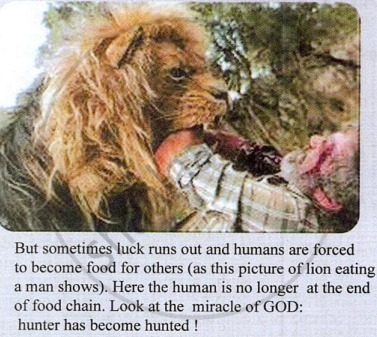
| Some hunters are roaming in the plush green forest of Africa. They spot a deer and kill it. They decide to roast the deer there and then and eat it. When the hunters had just finished enjoying the feast of roasted deer, a lion attacks them. The lion kills one of the hunters and eats his flesh. |
- Write a food chain which provides food to the lion in this case.
- Which animal (other than deer) the lion could look for food if he did not get the hunter as prey?
- Which other animal in the forest could have been in place of lion?
- How does the above food chain differ from the food chain such as: plants → goat → man?
  |
Concept: undefined >> undefined
