Please select a subject first
Advertisements
Advertisements
Label the body organization of human in the following figure:

Concept: Criteria for New System of Classification > Grades of Organization
Identify my class/phylum and give one example of it:
We form the highest number of animals on the planet. We have bilateral symmetry and our exoskeleton is in the form of chitin.
Concept: Non Chordates (Invertebrata) >> Phylum: Arthropoda
Read the following extract and answer the questions that follow :
A liberal view behind the concept of organ and body donation is that after death our body should be useful to other needful persons so that their miserable life would become comfortable. Awareness about these concepts is increasing in our country and people are voluntarily donating their bodies.
Life of many people can be saved by organ and body donation. Blinds can regain their vision. Life of many people can be rendered comfortable by donation of organs like liver, kidneys, heart, heart valves, skin etc. Similarly, body can be made available for research in medical studies. Many government and social organizations are working towards increasing the awareness about body donation.
1) What is the liberal view behind the organ and body donation ?
2) Name any four organs that can be donated.
Concept: Organ and Body Donation
Organs like ______ can be donated after death.
Concept: Organ Transplantation
i. Which mental illness is shown in the picture given below?
ii. Which social message would you like to give through it?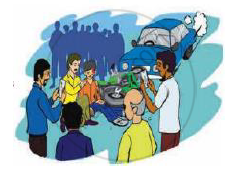
Concept: Concept of Social Health
Give three examples of diseases endangering the social health.
Concept: Concept of Social Health
What will you do? Why?
You are spending more time in internet/mobile games, phone, etc.
Concept: Concept of Social Health
What will you do? Why?
You have to use free space around your home for good purpose.
Concept: Concept of Social Health
Fill in the boxes with the help of the given due :
Continuous consumption of alcohol and tobacco material ___________
| A | O |
Concept: Concept of Social Health
Playing games on mobile while eating is right or wrong. Justify.
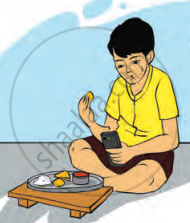
Concept: Concept of Social Health
What do you conclude from the following picture?

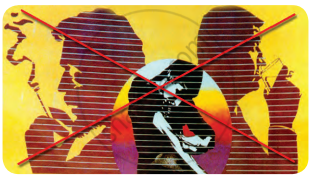
Concept: Concept of Social Health
Tobacco containing substances cannot cause cancer of mouth and lungs.
Concept: Concept of Social Health
Prepare a slogan for campaign against female foeticide.
Concept: Sexual Reproduction in Plants
Draw a diagram of the longitudinal section of a flower and label the following parts.
Concept: Sexual Reproduction in Plants
Sketch and label the essential and accessory whorls of flower.
Concept: Sexual Reproduction in Plants
What is an alloy?
Concept: Corrosion of Metals
Give two examples of alloys with their chemical composition.
Concept: Corrosion of Metals
In the extraction of aluminium: Name the process of concentration of bauxite.
Concept: Basic Principles of Metallurgy > Extraction of Metals
In the extraction of aluminium Write the cathode reaction in electrolytic reduction of alumina.
Concept: Basic Principles of Metallurgy > Extraction of Metals
