Advertisements
Advertisements
प्रश्न
Advertisements
उत्तर १
The given sequence is 2, 4, 6, 8 ... 344, 346, 348
Now, surely the above-mentioned range is in an A.P. or Arithmetic Progression. (Because the difference between two consecutive numbers in the given series is always constant.)
The above sequence is an A.P. with
a = t1 = 2,
d = t2 - t1
= 4 - 2
= 2
tn = 348
Since tn = a + (n - 1) d
∴ 348 = 2 + (n - 1) 2
∴ 348 = 2 - 2n + 2
∴ 348 = 2 + 2n - 2
∴ 348 = 2n
∴ n = `348/2`
∴ n = 174
Thus, the number of terms (n) = 174.
Now, Sn = `n/2` [2a + (n - 1)d]
∴ S174 = `174/2` [2(2) + (174 - 1)2]
= 87 [4 + (173)2]
= 87 [4 + 346]
= 87 × 350
= 30450
Hence, the sum of all even numbers between 1 and 350 is 30450.
उत्तर २
All even numbers between 1 and 350,
2, 4, 6, 8 ... 344, 346, 348
Given sequence is an A.P.
a = 2, d = 2, tn = 348
tn = a + (n - 1)d
348 = 2 + (n - 1)2
348 - 2 = (n - 1)2
`346/2` = n - 1
173 + 1 = n
n = 174
t1 = 2, tn = 348
Sn = `n/2[t_1+t_n]`
S174 = `174/2[2+348]`
S174 = 87 × 350
S174 = 30450
Hence, the sum of all even numbers between 1 and 350 is 30450.
संबंधित प्रश्न
In an A.P., if S5 + S7 = 167 and S10=235, then find the A.P., where Sn denotes the sum of its first n terms.
In an AP given a = 8, an = 62, Sn = 210, find n and d.
A spiral is made up of successive semicircles, with centres alternately at A and B, starting with centre at A of radii 0.5, 1.0 cm, 1.5 cm, 2.0 cm, .... as shown in figure. What is the total length of such a spiral made up of thirteen consecutive semicircles? (Take `pi = 22/7`)

[Hint: Length of successive semicircles is l1, l2, l3, l4, ... with centres at A, B, A, B, ... respectively.]
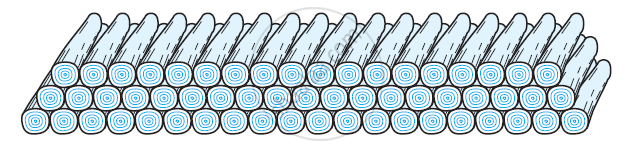
200 logs are stacked in the following manner: 20 logs in the bottom row, 19 in the next row, 18 in the row next to it and so on. In how many rows are the 200 logs placed, and how many logs are in the top row?
Find the sum of the following arithmetic progressions: 50, 46, 42, ... to 10 terms
Find the sum of first n odd natural numbers
In an A.P., if the first term is 22, the common difference is −4 and the sum to n terms is 64, find n.
How many terms of the AP 63, 60, 57, 54, ... must be taken so that their sum is 693? Explain the double answer.
Find the first term and common difference for the A.P.
`1/4,3/4,5/4,7/4,...`
Choose the correct alternative answer for the following question .
First four terms of an A.P. are ....., whose first term is –2 and common difference is –2.
If m times the mth term of an A.P. is eqaul to n times nth term then show that the (m + n)th term of the A.P. is zero.
The sum of third and seventh term of an A. P. is 6 and their product is 8. Find the first term and the common difference of the A. P.
The 19th term of an A.P. is equal to three times its sixth term. If its 9th term is 19, find the A.P.
If Sr denotes the sum of the first r terms of an A.P. Then , S3n: (S2n − Sn) is
The common difference of the A.P. \[\frac{1}{3}, \frac{1 - 3b}{3}, \frac{1 - 6b}{3}, ...\] is ______.
The term A.P is 8, 10, 12, 14,...., 126 . find A.P.
Q.1
Obtain the sum of the first 56 terms of an A.P. whose 18th and 39th terms are 52 and 148 respectively.
If sum of first 6 terms of an AP is 36 and that of the first 16 terms is 256, find the sum of first 10 terms.
The sum of n terms of an A.P. is 3n2. The second term of this A.P. is ______.
