Advertisements
Advertisements
The vapour content in the air is measured using a physical quantity called ______.
Concept: Dew Point and Humidity
Write a short note.
Specific heat capacity
Concept: Specific Heat Capacity
How much is the relative humidity at the dew point?
Concept: Dew Point and Humidity
To study energy exchange between hot and cold objects, the system of both objects is isolated from the environment by keeping them inside ______.
Concept: Specific Heat Capacity
Match the columns:
| Column ‘A’ | Column ‘B’ |
| The SI unit of specific heat capacity | (a) Jkg−1°C−1 |
| (b) kg/m3 | |
| (c) calorie |
Concept: Specific Heat Capacity
How do we feel about air in each of the following conditions?
- Relative humidity is more than 60%.
- Relative humidity is less than 60%.
Concept: Dew Point and Humidity
Observe the following diagram and answer the questions given below:

Specific heat capacity of metals
- Which element has maximum specific heat capacity? Justify.
- Which element has minimum specific heat capacity? Justify.
- Define specific heat of object.
Concept: Specific Heat Capacity
Write the use of ‘Calorimeter’.
Concept: Measurement of Specific Heat: (Mixing Method) and Calorimeter
| Column I | Column II | Column III | |
| 1 | Dispersion | Long-sightedness | Twinkling of stars |
| 2 | Refraction | Splitting of white light into component colours | Convex lens |
| 3 | Hypermetropia | Change in the direction of the ray of light due to change in medium | Spectrum of seven colours |
Concept: Refraction of Light
Choose and write the correct option.
If we gradually increase the angle of incidence of a ray of light passing through prism then …..
Concept: Refraction of Light
The phenomenon of splitting of light into its component colours is ___________ .
Concept: Dispersion of Light Through a Prism
The phenomenon of change in the direction of light when it passes from one transparent medium to another is called ___________.
Concept: Refraction of Light
Draw a labelled diagram: Dispersion of light through a prism.
Concept: Dispersion of Light Through a Prism
Answer the following:
What do you mean by dispersion? Name the different colours of light in the proper sequence in the spectrum of light.
Concept: Dispersion of Light Through a Prism
Match the Columns:
| Column ‘A’ | Column ‘B’ |
| The wavelength of red light | (a) 600 nm |
| (b) 700 nm | |
| (c) 500 nm |
Concept: Dispersion of Light Through a Prism
Observe the given figure and name the following.
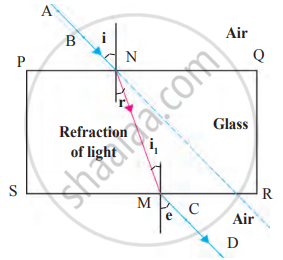
| Ray AB | |
| Ray NM | |
| Ray MD | |
| ∠ r |
Concept: Refraction of Light
Observe the given figure and answer the following questions.
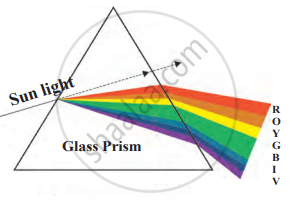
- Which colour light rays bend most?
- Which colour light rays bend least.
- What is the wavelength of violet light rays?
Concept: Dispersion of Light Through a Prism
______ colour is deviated the least in the spectrum of white light obtained with a glass prism.
Concept: Dispersion of Light Through a Prism
In refraction of light through a glass slab, the directions of the incident ray and the refracted ray are ______.
Concept: Refraction of Light
