Please select a subject first
Advertisements
Advertisements
Give a term for the following:
An ART in which eggs are removed from the ovary of the female, fertilised and then placed in her fallopian tube.
Concept: Infertility
Expand the following abbreviation:
PID
Concept: Sexually Transmitted Diseases (STD) or Sexually Transmitted Infections (STI)
Name any two Cu-ions releasing IUDs.
Concept: Infertility
Explain any two ways by which IUDs devices act as contraceptives.
Concept: Infertility
|
Sapna has been diagnosed with an infection of the reproductive tract caused by bacteria. She experiences burning sensation during urination, pain around her genitalia and observes pus containing discharge. Her doctor tells her that this infection has an incubation period of two to five days but can be cured. |
What is the biological name of the causative agent of the disease Sapna is suffering from?
Concept: Sexually Transmitted Diseases (STD) or Sexually Transmitted Infections (STI)
Which is the most commonly prescribed non-steroidal oral contraceptive pill in India?
Concept: Concept of Reproductive Health
Which one of the following choices reflects the correct number of chromosomes in the zygote and in the second polar body of Drosophila melanogaster?
| Zygote | Meiocytes | |
| I | 08 | 08 |
| II | 04 | 08 |
| III | 08 | 04 |
| IV | 04 | 04 |
Concept: Infertility
All STDs do not affect the genital organs. Justify the statement.
Concept: Sexually Transmitted Diseases (STD) or Sexually Transmitted Infections (STI)
The genotype of a person withTumer's syndrome will be:
(i) 44+XXY
(ii) 44+XYY
(iii) 44+XO
(iv) 44+XXYY
Concept: Human Genetic Disorders
Choose the correct options of the following question:
Study the given monohybrid cross:
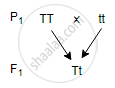
A test cross for this Fj will be:
Concept: Chromosomal Theory of Inheritance
Define the Homologous chromosomes
Concept: Chromosomal Theory of Inheritance
A homozygous pea plant with round seed coat and yellow cotyledons are crossed with another homozygous, pea plant having wrinkled seed coat and green cotyledons.
- Give the types of gametes produced by plants of F1-generation.
- Give the dihybrid phenotypic ratio with the corresponding phenotypes.
- State Mendel’s principle involved in this cross.
Concept: Heredity and Variation
Mention one cause for variation in nature.
Concept: Heredity and Variation
Explain the process of sex determination in honey bees.
Concept: Sex Determination >> Sex Determination in Honey Bees
Give an account of artificial chromosomes in the transfer of genetic material.
Concept: Chromosomal Theory of Inheritance
What is the genotype of Turner's Syndrome?
Concept: Human Genetic Disorders
Mention any one symptom of Turner's syndrome.
Concept: Human Genetic Disorders
A haemophilic man marries a carrier woman and they have a daughter. What is the probability of their daughter being haemophilic?
Concept: Chromosomal Theory of Inheritance
In a karyotype analysis, X and Y chromosomes represent sex chromosomes.
Name the scientist who discovered the X chromosome.
Concept: Chromosomal Theory of Inheritance
Jacob is genetically a carrier of the disorder that affects the shape of the RBCs, as shown in the diagram below. His son James suffers from the same disorder.

- Give the biochemical reason for the disorder that changes the shape of the RBCs, as shown above.
- Draw a Punnett square to show the genotype of the mother of James.
- Name and define the type of 'point mutation' responsible for this disorder.
Concept: Human Genetic Disorders
