Advertisements
Advertisements
प्रश्न
A haemophilic man marries a carrier woman and they have a daughter. What is the probability of their daughter being haemophilic?
Advertisements
उत्तर
50%
Explanation:
A haemophilic male (XhY) and a carrier lady (XXh) have a 50% of probability of conceiving a haemophiliac daughter. This is because one of the two probable daughter genes codes for haemophilia, whereas the other does not. Half of the daughters are carriers and half are hemophilic.
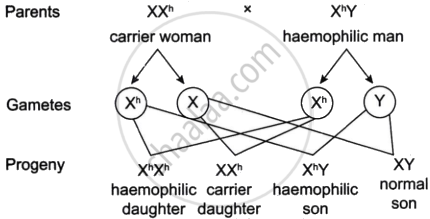
APPEARS IN
संबंधित प्रश्न
Briefly mention the contribution of T. H. Morgan in genetics.
An allohexaploidy contains
If the haploid number in a cell is 18. The double monosomic and trisomic number will be
Match the column I (Type of chromosome) with column II (name of chromosome).
| Type of chromosome | Name of chromosome | ||
| i. |  |
P. | Acrocentric |
| ii. |  |
Q. | Telocentric |
| iii. |  |
R. | Metacentric |
| iv. |  |
S. | Sub-metacentric |
Telocentric chromosome differs from acrocentric chromosome in that ____________.
A gene pair hides the effect of another. The phenomenon is ______.
In a certain taxon of insects some have 17 chromosomes and the others have 18 chromosomes. The 17 and 18 chromosome-bearing organisms are ______.
Who postulated the 'Chromosomal theory of inheritance'?
Genes located on same locus but having different expressions are:
According to the Chromosomal Theory of Inheritance, chromosomes serve which fundamental role in heredity?
