Advertisements
Advertisements
Using the phasor diagram, derive the expression for the current flowing in an ideal inductor connected to an a.c. source of voltage, v= vo sin ωt. Hence plot graphs showing the variation of (i) applied voltage and (ii) the current as a function of ωt.
Concept: Different Types of AC Circuits: AC Voltage Applied to a Series LCR Circuit
Derive an expression for the average power dissipated in a series LCR circuit.
Concept: Different Types of AC Circuits: AC Voltage Applied to a Series LCR Circuit
Choose the correct answer from given options
The phase difference between the current and the voltage in series LCR circuit at resonance is
Concept: Different Types of AC Circuits: AC Voltage Applied to a Series LCR Circuit
A 100 Ω resistor is connected to a 220 V, 50 Hz ac supply.
- What is the rms value of current in the circuit?
- What is the net power consumed over a full cycle?
Concept: Different Types of AC Circuits: AC Voltage Applied to a Resistor
An iron cored coil is connected in series with an electric bulb with an AC source as shown in figure. When iron piece is taken out of the coil, the brightness of the bulb will ______.
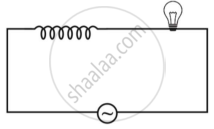
Concept: Different Types of AC Circuits: AC Voltage Applied to a Capacitor
If the reading of the voltmeter V1 is 40 V, then the reading of voltmeter V2 is ______.

Concept: Different Types of AC Circuits: AC Voltage Applied to a Resistor
An a.c. source generating a voltage ε = ε0 sin ωt is connected to a capacitor of capacitance C. Find the expression for the current I flowing through it. Plot a graph of ε and I versus ωt to show that the current is ahead of the voltage by π/2.
Concept: Different Types of AC Circuits: AC Voltage Applied to a Capacitor
An ac voltage V = V0 sin ωt is applied across a pure inductor of inductance L. Find an expression for the current i, flowing in the circuit and show mathematically that the current flowing through it lags behind the applied voltage by a phase angle of `π/2`. Also draw graphs of V and i versus ωt for the circuit.
Concept: Different Types of AC Circuits: AC Voltage Applied to an Inductor
A series RL circuit with R = 10 Ω and L = `(100/pi)` mH is connected to an ac source of voltage V = 141 sin (100 πt), where V is in volts and t is in seconds. Calculate
- the impedance of the circuit
- phase angle, and
- the voltage drop across the inductor.
Concept: Different Types of AC Circuits: AC Voltage Applied to a Series LCR Circuit
A resistor of 50 Ω, a capacitor of `(25/pi)` µF and an inductor of `(4/pi)` H are connected in series across an ac source whose voltage (in volts) is given by V = 70 sin (100 πt). Calculate:
- the net reactance of the circuit
- the impedance of the circuit
- the effective value of current in the circuit.
Concept: Different Types of AC Circuits: AC Voltage Applied to a Capacitor
Which of the following statements about a series LCR circuit connected to an ac source is correct?
Concept: Different Types of AC Circuits: AC Voltage Applied to a Series LCR Circuit
An alternating voltage of 220 V is applied across a device X. A current of 0.22 A flows in the circuit and it lags behind the applied voltage in phase by π/2 radian. When the same voltage is applied across another device Y, the current in the circuit remains the same and it is in phase with the applied voltage.
- Name the devices X and Y and,
- Calculate the current flowing in the circuit when the same voltage is applied across the series combination of X and Y.
Concept: Different Types of AC Circuits: AC Voltage Applied to a Series LCR Circuit
An ideal inductor is connected across an AC source of voltage. The current in the circuit ______.
Concept: Different Types of AC Circuits: AC Voltage Applied to an Inductor
The primary coil having NP turns of an ideal transformer is supplied with an alternating voltage VP. Obtain an expression for the voltage VS induced in its secondary coil having NS turns.
Concept: Transformers
Mention two main sources of power loss in real transformers.
Concept: Transformers
What is the ratio of inductive and capacitive reactance in an ac circuit?
Concept: Different Types of AC Circuits: AC Voltage Applied to an Inductor
The large scale transmission of electrical energy over long distances is done with the use of transformers. The voltage output of the generator is stepped-up because of ______.
Concept: Transformers
Draw the phasor diagram for a series LRC circuit connected to an AC source.
Concept: Different Types of AC Circuits: AC Voltage Applied to a Series LCR Circuit
Plot a graph to show the variation of current with a frequency of the ac source, explaining the nature of its variation for two different resistances R1 and R2 (R1 < R2) at resonance.
Concept: Forced Oscillations and Resonance
When an alternating voltage of 220V is applied across device X, a current of 0.25A flows which lags behind the applied voltage in phase by π/2 radian. If the same voltage is applied across another device Y, the same current flows but now it is in phase with the applied voltage.
- Name the devices X and Y.
- Calculate the current flowing in the circuit when the same voltage is applied across the series combination of X and Y.
Concept: Different Types of AC Circuits: AC Voltage Applied to a Series LCR Circuit
