Please select a subject first
Advertisements
Advertisements
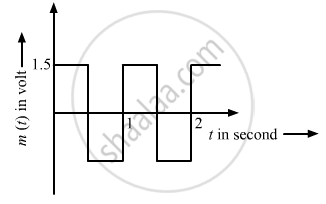
The carrier wave of a signal is given by C(t) = 3 sin (8πt) volt. The modulating signal is a square wave as shown. Find its modulation index.
Concept: Modulation and Its Necessity
Write any two factors which justify the need for modulating a signal ?
Concept: Bandwidth of Signals
Draw a diagram showing an amplitude modulated wave by superposing a modulating signal over a sinusoidal carrier wave.
Concept: Bandwidth of Signals
Write briefly any two factors which demonstrate the need for modulating a signal. Draw a suitable diagram to show amplitude modulation using a sinusoidal signal as the modulating signal.
Concept: Bandwidth of Signals
Give two examples of communication system which use space wave mode.
A TV tower is 80 m tall. Calculate the maximum distance upto which the signal transmitted from the tower can be received.
Concept: Sinusoidal Waves
By what percentage will the transmission ranges of TV tower be affected when the height of the tower is increased by 21%?
Concept: Bandwidth of Transmission Medium
Why are high frequency carrier waves used for transmission?
Concept: Bandwidth of Transmission Medium
What is meant by term ‘modulation’? Draw a block diagram of a simple modulator for obtaining an AM signal.
Concept: Amplitude Modulation (AM)
Why is frequency modulation preferred over amplitude modulation for transmission of music?
Concept: Amplitude Modulation (AM)
Write the function of receiver in communication system.
Concept: Basic Terminology Used in Electronic Communication Systems
Define amplitude modulation in a communication system.
Concept: Amplitude Modulation (AM)
Write the functions of the transducer and repeaters.
Concept: Basic Terminology Used in Electronic Communication Systems
What is the function of a bandpass filter used in a modulator for obtaining AM signal?
Concept: Basic Terminology Used in Electronic Communication Systems
Differentiate between amplitude modulated (AM) and frequency modulated (FM) waves by drawing suitable diagrams. Why is FM signal preferred over AM signal?
Concept: Detection of Amplitude Modulated Wave
Choose the correct answer from given options
The graph showing the correct variation of linear momentum (p) of a charge particle with its de-Broglie wavelength (λ) is _____________.
Concept: Energy and Momentum
Mention the main recommendation of the state reorganization Commission of 1953.
Concept: Organisation and Reorganization of States
What is meant of shock therapy?
Concept: Shock Therapy and Its Consequenes
Identity any two consequences of the partition of India 1947.
Concept: Legacy of Partition - Challenge of 'Refugee' Resettlement, the Kashmir Problem
Differentiate between the capitalist and the socialist models of development.
Concept: Introduction of Democratic Politics and Capitalism in Post-communist Regimes
How did the reorganization of States take place in India after its independence? Explain.
Concept: Organisation and Reorganization of States
