Advertisements
Advertisements
प्रश्न
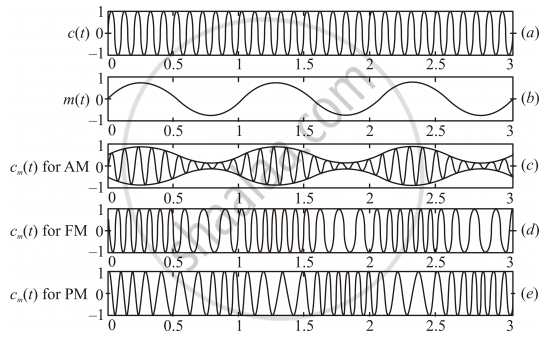
Write briefly any two factors which demonstrate the need for modulating a signal. Draw a suitable diagram to show amplitude modulation using a sinusoidal signal as the modulating signal.
Advertisements
उत्तर
The need for modulation can be summarized as follows:
(1) The antenna needed for transmitting signals should have size at least λ/4, where, λ is the wavelength. The information signal, also known as baseband signal is of low frequency (and therefore the wavelength is high). If we need to transmit such a signal directly, the size of the antenna will be very large and impossible to build. Hence direct transmission is not practical.
(2) The radiated power by an antenna is inversely proportional to the square of the wavelength. So, if we use high frequency signals, the power radiated will be increased.
(3) If we transmit the baseband signals directly, the signals from different transmitters will get mixed up and the information will be lost. Because of these reasons, we use the technology of modulation, for transmitting message signals effectively for long distances.
APPEARS IN
संबंधित प्रश्न
Frequencies in the UHF range normally propagate by means of:
(a) Ground waves.
(b) Sky waves.
(c) Surface waves.
(d) Space waves.
Write any two factors which justify the need for modulating a signal ?
Draw a diagram showing an amplitude modulated wave by superposing a modulating signal over a sinusoidal carrier wave.
What do you mean by bandwidth of a signal? Give its importance.
A TV tower has a height of 100 meter. If the coverage range is to be made three times then the height of the tower should be increased by.
The sound produced by a funning fark is a sort of:-
What is meant by deviation in frequency of FM wave?
The audio frequency range is
Broadcast band in which FM lies is ______.
Would sky waves be suitable for transmission of TV signals of 60 MHz frequency?
