Advertisements
Advertisements
Differentiate between vas deferens and vasa efferentia.
Concept: The Male Reproductive System
Differentiate between spermatogenesis and spermiogenesis.
Concept: The Male Reproductive System
Explain the changes that occur in the ovary and uterus during menstrual cycle in human females. Mention the influence of pituitary and ovarian hormones in bringing these changes.
Concept: Menstrual Cycle (Ovarian Cycle)
Draw a sectional view of the human ovary. Label the following parts :
(ii) Secondary oocyte
(iii) Graafian follicle
(iv) Corpus luteum
Concept: The Female Reproductive System
In the figure given below, parts A and B show the level of hormones which influence the menstrual cycle. Study the figure and answer the questions that follow:
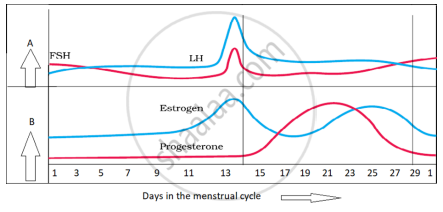
- Name the organs which secrete the hormones represented in parts A and B.
- State the impact of the hormones in part B on the uterus of the human female during 6 to 15 days of the menstrual cycle.
Concept: Menstrual Cycle (Ovarian Cycle)
Explain the function of the following structure in the human male reproductive system.
Scrotum
Concept: The Male Reproductive System
Explain the function of the following structure in the human male reproductive system.
Leydig cells
Concept: The Male Reproductive System
Explain the function of the following structure in the human male reproductive system.
Male accessory glands
Concept: The Male Reproductive System
The graph given below shows the number of primordial follicles per ovary in women at different ages. Study the graph and answer the questions that follow.

- What is the average age of the women at the onset of menopause?
- At what age are maximum primordial follicles present in the ovary, according to the given graph?
Concept: Menstrual Cycle (Ovarian Cycle)
Given below are the structural details of a human mammary gland:
- The glandular tissue in the breast has 15-20 clusters. of cells called alveoli.
- The milk is stored in the lumen of the alveoli.
- The alveoli join to form the mammary ducts.
- Mammary ampulla is connected to lactiferous ducts.
Choose the option that gives the correct detail of the human mammary gland.
Concept: The Female Reproductive System
Explain the process of hormonal regulation of spermatogenesis.
Concept: Spermatogenesis
Explain the phases in embryonic development from the morula stage till the establishment of pregnancy in a human female.
Concept: Pregnancy and Embryonic Development
Mention the problems that are taken care of by reproduction and child health care programme.
Concept: Concept of Reproductive Health
A large number of married couples the world over are childless. It is shocking to know that in India the female partner is often blamed for the couple being childless.
- Why in your opinion the female partner is often blamed for such situations in India? Mention any two values that you as a biology student can promote to check this social evil.
- State any two reasons responsible for the cause of infertility.
- Suggest a technique that can help the couple to have a child where the problem is with male partner.
Concept: Infertility
An infertile couple is advised to adopt test-tube baby programme. Describe two principle procedures adopted for such technologies.
Concept: Infertility
If implementation of better techniques and new strategies are required to provide more efficient care and assistance to people, then why is there a statutory ban on amniocentesis? Write the use of this technique and give reason to justify the ban.
Concept: Concept of Reproductive Health
Explain the process of replication of a retrovirus after it gains entry into the human body.
Concept: Sexually Transmitted Diseases (STD) or Sexually Transmitted Infections (STI)
- What precaution(s) would you recommend to a patient requiring repeated blood transfusion?
- If the advise is not followed by the patient, there is an apprehension that the patient might contract a disease that would destroy the immune system of his/her body. Explain with the help of schematic diagram only how the immune system would get affected and destroyed.
Concept: Sexually Transmitted Diseases (STD) or Sexually Transmitted Infections (STI)
Name the kind of diseases/disorders that are likely to occur in humans if
(i) mutation in the gene that codes for an enzyme phenyl alanine hydrolase occurs,
(ii) there is an extra copy of chromosome 21,
(iii) the karyotype is XXY.
Concept: Concept of Reproductive Health
