Advertisements
Advertisements
Give two examples of fixed costs.
Concept: Fixed Cost and Variable Cost
What happens to the difference between Average Total Cost and Average Variable Cost as production is increased?
Concept: Relationship Between Average Variable Cost and Average Total Cost and Marginal Cost
Choose the correct alternative from given options:
The average product curve in the input-output plane, will be ____________.
Concept: Shapes of Product Curves
Answer the following question.
"Indian Rupee (₹) plunged to an all-time low of ₹ 74.48 against the US Dollar ($)".
− The Economic Times
In light of the above report, discuss the impact of the situation on Indian Imports.
Concept: Determination of Equilibrium Income in the Short Run >> Effect of an Autonomous Change in Aggregate Demand on Income and Output
On the basis of following schedule, answer the given questions:
| Income (in ₹ crores) |
Savings (in ₹ crores) |
| 0 | -20 |
| 50 | -10 |
| 100 | 0 |
| 150 | 30 |
| 200 | 60 |
- Calculate Marginal Propensity to Save (MPS) at ₹ 150 crores level of income.
- What is the value of Autonomous Consumption?
Concept: Aggregate Demand and Its Components >> Consumption
"In an economy, the autonomous consumption is ₹ 100 and Marginal Propensity to Consume (MPC) is 0.6. If the equilibrium level of Income is 2,000, then the autonomous investment is ₹ 300." Justify the statement with valid calculation.
Concept: Aggregate Demand and Its Components >> Consumption
Distinguish between 'Fixed Investment' and 'Inventory Investment'.
Concept: Aggregate Demand and Its Components >> Investment
In an economy, the value of Marginal Propensity to Save (MPS) is 0.25, what will be the value of increase in income, if investments increased by ₹ 200 crores?
Concept: Aggregate Demand and Its Components >> Consumption
What is revenue expenditure?
Concept: Classification of Expenditure
Market for a good is in equilibrium. There is simultaneous "decrease" both in demand and supply of the good. Explain its effect on market price
Concept: Market Equilibrium
Explain the chain of effects of excess supply of a good on its equilibrium price
Concept: Equilibrium Price
Explain how government budget can be helpful in bringing economic stabilization in the economy.
Concept: Objectives of Government Budget
A market for a good is in equilibrium. The supply of good "decreases". Explain the chain of effects of this change
Concept: Market Equilibrium
Giving reason, state whether the following is a revenue expenditure or a capital expenditure in a government budget:
Expenditure of building a bridge.
Concept: Classification of Expenditure
What is meant by price ceiling? Explain its implications.
Concept: Price Ceiling
Answer the following question.
In the given diagram, OP is the market-determined price, and OP1 is the price fixed by the government.
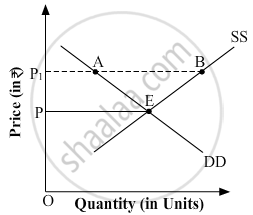
Concept: Price Floor
Suppose the demand and supply equations of a commodity X in a perfectly competitive market are given by :
Qd = 1700 – 2P
Qs = 1300 + 3P
Calculate the value of equilibrium price and equilibrium quantity of the commodity X.
Concept: Equilibrium Price
Answer the following question.
In the given figure, what does the gap 'KT' represent? State any two fiscal measures to correct the situation.
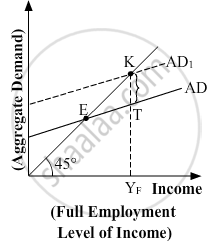
Concept: Measures of Government Deficit
Answer the following question.
Define "Trade surplus". How is it different from "Current account surplus"?
Concept: Concept of Balance of Payments >> Balance of Payments Surplus and Deficit
"Under the flexible exchange rate system, the Central Bank does not intervene in the foreign exchange market."
Justify the statement, giving valid arguments.
Concept: Determination of the Exchange Rate
