- A concave mirror has an inward-curved reflecting surface, while a convex mirror has an outward-curved reflecting surface.
- Important parts of a spherical mirror: Pole (P), Centre of Curvature (C), Principal Axis, and Principal Focus (F).
- For spherical mirrors, the relation is R = 2f, where R is the radius of curvature and f is the focal length.
- In concave mirrors, parallel rays converge at the focus; in convex mirrors, they appear to diverge from the focus behind the mirror.
Definitions [83]
Definition: Spherical Mirrors
Mirrors whose reflecting surfaces are spherical are called spherical mirrors.
OR
A spherical mirror is a part of a hollow sphere, whose one side is silvered and coated with red oxide and the other side is the reflecting surface.
OR
A spherical mirror is a piece cut out of a spherical surface, which can be concave or convex.
Definition: Convex Mirror
A spherical mirror whose reflecting surface is curved outwards, is called a convex mirror.
OR
A convex mirror is one whose reflecting surface is away from the centre of the sphere of which the mirror is a part.
OR
The reflecting surface is on the outer side of the sphere (diverging mirror).
Define the term Pole.
Pole is the centre of the reflecting surface, in this case, a spherical mirror.
Define the term Aperture.
Aperture is the distance between the extreme points on the periphery of the mirror.
Define the term Centre of curvature.
Centre of curvature is the centre of the imaginary sphere to which the mirror belongs.
Define the term Principle focus.
Principal focus of a spherical mirror is a point on the principal axis of the mirror, where all the rays travelling parallel to the principal axis and close to it after reflection from the mirror, converge to or appear to diverge from.
Define the following term:
spherical mirror
“A mirror which is made from a part of a hollow sphere is called Spherical Mirror.
Define the following term:
convex mirror
“A mirror made by silvering the inner surface such that reflection takes place from the bulging surface” is called Convex Mirror.
The Centre of curvature is towards the silvered surface.
Define the following term:
concave mirror
“A mirror made by silvering the outer or the bulging surface such that the reflection takes place from the concave surface.” Centre of curvature is towards the reflecting surface.
Define the following term in relation to concave mirror.
Pole
Pole “is the mid-point of the mirror”.
Define the following term in relation to concave mirror.
Center of curvature
The centre of a hollow sphere of which the mirror forms a part is called the centre of curvature.
Define the following term in relation to concave mirror.
Principal axis
An imaginary line passing through the pole and the centre of curvature of a spherical mirror is called principal axis.
Define the following term in relation to concave mirror.
Principal focus
It is a point on the principal axis, where a beam of light, parallel to the principal axis, after reflection actually meet.
Define the following term in relation to concave mirror.
Radius of curvature
The linear distance between the pole and the center of curvature is called the radius of curvature.
Define the following term in relation to concave mirror.
Focal length
The linear distance between the pole and the principal focus is called focal length.
Define the term Focus of a concave mirror.
The focus of a concave mirror is a point on the principal axis of the mirror, where all the rays travelling parallel to the principal axis and close to it after reflection from the mirror converge to that point.
Define the term Normal.
Normal to the surface of a mirror at any point is the straight line at the right angle to the tangent drawn at that point.
Definition: Centre of Curvature
The reflecting surface of a spherical mirror forms a part of a sphere. This sphere has a centre. This point is called the centre of curvature of the spherical mirror. It is represented by the letter C.
OR
The centre of the sphere of which the mirror forms a part, is called the ‘centre of curvature' of the mirror.
Definition: Pole
The centre of the reflecting surface of a spherical mirror is a point called the pole. The pole is usually represented by the letter P.
OR
The central point of the reflecting surface of the mirror is called the 'pole' of the mirror.
Definition: Principal Axis
A straight line passing through the pole and the centre of curvature of a spherical mirror. This line is called the principal axis.
OR
The straight line joining the pole and the centre of curvature of the mirror and extended on both sides is called the 'principal axis' of the mirror.
Definition: Radius of Curvature
The radius of the sphere of which the reflecting surface of a spherical mirror forms a part is called the radius of curvature of the mirror. It is represented by the letter R.
OR
The radius of the sphere of which the mirror forms a part, is called the 'radius of curvature' of the mirror.
Definition: Concave Mirror
A spherical mirror, whose reflecting surface is curved inwards, that is, faces towards the centre of the sphere, is called a concave mirror.
OR
A concave mirror is one whose reflecting surface is towards the centre of the sphere of which the mirror is a part.
OR
The reflecting surface is on the inner side of the sphere (converging mirror).
Define focal length.
The distance between the pole and the principal focus is called the focal length (f) of a spherical mirror.
Define linear magnification produced by a mirror.
The ratio of the height of an image (h') to the height of an object (h) is known as linear magnification
That is,
`mh/h`
where, h' = height of image
h = height of object
Define the principal focus of a concave mirror.
Light rays that are parallel to the principal axis of a concave mirror converge at a specific point on its principal axis after reflecting from the mirror. This point is known as the principal focus of the concave mirror.
Definition: Refraction
The change in the direction of the path of light when it passes from one transparent medium to another transparent medium is called refraction. The refraction of light is essentially a surface phenomenon.
or
When light passes from one transparent medium to another, its speed and direction change. This is called refraction.
Definition: Refraction of Light
When travelling obliquely from one medium to another, the direction of propagation of light in the second medium changes. This phenomenon is known as refraction of light.
OR
Light changes its direction when going from one transparent medium to another transparent medium. This is called the refraction of light.
OR
The bending of the light ray from its path in passing from one medium to the other medium is called 'refraction' of light.
OR
When a ray of light impinges on a polished, smooth, shiny surface, the rebounding of light within the same medium is called reflection of light.
Definition: Refracted Light
Refracted light is the part of light enters into the other medium and travels in a straight path but in a direction different from its initial direction and is called the refracted light.
Define the term refractive index of a medium in terms of velocity of light.
It is defined as the ratio of the velocity of light in medium 1 to the velocity of light in medium 2.
Define the absolute refractive index of a medium.
The absolute refractive index is the ratio of the velocity of light in a vacuum to that of the medium.
Definition: Lateral Displacement
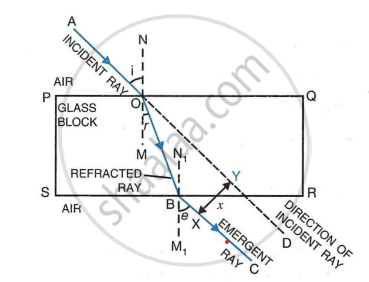
The perpendicular distance XY between the path of the emergent ray BC and the direction of the incident ray OD is called the lateral displacement.
Definition: Critical Angle
Critical angle is the angle of incidence in the denser medium corresponding to which the angle of refraction in the rarer medium is 90°.
Define critical angle for a given medium.
When a ray of light propagates from a denser medium to a rarer medium, the angle of incidence for which the angle of refraction is 90° is called the critical angle.
Definition: Critical Angle
The angle of incidence in the denser medium corresponding to an angle of refraction of 90° in the rarer medium is called the critical angle.
Definition: Total Internal Reflection
The phenomenon where light rays are completely reflected back into a medium instead of being refracted into another medium is called total internal reflection.
or
Complete reflection of a ray of light at the interface of an optically denser medium and a rarer medium, back into the denser medium.
Definition: Optical Centre
The point inside a lens on the principal axis, through which light rays pass without changing their path is called the optical centre of a lens.
OR
The point on the principal axis of a lens such that a ray of light directed towards it emerges from the lens in the same direction, without deviation.
Definition: Lens
A lens is a transparent refracting medium bounded by either two spherical surfaces, or one spherical surface and the other surface plane.
OR
A lens is a transparent medium bound by two surfaces.
OR
A lens is a transparent medium (such as glass) bounded by two curved surfaces or one curved and one plane surface.
Definition: Principal Focus
Principal focus (F) is the point on the principal axis at which light rays parallel to the principal axis converge after passing through a convex lens.
Definition: Radius of Curvature
The radii (R1 and R2) of the spheres whose parts form surfaces of the lenses are called the radii of curvature of the lens.
Definition: Centre of Curvature
The centres of spheres whose parts form surfaces of the lenses are called centres of curvatures of the lenses.
Definition: Converging Lens or Convex Lens
A lens which bulges out in the middle, is a convex lens. A light beam converges on passing through such a lens, so it is also called a converging lens.
OR
The lens which has two spherical surfaces which are puffed up outwards is called a convex or double convex lens.
OR
The lenses which are thicker in the middle and thinner at the edges, are called 'convex lenses'.
Definition: Focal Length
The distance between the optical centre and principal focus of a lens is called its focal length.
Definition: Principal Axis
The imaginary line passing through both centres of curvature is called the principal axis of the lens.
OR
The line joining the centres of curvature of the surfaces of the lens is called the 'principal axis' of the lens.
Definition: Diverging Lens or Concave Lens
A lens which is bent inwards in the middle is a concave lens. Such a lens diverges the light rays incident on it, so it is also called a diverging lens.
OR
This lens is thicker near the centre as compared to the edges. The lens with both surfaces spherical on the inside is called a concave or double concave lens.
OR
The lenses which are thinner in the middle and thicker at the edges, are called 'concave lenses'.
Define the power of a lens.
Power of a lens is defined as the ability of a lens to bend the rays of light. It is given by the reciprocal of focal length in metre.
The power of a lens is a measure of the deviation produced by it in the path of rays refracted through it.
Definition: Power of a Lens
The deviation of the incident light rays produced by a lens on refraction through it, is a measure of its power.
or
The power of a lens is defined as the reciprocal of its focal length. It is represented by the letter P.
OR
The power (P) of a thin lens is equal to the reciprocal of its focal length (f) measured in metres.
Definition: Linear (Lateral / Transverse) Magnification
Linear magnification produced by a spherical mirror is the ratio of the size of the image to the size of the object, both measured perpendicular to the principal axis.
Definition: Focal Length
The distance of the principal focus from the pole of the mirror is called the 'focal length' of the mirror.
Definition: Principal Focus
The point on the principal axis at which light rays parallel to the principal axis, afterreflection from the mirror, actually meet or appear to come from, is called the 'principal focus' of the mirror.
Definition: Aperture
The diameter of the periphery of the mirror is called the 'aperture' of the mirror.
Definition: Focal Plane
The plane perpendicular to the principal axis and passing through the principal focus of the mirror is called the ‘focal plane' of the mirror.
Definition: Linear (Lateral/Transverse) Magnification of Lens
The linear magnification produced by a spherical (convex or concave) lens is the ratio of the size of the image formed by the lens to the size of the object, both measured perpendicular to the principal axis.
Definition: Focal Plane
The plane passing through the focus of a lens and perpendicular to the principal axis is called the 'focal plane'.
Definition: Second Focus
The rays travelling parallel to the axis of the lens, after refraction through the lens, either go towards a fixed point on the axis or appear to come from a point. This point is called the 'second focus' or the 'principal focus' of the lens.
The distance of the second focus from the optical centre of the lens is called the 'second focal length' or the 'principal focal length' of the lens.
Definition: First Focus
The rays starting from a fixed point on the principal axis of a lens, or appearing to go towards a fixed point on the axis, after refraction through the lens, become parallel to the principal axis. This point is called the 'first focus' of the lens.
The distance of the first focus from the optical centre of the lens is called the 'first focal-length' of the lens.
Definition: Refractive Index
The refractive index of a medium is the parameter that tells how much slower light travels in that medium compared to vacuum.
Mathematically,
n = \[\frac{\text{velocity of light in vacuum}}{\text{velocity of light in medium}}=\frac{c}{v}\]
where c = 3 × 10⁸ ms-1.
Definition: Relative Refractive Index
When the velocity of light in a medium is compared with that in another medium, the parameter is called the relative refractive index.
Definition: Lateral Shift
“The perpendicular distance between the emergent ray and the direction of the incident ray is called the lateral shift.”
Definition: Critical Angle
The critical angle for two given media is the angle of incidence in the denser medium for which the angle of refraction in the rarer medium is 90°.
Definition: Total Internal Reflection
When a ray of light, travelling from a denser medium to a rarer medium, is incident at the interface of the two media at an angle greater than the critical angle for the two media, the ray is 'totally' reflected back into the denser medium.
Definition: Simple Microscope
A simple microscope is a short-focus convex lens used to obtain a magnified, erect, and virtual image of a close object.
Definition: Magnifying Power
The magnifying power of a simple microscope is the ratio of the angle subtended by the image at the eye to the angle subtended by the object when placed at the least distance of distinct vision.
Definition: Compound Microscope
A compound microscope is an optical instrument which produces high magnification by using two converging lenses: an objective and an eyepiece.
Definition: Far Point of the Eye
The far point of a normal eye is the point at infinity, which can be seen distinctly when the eye is in a relaxed state.
Definition: Near Point of the Eye
The near point of the eye is the nearest point at which an object can be seen distinctly.
Definition: Visual Angle
The angle which an object subtends at our eye is called the 'visual angle’.
Definition: Magnifying Power
The magnifying power of an optical instrument is defined as the ratio of the visual angle subtended by the image formed by the instrument at the eye to the visual angle subtended by the object at the unaided eye.
Definition: Microscope
A microscope is an optical instrument which forms a large image of a small and close object so that it subtends a large visual angle at the eye.
Definition: Objective Lens
The lens placed near the object, of short focal length and small aperture, is called the objective lens.
Definition: Eyepiece Lens
The lens placed near the eye, of larger focal length and aperture, is called the eyepiece.
Definition: Astronomical Telescope
An astronomical telescope is an optical instrument used to observe distant heavenly objects by increasing the visual angle subtended at the eye.
Definition: Resolving Power
The power of an optical instrument to produce distinctly separate images of two close objects is called the ‘resolving power' of that instrument.
Definition: Power of Accommodation
The power of changing the focal length of the eye lens to see objects clearly at different distances is called the power of accommodation of the eye.
Definition: Least Distance of Distinct Vision
The nearest distance up to which the eye can see clearly by applying maximum power of accommodation is called the least distance of distinct vision.
Definition: Reflecting Telescope
A telescope that uses a concave mirror as the objective to collect and focus light from distant objects.
Definition: Newtonian Reflecting Telescope
A reflecting telescope in which a plane mirror inclined at 45° deflects light from a concave primary mirror to an eyepiece placed at the side.
Definition: Cassegrain Reflecting Telescope
A reflecting telescope that uses a paraboloidal primary mirror with a central hole and a convex secondary mirror, with the eyepiece placed behind the primary mirror.
Definition: Angular Dispersion
The angle between the emergent rays of any two colours is called ‘angular dispersion’ between those colours.
Definition: Prism
A prism is a homogeneous, transparent medium bounded by two plane surfaces inclined to each other at an angle.
Definition: Scattering of Light
When sunlight passes through the Earth's atmosphere, much of the light is absorbed by the fine dust particles and air molecules in the atmosphere, which give out the absorbed light in some other direction. This is 'scattering of light'.
Definition: Rainbow
The coloured arcs seen in the sky when sunlight is dispersed by raindrops are called rainbows.
Definition: Dispersive Power
When white light passes through a thin prism, the ratio of the angular dispersion between the violet and the red emergent rays and the deviation suffered by a mean ray (ray of yellow colour) is called the ‘dispersive power' of the material of the prism. It is denoted by ω.
Definition: Angle of Deviation
The angle between the direction of the incident ray (produced forward) and the emergent ray (produced backward) is called the angle of deviation.
Formulae [19]
Formula: Power of a Lens
Power of lens (in D) = \[\frac{1}{\text{focal length (in metre)}}\]
or
P = \[\frac {1}{f}\]
or
P = \[\frac {1}{f (m)}\]
Power of a Lens in a Medium:
P = (n2 - n1)\[\left(\frac{1}{R_{1}}-\frac{1}{R_{2}}\right)\] = \[\frac {n_1}{f}\]
Formula: Magnification
m = -\[\frac {v}{u}\]
OR
m = -\[\frac {v}{u}\] = \[\frac {f - v}{f}\] = \[\frac {f}{f - u}\].
Formula: Mirror Formula for Concave Mirror
\[\frac {1}{v}\] + \[\frac {1}{u}\] = \[\frac {1}{f}\]
Formula: Mirror Formula for Convex Mirror
\[\frac {1}{v}\] + \[\frac {1}{u}\] = \[\frac {1}{f}\]
Formula: Linear Magnification of Lens
m = \[\frac {v}{u}\]
OR
m = \[\frac {f}{f + u}\]
Formula: Combined Focal Length
- Both the Lenses are Convex:
\[\frac {1}{f}\] = \[\frac {1}{f_1}\] + \[\frac {1}{f_2}\] - One Lens is Convex and the Other is Concave:
\[\frac {1}{f}\] = \[\frac {1}{f_1}\] - \[\frac {1}{f_2}\] - Combined Power:
P = P1 + P2
Formula: Lens Maker's Formula
\[\frac {1}{v}\] - \[\frac {1}{u}\] = \[\frac {1}{f}\]
Formula: Refraction at a Spherical Surface
\[\frac{n}{v}-\frac{1}{u}=\frac{n-1}{R}\]
Formula: Relative Refractive Index Ratio
\[^2n_3=\frac{n_3}{n_2}\]
Formula: Refractive Index
\[^1n_2=\frac{v_1}{v_2}=\frac{n_2}{n_1}\]
Formula: Lateral Shift
Lateral shift (d) = t sin (i − r) sec r
Formula: Critical Angle Formula
\[_1n_2=\frac{1}{\sin C}\cdot\]
Formula: Magnifying Power of a Telescope
General Magnifying Power of a Telescope:
M = \[\frac {f_o}{u_e}\]
Final Image at the Least Distance of Distinct Vision:
M = \[\frac{f_o}{f_e}\left(1+\frac{D}{f_e}\right)\]
Normal Adjustment / Final Image at Infinity:
M = -\[\frac {f_o}{f_e}\]
Formula: Magnifying Power of a Reflecting Telescope
M = -\[\frac {f_o}{f_e}\]
- fo = focal length of the concave (objective) mirror
- fe = focal length of the eyepiece
Formula: Magnifying power of Simple Microscope
Image at least distance of distinct vision:
M = 1 + \[\frac {D}{f}\]
Eye relaxed, image at infinity:
M = \[\frac {D}{f}\]
Formula: Magnifying Power of a Compound Microscope
M = m0 × me
Normal Adjustment, Image at D:
\[{M=\frac{L}{f_o}\left(1+\frac{D}{f_e}\right)}\]
Relaxed Eye, Image at Infinity:
\[{M=\frac{L}{f_o}\frac{D}{f_e}}\]
Formula: Dispersive Power
ω = \[\frac{n_{V}-n_{R}}{n_{Y}-1}\]
Internationally Accepted:
ω = \[\frac{n_{F}-n_{C}}{n_{D}-1}\]
Formula: Angular Dispersion
θ = (nV - nR) A
Formula: Refractive Index of the Prism
n = \[\frac{\sin\frac{A+\delta_{m}}{2}}{\sin\frac{A}{2}}\]
Theorems and Laws [4]
Law: Laws of Refraction
-
First Law: Incident ray, refracted ray, and normal to the interface at the point of incidence all lie in the same plane.
-
Second Law (Snell's Law): \[\frac{\sin i}{\sin r}=\mathrm{constant}=\frac{\mu_2}{\mu_1}\]
Extended Snell's Law: \[\frac{\sin i}{\sin r}=\frac{\mu_2}{\mu_1}=_1\mu_2=\frac{v_1}{v_2}=\frac{\lambda_1}{\lambda_2}\]
A ray of light moves from a rare medium to a dense medium as shown in the diagram below. Write down the number of the ray which represents the partially reflected ray.

Ray 2 shows partially reflected ray.
Law: Principle of Reversibility of Light
Statement
When a light ray, after undergoing any number of reflections and refractions, has its direction reversed, it retraces its entire original path. This is called the principle of reversibility of light.
Explanation / Proof
Consider a light ray passing from medium 1 to medium 2 and suffering refraction at the boundary.
Let the angle of incidence be i and the angle of refraction be r.
By Snell’s law, the refractive index of medium 2 with respect to medium 1 is:
1n2 = \[\frac {sin i}{sin r}\]
Now, suppose the refracted ray is reflected back and retraces the path in the reverse direction. In this case, the angle of incidence becomes r, and the angle of refraction becomes i.
Again, by Snell’s law, the refractive index of medium 1 with respect to medium 2 is:
2n1 = \[\frac {sin r}{sin i}\]
Multiplying the two equations:
1n2 × 2n1 = 1
This shows that the ray follows the same path in the reverse direction, proving the reversibility of the light path.
Conclusion
Hence, a light ray always retraces its original path when its direction is reversed, even after multiple reflections and refractions. This establishes the principle of reversibility of light.
Law: Rayleigh's Scattering Law
Rayleigh proved that the intensity of scattered light is inversely proportional to the fourth power of the wavelength; provided the scatterer is smaller in size than the wavelength of light :
Scattering ∝ \[\frac {1}{λ^4}\]
According to this law, the short waves of violet light (λ = 4000) are scattered about ten times more than the longer waves of red light (λ = 7000). The other colours are scattered by intermediate amounts.
Key Points
Key Points: Spherical Mirrors
Key Points: Sign Convention
- Pole (mirror) or optical centre (lens) is the origin; principal axis is the X-axis.
- Distances to the right are positive, to the left are negative; heights above the axis are positive, below are negative.
- Concave mirror: and R are negative; Convex mirror: and R are positive.
- Real images: image distance and magnification are negative; Virtual images: both are positive.
- Lenses are always negative; they are positive for real images and negative for virtual images; they are positive for convex lenses and negative for concave lenses.
Key Points: Refraction of Light
Key Points: Refraction of Light Through a Rectangular Glass Block
Key Points: Concept of Lenses
- Lenses are widely used in daily life, such as in spectacles, peepholes, magnifiers, and telescopes.
- Light passing through a lens undergoes refraction twice: once on entering and once on exiting the lens.
- The shape of a lens affects the direction of light; convex lenses converge light, while concave lenses diverge it.
- Most lenses have surfaces that are parts of spheres, with common types including biconvex, biconcave, plano-convex, and meniscus lenses.
Key Points: Image Formation Rules (Spherical Mirrors)
- Parallel ray rule: A ray parallel to the principal axis passes through the focus (concave) or appears to come from the focus (convex) after reflection.
- Focus ray rule: A ray passing through the focus (concave) or directed towards the focus (convex) becomes parallel to the principal axis after reflection.
- Centre of curvature rule: A ray passing through or directed towards the centre of curvature retraces its path after reflection.
- Law of reflection rule: A ray striking the mirror surface reflects according to the laws of reflection.
Key Points: Uses of Spherical Mirrors
- A concave mirror is used for shaving (erect, magnified image).
- Concave (parabolic) mirrors are used in telescopes to observe distant stars.
- Concave mirrors are used in torches, searchlights and headlights to produce a parallel beam.
- Concave mirrors are used by ENT doctors and eye specialists for examination.
- Convex mirrors are used in street lights to illuminate a large area.
- Convex mirrors are used as rear-view mirrors (erect, diminished image, wide view).
- Image identification:
Erect & same size → Plane mirror
Erect & magnified → Concave mirror
Erect & diminished → Convex mirror
Key Points: Conditions of Image Formation
- Many rays start from an object point, but only two or three rays are sufficient to locate the image.
- In mirrors, reflected rays remain on the same side of the mirror as the object; no real rays exist on the other side.
- If reflected rays actually meet, a real image is formed, which is inverted.
- If reflected rays diverge and meet only on backward extension, a virtual image is formed, which is erect.
- For lenses, real images are formed on the opposite side of the lens and are inverted, while virtual images are formed on the same side as the object and are erect.
Key Points: Relation between Focal Length and Radius of Curvature
- For a spherical mirror of small aperture, rays close to the principal axis (paraxial rays) obey the law of reflection accurately.
- In both concave and convex mirrors, using geometrical construction and the law of reflection, the focus lies midway between the pole and the centre of curvature.
- Hence, for a small-aperture spherical mirror, the focal length is half the radius of curvature:
f = \[\frac {R}{2}\]
Key Points: Combination of Lenses and Mirrors
- For two coaxial lenses separated by distance d, the equivalent focal length and power depend on f1, f2, and d.
- A concave lens always forms a virtual image; therefore, its focal length is determined by combining it with a mirror.
- A convex mirror also always forms a virtual image, so it is combined with a convex lens to find its focal length.
- With a convex lens and a plane mirror, if the object and image coincide without parallax, the object position determines the lens's focal length.
- Focal lengths in lens–mirror combinations are calculated using the lens formula and non-parallax positions.
Key Points: Coordinate Geometry Sign Convention
- The optical centre of the lens is taken as the origin; the principal axis is the X-axis and the perpendicular line through the optical centre is the Y-axis.
- Distances to the right of the optical centre are positive and to the left are negative; heights above the principal axis are positive and below are negative.
Key Points: Types of Lenses
- Convexo-convex (Bi-convex): Both surfaces are convex; radii of curvature may be equal or different.
- Plano-convex: One surface is plane and the other is convex.
- Concavo-convex (Convex meniscus): One surface is concave and the other convex; thicker at the centre.
- Concavo-concave (Bi-concave): Both surfaces are concave; radii of curvature may be equal or different.
- Plano-concave: One surface is plane, and the other is concave.
- Convexo-concave (Concave meniscus): One surface is convex and the other concave; thinner at the centre.
Key Points: Variation of Focal Length of a Lens
- The focal length of a lens depends on its refractive index and the radii of curvature of its surfaces (lens maker’s formula).
- Changing the surrounding medium changes a lens's focal length; it increases in a denser medium and may even alter the lens's properties.
Key Points: Applications of Total Internal Reflection
- Mirage is caused by total internal reflection in hot air layers, making objects appear inverted, as in water reflections.
- Diamonds sparkle because light undergoes repeated total internal reflections due to their small critical angle.
- Totally reflecting prisms use total internal reflection to reflect light efficiently.
- Right-angled prisms can turn light by 90° or 180° using total internal reflection.
- Prisms are better than mirrors because they reflect almost all light and produce clear images.
- Optical fibres guide light by total internal reflection and are used in communication and medical imaging.
Key Points: Physical Significance of Refractive Index
- Refractive index indicates the direction of bending of light at a boundary (towards or away from the normal).
- It gives the ratio of the speeds of light in vacuum and in the medium:
n = \[\frac {c}{v}\]So, a higher refractive index means a lower speed of light in the medium. - The frequency of light remains unchanged during refraction, but the wavelength changes; hence, the refractive index also gives information about the wavelength of light in a medium.
Key Points: Cause of Refraction
- Refraction occurs due to a change in the speed of light when it passes from one medium to another.
- The greater the change in speed, the greater is the bending of light at the boundary of the two media.
- According to Snell’s law:
If v1 > v2, the ray bends towards the normal (rarer to denser medium).
If v1 < v2, the ray bends away from the normal (denser to rarer medium).
Key Points: Real & Apparent Depth
- An object in a denser medium appears raised when viewed from a rarer medium due to refraction.
- Real depth is the actual depth of the object; apparent depth is the depth at which it appears.
- Refractive index is given by:
n = \[\frac{\text{Real depth}}{\text{Apparent depth}}\] - Normal displacement is the difference between real and apparent depths:
d = Real depth − Apparent depth - For a medium of thickness t:
d = t (1 − \[\frac {1}{n}\])
Key Points: Characteristics of a Compound Microscope
- For relaxed eye adjustment, the final image is formed at infinity, and the intermediate image lies at the focus of the eyepiece.
- Magnifying power (relaxed eye) is
M = \[\frac {L}{f_o}\]\[\frac {D}{f_e}\]. - Maximum magnification is obtained when the object is placed very close to the focal point of the objective.
- A bright, highly magnified image requires lenses with short focal lengths, with the objective having a small aperture.
- A compound microscope is used instead of a simple microscope to achieve higher magnification without sacrificing image quality.
Key Points: Compound Microscope
- A compound microscope uses two convex lenses, an objective (short focal length) and an eyepiece (longer focal length).
- The objective forms a real, inverted, magnified image, which acts as a virtual object for the eyepiece.
- The eyepiece produces a final virtual and highly magnified image, usually at the least distance of distinct vision or at infinity.
- Total magnifying power is the product of the magnifications of the objective and the eyepiece.
- Large magnification is achieved when the object is placed close to the objective's focal point and the eyepiece has a short focal length.
Key Points: Resolving Power of Optical Instruments
- According to Rayleigh’s criterion, two-point objects are just resolved when the principal maximum of one diffraction pattern falls on the first minimum of the other.
- Resolving power increases when the limit of resolution decreases; smaller separation means better resolution.
- For a telescope, the limit of resolution depends on wavelength and aperture, and a larger aperture gives higher resolving power.
- For a microscope, resolving power improves with a smaller wavelength of light and a larger numerical aperture.
- Electron microscopes have very high resolving power because electrons have extremely small wavelengths compared to visible light.
Key Points: Telescope
- An astronomical refracting telescope uses two convex lenses—an objective near the object and an eyepiece near the eye.
- The objective lens has a large focal length and a large aperture, so it can collect more light from distant objects.
- The objective forms a real, inverted, and diminished image of the distant object at its focal plane.
- This image serves as an object for the eyepiece, producing a magnified virtual image for the observer.
- Normal adjustment is done by making the final image at infinity, so the eye observes without strain.
- Refracting telescopes suffer from chromatic and spherical aberrations and have limited magnification and resolution.
Key Points: Specific Conditions for Emergent Ray
- The limiting angle of incidence is the angle at which a ray just emerges from the prism; for angles smaller than this, total internal reflection occurs at the second face.
\[i_1=\sin^{-1}\left[\sqrt{(n^2-1)}\sin A-\cos A\right]\] - For grazing incidence and grazing emergence, both angles of incidence are 90∘, and the condition for emergence is
A ≤ 2Ca
where C is the critical angle. - Maximum deviation by a prism occurs when the angle of incidence at the first face is 90∘ (grazing incidence).
δmax = δ1 + δ2 = (90° – C) + (i – r).
Key Points: Rainbows
- Rainbows are formed due to the dispersion of sunlight in raindrops.
- The primary rainbow is formed after one internal reflection in a raindrop and is brighter, with violet inside and red outside.
- The secondary rainbow is formed after two internal reflections and is fainter, with red inside and violet outside.
- The primary rainbow is seen at about 41°–43°, while the secondary rainbow is seen at about 51°–54° from the antisolar direction.
- Primary and secondary rainbows appear as concentric arcs with a common centre on the line joining the sun and the observer.
Key Points: Phenomena Based upon Scattering of Light
- Scattering of light by air molecules and fine dust particles explains many atmospheric optical phenomena.
- The sky appears blue because shorter-wavelength blue light scatters more strongly than red light in the atmosphere.
- If there were no atmosphere, the sky would appear black, as no scattering of sunlight would occur.
- Clouds appear white because water droplets and ice crystals are large and scatter all wavelengths nearly equally.
- The Sun appears reddish at sunrise and sunset because blue light scatters more strongly over a longer atmospheric path.
- Red light is used in danger signals because it suffers the least scattering and can be seen from long distances.
- Infra-red rays suffer very little scattering, so infra-red photography is possible in fog and mist.
Key Points: Refraction through a Prism
- The deviation produced by a prism depends on the angle of incidence, the angle of the prism, and the material of the prism.
- As the angle of incidence increases, the angle of deviation first decreases, becomes minimum, and then increases.
- For minimum deviation, the angle of incidence equals the angle of emergence (i = i′).
- In the condition of minimum deviation, the refracted ray inside the prism travels parallel to the base of the prism.
- For a thin prism, the deviation depends only on the refractive index of the material and the angle of the prism, and not on the angle of incidence.
Important Questions [3]
Concepts [41]
- Spherical Mirrors
- Fundamental Terms Related to Spherical Mirrors
- Relation Between Focal Length and Radius of Curvature of a Spherical Mirror
- Rules to Trace the Image Formed by Spherical Mirrors
- Conditions of Image Formation
- Position and Nature of Image Formed by Spherical Mirrors
- Sign Convention
- Mirror Formula for Concave Mirror
- Mirror Formula for Convex Mirror
- Linear Magnification by Spherical Mirrors
- Uses of Spherical Mirrors
- Refraction of Light
- Laws of Refraction
- Cause of Refraction
- Physical Significance of Refractive Index
- Reversibility of Light
- Refraction of Light Through a Rectangular Glass Block
- Refraction through Parallel Multiple Media
- Real and Apparent Depths: Normal Displacement
- Critical Angle
- Total Internal Reflection
- Applications of Total Internal Reflection
- Coordinate Geometry Sign Convention for Measuring Distances and Lengths
- Refraction at Concave Spherical Surface
- Refraction at a Convex Spherical Surface
- Concept of Lenses
- Converging and Diverging Actions of Lenses
- Lens Maker's Formula
- Factors Affecting Focal Length of a Lens
- Image Formation by Thin Lenses
- Ray Diagrams for Formation of Image by a Convex Lens
- Ray Diagram for Formation of Image by a Concave Lens
- Linear Magnification by Spherical Lenses
- Power of a Lens
- Combined Focal Length of Two Thin Lenses in Contact
- Combination of Lenses and Mirrors
- Overview: Reflection of Light: Spherical Mirrors
- Overview: Refraction of Light at Spherical Surfaces: Lenses
- Overview: Refraction of Light at a Plane Interface
- Overview: Optical Instruments
- Overview: Refraction and Dispersion of Light through a Prism
