Definitions [38]
Light is an electromagnetic wave that travels in straight lines in a homogeneous medium.
-
Speed of light in vacuum: c = 3 × 10⁸ m/s.
The branch of optics that is based on rectilinear propagation of light and deals with mirrors, lenses, reflection, refraction, etc. is called ray optics.
The phenomenon that is based on the fact that light waves are transverse electromagnetic waves is called polarisation.
Coupled time-varying electric and magnetic fields that propagate in space are called electromagnetic waves.
The branch of optics that considers light as a wave which can bend around objects, diffract and interfere, etc. is called wave optics.
A branch of optics that describes light propagation in terms of rays is called ray optics.
The aberration that arises due to the spherical shape of the reflecting surface is called spherical aberration.
A mirror with a curved reflecting surface is called a curved mirror.
A curved mirror whose reflecting surface is on the inner side of the curved surface is called a concave mirror.
A curved mirror whose reflecting surface is on the outer side of the curved surface is called a convex mirror.
The ratio of linear size of an image to that of the object, measured perpendicular to the principal axis, is called lateral magnification.
Define the principal focus of a concave mirror.
Light rays that are parallel to the principal axis of a concave mirror converge at a specific point on its principal axis after reflecting from the mirror. This point is known as the principal focus of the concave mirror.
Total internal reflection is the complete reflection of light back into an optically denser medium when light travels from a denser medium to a rarer medium and the angle of incidence exceeds the critical angle.
The critical angle is the angle of incidence in the denser medium for which the angle of refraction in the rarer medium is 90 degrees.
Refracted light is the part of light enters into the other medium and travels in a straight path but in a direction different from its initial direction and is called the refracted light.
The ray that enters the second medium after crossing the boundary is called the refracted ray.
A normal is an imaginary line drawn perpendicular to the boundary at the point of incidence.
When travelling obliquely from one medium to another, the direction of propagation of light in the second medium changes. This phenomenon is known as refraction of light.
OR
Light changes its direction when going from one transparent medium to another transparent medium. This is called the refraction of light.
OR
The bending of the light ray from its path in passing from one medium to the other medium is called 'refraction' of light.
OR
When a ray of light impinges on a polished, smooth, shiny surface, the rebounding of light within the same medium is called reflection of light.
The change in the direction of the path of light when it passes from one transparent medium to another transparent medium is called refraction. The refraction of light is essentially a surface phenomenon.
or
When light passes from one transparent medium to another, its speed and direction change. This is called refraction.
Define critical angle for a given medium.
When a ray of light propagates from a denser medium to a rarer medium, the angle of incidence for which the angle of refraction is 90° is called the critical angle.
Define the following terms used in the study of reflection of light by drawing a labelled ray-diagram:
- Incident ray
- Point of incidence
- Normal
- Reflected ray
- Angle of incidence
- Angle of reflection
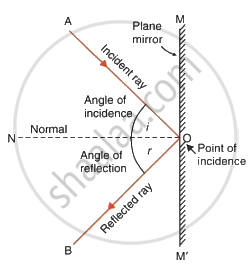
- Incident ray: The ray of light which falls on the mirror surface is called the incident ray.
- Point of incidence: The point at which the incident ray falls on the mirror is called the point of incidence.
- Normal: The normal is a line at right angles to the mirror surface at the point of incidence.
- Reflected ray: The ray of light which is sent back by the mirror is called the reflected ray.
- Angle of incidence: The angle of incidence is the angle made by the incident ray with the normal at the point of incidence.
- Angle of reflection: The angle of reflection is the angle made by the reflected ray with the normal at the point of incidence.
An optical fibre is a thin, transparent fibre of glass or plastic that transmits light signals using repeated total internal reflection.
A mirage is an optical illusion seen on hot roads or in deserts where distant objects appear reflected from water-like surfaces.
The aberration that occurs due to the lens refracting different wavelengths of light at different angles, resulting in an image consisting of different colours without a single focussed image, is called chromatic aberration.
The aberration caused by the spherical shape of the lens, where light rays at the edges focus at a different point than those near the centre, leading to a blurred image, is called spherical aberration.
The angular separation between the two extreme rays of a dispersed beam of light is called angular dispersion.
The phenomenon of splitting of white light by a prism into its constituent colours is known as dispersion.
OR
The splitting of light into its component colours is called dispersion.
OR
The process of separation of light into its component colours while passing through a medium is called the dispersion of light.
OR
The phenomenon in which white light splits into its constituent colours when it passes through a prism or another medium is called dispersion of light.
Define the term dispersion of light.
The phenomenon of the splitting of white light by a prism into its constituent colours is known as dispersion of light.
When a beam of white light or composite light is refracted through any transparent media such as glass or water, it is split into its component colours. This phenomenon is called ‘dispersion of light’.
On passing white light through a prism, the band of colours seen on a screen is called the spectrum.
or
The band of the coloured components of a light beam is called its spectrum.
An arc of seven colours formed in the sky with red on the outer edge and violet on the inner edge, caused by single total internal reflection inside water droplets, is called a primary rainbow.
The optical illusion of water or distant objects caused by refraction of light due to temperature differences in air layers is called a mirage.
An arc of seven colours with red on the inner edge and violet on the outer edge, caused by double total internal reflection inside water droplets, is called a secondary rainbow.
For a normal, unaided human eye, D = 25 cm. If an object is brought closer than this, we cannot see it clearly. The minimum distance from the eye at which an object can be seen clearly is called the least distance of distinct vision.
OR
Due to the limitation of focusing the eye lens, it is not possible to take an object closer than a certain distance. This distance is called the least distance of distinct vision.
Angular magnification or magnifying power of an optical instrument is defined as the ratio of the visual angle made by the image formed by that optical instrument (β) to the visual angle subtended by the object when kept at the least distance of distinct vision (α).
An optical instrument that uses a single convex lens to magnify small objects is called a simple microscope.
An optical instrument that uses objective and eye piece lenses to magnify tiny objects in detail is called a compound microscope.
An optical instrument that uses objective and eye piece lenses to magnify distant terrestrial or celestial objects is called a telescope.
Define the term ‘resolving power of a telescope’.
The resolving power of an astronomical telescope is defined as the reciprocal of the smallest angular separation between two point objects whose images can just be resolved by the telescope.
R.P = `(1.22 lambda)/D`
Resolving power is the ability of the telescope to distinguish clearly between two points whose angular separation is less than the smallest angle that the observer’s eye can resolve.
Formulae [7]
For light travelling from medium 1 to medium 2, where medium 1 is denser than medium 2:
where:
- C = critical angle
- n1 = refractive index of the denser medium
- n2 = refractive index of rarer medium
For a denser medium to air:
sin C = \[\frac {1}{μ}\]
where μ is the refractive index of the denser medium with respect to air.
n = \[\frac {\text {sin i}}{\text {sin r}}\] = \[\frac {c}{v}\] = \[\frac {\text {Real depth}}{\text {Apparent depth}}\]
d = t - \[\frac {t}{μ}\] = t\[\left(1-\frac{1}{\mu}\right)\]
\[\frac{n_2-n_1}{R}=\frac{n_2}{v}-\frac{n_1}{u}\]
- MMax = 1 + \[\frac {D}{f}\]
- MMin = \[\frac {D}{f}\]
M = mo × Me
- \[\mathrm{M_{D.D.V}=\frac{f_{o}}{f_{e}}\left(1+\frac{f_{e}}{D}\right)}\]
- M = \[\frac{\mathrm{f}_{0}}{\mathrm{f}_{0}}\]
Theorems and Laws [1]
The laws of refraction are fundamental for board examinations and objective tests.
First law
The incident ray, the refracted ray, and the normal at the point of incidence all lie in the same plane.
Second law
For a given pair of media, the ratio of the sine of the angle of incidence to the sine of the angle of refraction remains constant.
\[\frac {\text {sin i}}{\text {sin r}}\] = constant
This constant is called the refractive index of the second medium with respect to the first medium.
Key Points
- Light consists of energy-carrying photons guided by the rules of electromagnetic (EM) waves.
- Commonly observed phenomena of light are broadly classified into three categories: Ray optics, Wave optics, and Particle nature of light.
- Light thus exhibits a dual nature — it behaves both as a wave (wave optics) and as a particle (photon/particle nature), depending on the phenomenon observed.
- The plane mirror image is always erect, virtual, the same size, the same distance behind the mirror, and laterally inverted.
- A convex mirror always gives a virtual, erect, diminished image; it is a diverging mirror with positive focal length.
- A concave mirror is a converging mirror with a negative focal length; the nature of the image depends on the object position.
- Cartesian Sign Convention: All distances from the pole; along incident light = positive; against = negative; above principal axis = positive; below = negative.
Lens Formula:
\[\frac{1}{v}-\frac{1}{u}=\frac{1}{f}\]
Magnification:
\[m=\frac{h_i}{h_o}=\frac{v}{u}=\frac{f}{f+u}=\frac{f-v}{f}\]
Combination of Thin Lenses in Contact:
- Effective focal length: \[\frac{1}{F}=\frac{1}{f_1}+\frac{1}{f_2}+\frac{1}{f_3}+...\]
- Total power: P = P1 + P2 + P3 + ...
- When one lens is concave and other convex: \[F=\frac{f_1f_2}{f_2-f_1}\]
For Separated Lenses (distance d apart):
- Dispersion is the splitting of white light into seven colours (VIBGYOR) when it passes through a prism or similar transparent medium.
- Human eyes can detect light with wavelengths ranging from 400 nm (violet) to 700 nm (red).
- Different colours travel at different speeds in a medium like glass, so each colour has a different refractive index.
- Violet light bends the most, and red light bends the least, as it passes through a prism, producing a spectrum.
- A rainbow is formed due to dispersion, refraction, and internal reflection of sunlight by raindrops acting as tiny prisms.
- A rainbow forms due to refraction, dispersion, and internal reflection inside a single raindrop.
- Primary rainbow → 2 refractions + 1 internal reflection; red outer, violet inner (θR = 43°, θV = 41°).
- Secondary rainbow → 2 refractions + 2 internal reflections; red inner, violet outer (θR = 51°, θV = 54°).
- Mirage is an optical illusion of water on a hot day caused by upward bending of light due to temperature differences in air layers.
Concepts [22]
- Fundamental Concepts of Light
- Nature of Light
- Ray Optics Or Geometrical Optics
- Cartesian Sign Convention
- Reflection>Reflection from a Plane Surface
- Reflection>Reflection from Curved Mirrors
- Total Internal Reflection
- Refraction of Light
- Applications of Total Internal Reflection
- Refraction at a Spherical Surface and Lenses
- Thin Lenses and Their Combination
- Refraction at a Single Spherical Surface
- Lens Makers' Equation
- Dispersion of Light Through a Prism
- Analysis of Prism
- Thin Prisms
- Some Natural Phenomena Due to Sunlight
- Defects of Lenses
- Introduction to Optical Instruments
- Simple Microscope or a Reading Glass
- Compound Microscope
- Telescope
