ISC (Commerce)
ISC (Arts)
Academic Year: 2024-2025
Date: मार्च 2025
Advertisements
- You are allowed additional fifteen minutes for only reading the question paper.
- You must NOT start writing during reading time.
- This question paper has 9 printed pages.
- It is divided into three sections and has 13 questions in all.
- All questions are compulsory. Answer all questions.
- Section A has sixteen subparts which are very short answer questions. Each question carries 1 mark.
- While attempting Multiple Choice Questions in Section A, you are required to write only ONE option as the answer.
- Section B has eight questions which are short answer questions. Each question carries 4 marks.
- Section C has four questions which are long answer questions. Each question carries 8 marks.
- Internal choices have been provided in two questions in Section B and in one question in Section C.
- The intended marks for questions are given in brackets [ ].

Points K and T will NOT be attained by the consumer. Select the reason from the options given below.
K does not lie on any IC and entire money is not spent at T.
K is beyond the financial capacity of the consumer and T provides a lower level of satisfaction.
Equilibrium should be unique and that is point E.
K gives more of both the goods A and B and T gives less B.
Chapter:
Utility maximising consumers would like to decrease the consumption when ______.
MUx = Px
MUx > Px
MUx < Px
MUx = Py
Chapter: [1] Demand

With reference to the diagram shown above, select the reason for the movement from point M to N from the following options.
Increase in the real income of the consumer and rise in relative price of the commodity.
Increase in the real income of the consumer and fall in relative price of the commodity.
Decrease in the real income of the consumer and rise in relative price of the commodity.
Decrease in the real income of the consumer and fall in relative price of the commodity.
Chapter: [6] National Income
Naseer is planning to buy a car for his family. Observe the image shown below and select the MOST rational reaction of Naseer.
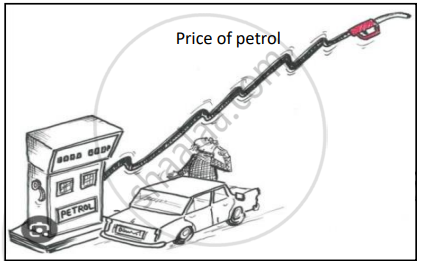
Naseer will not change his decision to buy a car.
He will postpone his plan to buy a car.
Naseer will become indecisive.
He will decide to purchase two cars instead of one.
Chapter:
Which one of the following statements is CORRECT with reference to government budget?
Interest paid on government’s borrowing reduces liability of the government.
Financial aid received from the World Bank for cyclone affected areas is revenue receipt.
Grants given by the central government to the state government is capital expenditure.
Profits of BHEL, a PSU, increase the assets of the government.
Chapter:
If the value of US Dollar increases continuously in terms of Yen, it will result in ______.
More import from USA by Japan.
More import from Japan by USA.
More export of USA to Japan.
Less export of Japan to USA.
Chapter:
Sometimes, a firm considers the action and reaction of its rival firms while determining its price and output levels.
Which market form does such firm belong to?
Perfect Competition
Monopoly
Monopolistic competition
Oligopoly
Chapter:
Assertion: A firm is able to sell more quantity of a commodity by reducing its price.
Reason: As it sells additional units of the commodity at a lower price, the firm’s marginal revenue will be less than its average revenue.
Both Assertion and Reason are true and Reason is the correct explanation of Assertion.
Both Assertion and Reason are true but Reason is not the correct explanation of Assertion.
Assertion is true and Reason is false.
Both Assertion and Reason are false.
Chapter:
Assertion: GST is a kind of Proportional tax.
Reason: The tax rate remains same irrespective of the level of income of the people.
Both Assertion and Reason are true, and Reason is the correct explanation of Assertion.
Both Assertion and Reason are true, but Reason is not the correct explanation of Assertion.
Assertion is true and Reason is false.
Both Assertion and Reason are false.
Chapter:
Oligopoly differs from monopolistic competition on the basis of number of sellers.
State any other difference between these two market forms.
Chapter:
APC can be greater than one, but MPC is always less than one. Give a reason to justify this phenomenon.
Chapter:
If aggregate demand exceeds aggregate supply in a situation of full employment, what will be its impact on the economy?
Chapter: [2] Theory of Income and Employment
If autonomous payments are higher than autonomous receipts, how can BOP be brought into balance?
Chapter:
Monopsony is regarded as a buyers’ market. Do you agree? Give a reason.
Chapter:
Illustrate that the investment multiplier is inversely proportional to MPS.
Chapter: [2] Theory of Income and Employment
Give one measure to overcome a deflationary gap.
Chapter:
Prices of air conditioners and refrigerators have shot up in the new year as consumer durables makers pass on the impact of rising raw material costs and higher freight charges to customers, while home appliances like washing machines may witness a 5–10 per cent price hike later this month or by March.
(Source: The Economic Times)
Explain the behaviour of supply of this consumer durable. Illustrate the same in a diagram.
Chapter: [3] Supply
If the price hike in the market is about 10% and this leads to the fall in the quantity demanded by 12%, calculate the price elasticity of demand. Mention the degree of price elasticity of demand.
Chapter:
Union Finance Minister Mrs. Nirmala Sitharaman announced during her Budget speech that the Centre would reduce its fiscal deficit to 5.1% of gross GDP in 2024 – 25. (The present fiscal deficit is 5.8% of GDP.)
(Source: Union budget 2024 – 25)
What would be the impact of this decision on government borrowing? Why?
Chapter:
Advertisements
It is believed that increase in public expenditure leads to Inflation. Under what circumstances may a government consider it prudent to increase public expenditure to control inflation?
Chapter:
Given that the fixed cost is Rs. 30. Calculate TVC and TC from the following data:
| Output (units) | 0 | 1 | 2 | 3 |
| Marginal Cost | 0 | 10 | 15 | 25 |
Chapter:
Give any two differences between returns to a factor and returns to scale.
Chapter:
Draw a well labelled diagram to show AFC curves. State the nature of a curve.
Chapter:
Study the data given below and identify the laws followed in the production of A and B depicted in the Table I and Table II. Justify your answer with a reason for each.
| Table I | Table II | ||||
| Machines | Labour | Output of A (units) | Machines | Labour | Output of B (units) |
| 5 | 10 | 1000 | 5 | 10 | 400 |
| 5 | 11 | 1150 | 10 | 20 | 800 |
| 5 | 12 | 1310 | 15 | 30 | 1200 |
Chapter: [5] Concepts of Production
Why does a firm under perfect competition earn only normal profits in the long run?
Chapter:
A car company ‘W’ hired an international cricket player for its endorsement in India, while two other car companies’ ‘Y’ and ‘R’ hired two famous Bollywood film stars for this purpose. Explain the features of the competitive market indicated above.
Chapter:
A firm under perfect competition is a price taker but the industry is the price maker. Defend or refute this statement by giving a reason.
Chapter:
Normal profits for a firm imply that the firm is breaking even. Explain.
Chapter: [5] Concepts of Production
India has been operating on a managed floating exchange rate regime since March 1993. Explain the statement.
Chapter:
List different components of Balance of Payment on current account and capital account.
Chapter:
With the help of a reason, explain why the following are included in calculation of National Income.
Goods supplied free of cost by the government.
Chapter:
With the help of a reason, explain why the following are included in calculation of National Income.
Own account production
Chapter:
Advertisements
Outline any two precautions that should be taken in estimation of National income by Expenditure method.
Chapter:
Differentiate between personal income and private income.
Chapter: [6] National Income
Why are net exports added in the total expenditure in measuring National income by Expenditure method?
Chapter:
With the help of a diagram, determine the equilibrium level of output and income by using Aggregate demand and aggregate supply approach.
Chapter: [2] Theory of Income and Employment
What are Average product?
Chapter: [5] Concepts of Production
What is marginal product?
Chapter: [5] Concepts of Production
With the help of a suitable diagram, discuss the relationship between Average product and Marginal Product.
Chapter: [5] Concepts of Production
Which stage of the Law of Variable proportions will be the best for the producer? Explain with a reason.
Chapter: [5] Concepts of Production
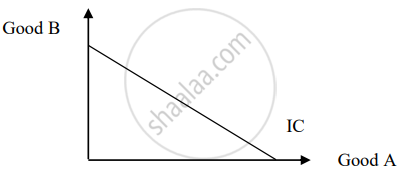
Will you defend or refute the case depicted in the following diagram? Provide a rationale in support of your view.
Chapter:
Name the law which deals with the behaviour of marginal utility when the consumer consumes a commodity continuously at a given time. Explain this law with the help of a diagram.
Chapter:
Discuss the categories of Factor income considered in calculating the National income by Income method.
Chapter:
Calculate GDPmp and NNPfc from the following data:
| Items | ₹ (in Crore) | |
| (i) | Wages & salaries | 170 |
| (ii) | Rent | 10 |
| (iii) | Interest | 20 |
| (iv) | Profits | 25 |
| (v) | Dividend | 12 |
| (vi) | Royalty | 5 |
| (vii) | Employer’s contribution to social security | 30 |
| (viii) | Net factor income from abroad | (-) 3 |
| (ix) | Consumption of fixed capital | 34 |
| (x) | Net indirect tax | 38 |
Chapter: [6] National Income
Explain the different components of Final Expenditure in calculating the National income by Expenditure method.
Chapter: [6] National Income
Calculate GNPmp using Income method and Expenditure method from the following data:
| Items | ₹ (in Crore) | |
| (i) | Private final consumption expenditure | 800 |
| (ii) | Net exports | 20 |
| (iii) | Rent | 40 |
| (iv) | Interest | 60 |
| (v) | Government final consumption expenditure | 200 |
| (vi) | Profit | 120 |
| (vii) | Net domestic capital formation | 100 |
| (viii) | Compensation of employees | 800 |
| (ix) | Net indirect taxes | 100 |
| (x) | Consumption of fixed capital | 20 |
| (xi) | Net factor income from abroad | (−) 30 |
Chapter:
Read the passage given below and answer the questions that follow.
|
In India, Fixed deposits have long been a favourite investment choice of people, especially senior citizens, as it promise steady returns. It attracts those who are seeking a stable income. But it’s an illusion in the period of inflation. Inflation is the rate at which the general level of prices for goods and services rises, subsequently eroding the purchasing power of money. In simple terms, what money could buy today might not a few years down the line. Fixed deposits are financial instruments offered by banks where you deposit a lump sum amount for a fixed period at a predetermined rate of interest. Consider an investment of Rs 1 crore in a fixed deposit at a 6% annual interest rate and the annual rate of inflation is 5%. By the 10th year your pre inflation return is 1.79 crore, but post inflation it’s just 1.10 crore. The nominal value of investment in fixed deposits may appear to grow, inflation significantly diminishes their real value and purchasing power over time.
|

- What is the theme of the extract? (2)
- Differentiate between Demand pull and Cost push inflation. (2)
- What are the demand deposits and time deposits? (2)
- Since 1998 RBI has been using new measures of money supply, M0, M1, M2 and M3. Which one of these measures incorporates fixed deposit as one of its components? Mention the other components of that measure. (2)
Chapter:
Other Solutions
Submit Question Paper
Help us maintain new question papers on Shaalaa.com, so we can continue to help studentsonly jpg, png and pdf files
CISCE previous year question papers Class 12 Economics with solutions 2024 - 2025
Previous year Question paper for CISCE Class 12 -2025 is solved by experts. Solved question papers gives you the chance to check yourself after your mock test.
By referring the question paper Solutions for Economics, you can scale your preparation level and work on your weak areas. It will also help the candidates in developing the time-management skills. Practice makes perfect, and there is no better way to practice than to attempt previous year question paper solutions of CISCE Class 12.
How CISCE Class 12 Question Paper solutions Help Students ?
• Question paper solutions for Economics will helps students to prepare for exam.
• Question paper with answer will boost students confidence in exam time and also give you an idea About the important questions and topics to be prepared for the board exam.
• For finding solution of question papers no need to refer so multiple sources like textbook or guides.
