English Medium
Academic Year: 2024-2025
Date & Time: 25th February 2025, 10:30 am
Duration: 3h
Advertisements
General Instructions:
Read the following instructions carefully and follow them:
- This question paper contains 37 questions. All questions are compulsory.
- Question paper is divided into six sections — Section A, B, C, D, E and F.
- Section A - Questions no. 1 to 20 are Multiple Choice type questions. Each question carries 1 mark.
- Section B - Questions no. 21 to 24 are Very Short Answer type questions. Each question carries 2 marks. Answer to these questions should not exceed 40 words.
- Section C - Questions no. 25 to 29 are Short Answer type questions. Each question carries 3 marks. Answer to these questions should not exceed 60 words.
- Section D - Questions no. 30 to 33 are Long Answer (LA) type questions. Each question carries 5 marks. Answer to these questions should not exceed 120 words.
- Section E - Questions no. 34 to 36 are Case/Source-based questions with three sub-questions. Each question carries 4 marks.
- Section F - Question no. 37 is Map skill-based question with two parts - 37(a) from History (2 marks) and 37(b) from Geography (3 marks). This question carries total 5 marks.
- In addition to this, NOTE that a separate question has been provided for Visually Impaired candidates in lieu of questions having visual inputs, maps, etc. Such questions are to be attempted by Visually Impaired candidates only.
Study the following table related to ‘World Human Development Index’ and answer the question that follow:
| S. No. | Country | HDI Rank in the world |
| 1. | India | 130 |
| 2. | Myanmar | 148 |
| 3. | Nepal | 149 |
| 4. | Pakistan | 150 |
Which one of the following countries has the lowest rank in ‘Human Development Index’?
India
Myanmar
Nepal
Pakistan
Chapter:
Choose the correctly matched pair from the following:
| Political Party | State |
| Janata Dal (Secular) | Bihar |
| Political Party | State |
| Maharashtrawadi Gomantak Party | Goa |
| Political Party | State |
| Dravida Munnetra Kazhagam | Andhra Pradesh |
| Political Party | State |
| All India Forward Bloc | Punjab |
Chapter:
Which of the following countries is an example of sharing of power between the national and state governments to account for internal diversity?
United States of America
Australia
Belgium
Switzerland
Chapter:
Which one of the following organisations has its headquarter in Brussels?
United Nations Organisation
European Union
Non-Alignment Movement
South Asian Association for Regional Co-operation
Chapter:
Match Column I with Column II and choose the correct option:
| Column I (Thermal Power Plant) |
Column II (State) |
||
| a. | Talcher | i. | Telangana |
| b. | Ramagundam | ii. | Odisha |
| c. | Bhusawal | iii. | Andhra Pradesh |
| d. | Vijayawada | iv. | Maharashtra |
a - ii, b - i, c - iv, d - iii
a - iii, b - iv, c - i, d - ii
a - iv, b - iii, c - ii, d - i
a - ii, b - i, c - iii, d - iv
Chapter:
Assertion (A): India has enormous possibilities of production of solar energy.
Reason (R): Most of the land area of India falls under the cold zone.
Both (A) and (R) are true and (R) is the correct explanation of (A).
Both (A) and (R) are true, but (R) is not the correct explanation of (A).
(A) is true, but (R) is false.
(A) is false, but (R) is true.
Chapter:
Swapna is a small farmer. Swapna wants to cultivate cotton. What kind of geographical conditions will be suitable for this? Choose the most appropriate option.
Laterite soil, Moderate rainfall, Low temperature and Bright sunshine
Black soil, Light rainfall, High temperature and Bright sunshine
Laterite soil, Light rainfall, High temperature and Moderate sunshine
Black soil, High rainfall, Low temperature and Moderate sunshine
Chapter:
Choose the correct option of the states that have been majorly benefited by the Sardar Sarovar Dam.
Rajasthan, Gujarat, Punjab and Haryana
Maharashtra, Madhya Pradesh, Gujarat and Rajasthan
Maharashtra, Madhya Pradesh, Telangana and Andhra Pradesh
Madhya Pradesh, Rajasthan, Karnataka and Chhattisgarh
Chapter:
Match Column I with Column II and choose the correct option:
| Column I (River) |
Column II (Dam) |
||
| a. | Chambal | i. | Salal |
| b. | Ganga | ii. | Bhakra Nangal |
| c. | Chenab | iii. | Gandhi Sagar |
| d. | Satluj | iv. | Tehri |
a - ii, b - iii, c - i, d - iv
a - ii, b - iii, c - iv, d - i
a - iii, b - iv, c - i, d - ii
a - iii, b - iv, c - ii, d - i
Chapter:
Which of the following characteristics of the Indian Wild Life (Protection) Act are correct? Choose the most appropriate option.
Characteristics:
- To make provisions for habitat for wild animals.
- To publish list of protected species.
- To ban hunting to save endangered species.
- To include important subjects like forests and wildlife in the Union List.
Only I, II and III are correct.
Only I, II and IV are correct.
Only II, III and IV are correct.
Only I, III and IV are correct.
Chapter:
Choose the correctly matched pair from the following:
| National Park/Tiger Reserve | State |
| Corbett National Park | Himachal Pradesh |
| National Park/Tiger Reserve | State |
| Bandhavgarh National Park | Rajasthan |
| National Park/Tiger Reserve | State |
| Periyar Tiger Reserve | Tamil Nadu |
| National Park/Tiger Reserve | State |
| Manas Tiger Reserve | Assam |
Chapter:
Read the following characteristics of ‘Jikji’ Korea carefully and choose the correct option:
Characteristics:
- It is one of the oldest existing printed books in the world.
- It contains the main beliefs of Christianity.
- Its second volume is available in the National Library of France.
- It was inscribed on the UNESCO Memory of the World Register in 2001.
Only I, II and III are correct.
Only II, III and IV are correct.
Only I, III and IV are correct.
Only I, II and IV are correct.
Chapter:
In the mid-16th century, diseases like smallpox reached America through which of the following?
Spanish soldiers
French merchants
Portuguese sailors
British tourists
Chapter:
Arrange the following events in chronological order and choose the correct option:
- Defeat of Napoleon in the battle of Leipzig
- Beginning of struggle for Greek independence
- Formation of customs union Zollverein
- Signing of Treaty of Vienna
I, II, III, IV
I, II, IV, III
II, I, III, IV
II, I, IV, III
Chapter:
‘Potato famine’ was related to which of the following countries?
England
Ireland
Finland
Scotland
Chapter:
Statement I: Information and communication technology stimulate the process of globalisation.
Statement II: It is used to contact each other, receive information instantly and communicate with remote areas.
Both statements I and II are correct and statement II is the correct explanation of statement I.
Both statements I and II are correct, but statement II is not the correct explanation of statement I.
Statement I is correct, but statement II is incorrect.
Statement I is incorrect, but statement II is correct.
Chapter:
Advertisements
Arrange the following sources of credit in the most to least order to meet the credit requirement of rural households in India and choose the correct option:
- Government
- Cooperative Banks and Societies
- Moneylenders
- Relatives and friends
III, II, I, IV
III, II, IV, I
I, III, II, IV
I, III, IV, II
Chapter:
Rakhi has done an economic survey of her area. The survey has revealed that people earn their livelihood by doing different jobs. The table prepared by Rakhi for this is given below. Study the table carefully and answer the question that follows:
| S. No. | Work | No. of People |
| 1. | Farmer working in his fields | 250 |
| 2. | Teachers teaching in school | 10 |
| 3. | Handloom weaver working in his/her house | 70 |
| 4. | Workers working in big factories | 140 |
| 5. | Employees working at a hospital in the area | 60 |
| Total | 530 |
How many people are working in the organised sector?
380
140
320
210
Chapter:
Look at the given picture and answer the question that follows:
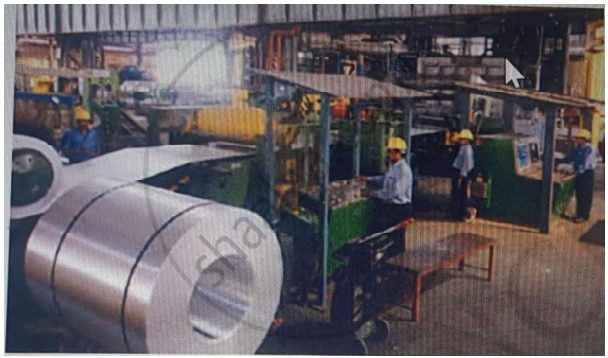
The work being done in the picture falls under which sector of the economy?
Primary
Quaternary
Tertiary
Secondary
Chapter:
The total value of all final goods and services produced within a country in a particular year is called ______.
Per Capita Income
Per Capita Production
Gross National Income
Gross Domestic Production
Chapter:
How did reinterpretation of history become a means of creating a sense of nationalism by the end of the 19th century in India? Explain.
Chapter:
How did symbols and icons contribute to create a feeling of nationalism among the people in the national movement of India? Explain.
Chapter:
Suggest any three measures to solve the problem of land degradation in India and explain them.
Chapter:
“The Constitution of India prohibits discrimination on grounds of religion.” Justify the statement by giving two arguments.
Chapter:
“Globalisation is the process of rapid integration or interconnection between countries.” Explain the statement with examples.
Chapter:
Analyse the role of peasant communities in the Civil Disobedience Movement.
Chapter:
Read the story of Rinjha and answer the question that follows:
|
Story of Rinjha Rinjha lived with her family in a small village at the outskirts of Diphu in Assam. She enjoys watching her family members clearing, slashing and burning a patch of land for cultivation. She often helps them in irrigating the fields with water running through a bamboo canal from the nearby spring. She loves the surroundings and wants to stay here as long as she can, but this little girl has no idea about the declining fertility of the soil and her family’s search for a fresh patch of land in the next season. |
Suggest any three measures to Rinjha so that the fertility of the soil of her fields remains intact for a long time.
Chapter:
Why is power sharing essential for the success of democracy? Explain.
Chapter:
Explain the main functions of political parties.
Chapter: [3.4] Political Parties
Examine any five major challenges faced by the political parties in India.
Chapter: [3.4] Political Parties
Analyse the changes taking place in the sectors of the Indian economy in context of ‘Gross Domestic Product’.
Chapter:
How did the decade of the 1830s bring great difficulties to Europe? Explain.
Chapter:
Advertisements
How did Romanticism contribute to the development of nationalism in Europe in the early 19th century? Explain.
Chapter:
Suggest any three measures to overcome the air pollution.
Chapter:
Suggest any three measures to reduce thermal pollution.
Chapter:
How is democracy better than other types of government? Analyse.
Chapter:
Analyse the role of democracy in reducing inequality and poverty.
Chapter:
How is income an important factor in assessing the development of a country?
Chapter:
Mention the classification done by the World Bank.
Chapter:
How has the overuse of underground water created a serious crisis in many parts of India?
Chapter:
Explain with examples in the context of sustainable development.
Chapter:
Read the given source and answer the questions that follow:
|
Decentralisation in India The need for decentralisation was recognised in our Constitution. Since then, there have been several attempts to decentralise power to the level of villages and towns. Panchayats in villages and municipalities in urban areas were set up in all the States. But these were directly under the control of state governments. Elections to these local governments were not held regularly. Local governments did not have any powers or resources of their own. Thus, there was very little decentralisation in effective terms. A major step towards decentralisation was taken in 1992. The Constitution was amended to make the third-tier of democracy more powerful and effective. |
- At how many levels has decentralisation of power been done in the Indian Constitution? 1
- Explain the role of local self-government in solving problems. 1
- “Local government is the best way to realise one important principle of democracy, namely local self-government.” Explain the statement. 2
Chapter:
Read the given source and answer the questions that follow:
|
Arun’s Story Arun supervises the work of one farm labourer. Arun has seven acres of land. He is one of the few persons in Sonpur to receive bank loan for cultivation. The interest rate on the loan is 8.5 per cent per annum, and can be repaid anytime in the next three years. Arun plans to repay the loan after harvest by selling a part of the crop. He then intends to store the rest of the potatoes in a cold storage and apply for a fresh loan from the bank against the cold storage receipt. The bank offers this facility to farmers who have taken crop loan from them. |
- Under which source does Arun’s loan come? 1
- Mention one important term of credit for taking a loan from the bank. 1
- How is Arun’s loan beneficial? Explain any two reasons. 2
Chapter:
Read the given source and answer the questions that follow:
|
Print Culture and the French Revolution Many historians have argued that print culture created the conditions within which French Revolution occurred. Some arguments have been usually put forward in this context. First: print popularised the ideas of the Enlightenment thinkers. Collectively, their writings provided a critical commentary on tradition, superstition and despotism. They argued for the rule of reason rather than custom, and demanded that everything be judged through the application of reason and rationality. They attacked the sacred authority of the Church and the despotic power of the state, thus eroding the legitimacy of a social order based on tradition. The writings of Voltaire and Rousseau were read widely; and those who read these books saw the world through new eyes, eyes that were questioning, critical and rational. Second: print created a new culture of dialogue and debate. All values, norms and institutions were re-evaluated and discussed by a public that had become aware of the power of reason, and recognised the need to question existing ideas and beliefs. Within this public culture, new ideas of social revolution came into being. |
- What impact did the ideas of Enlightenment thinkers have on society? 1
- How did print culture affect religion in France? 1
- How did print culture contribute to the social revolution in France? 2
Chapter:
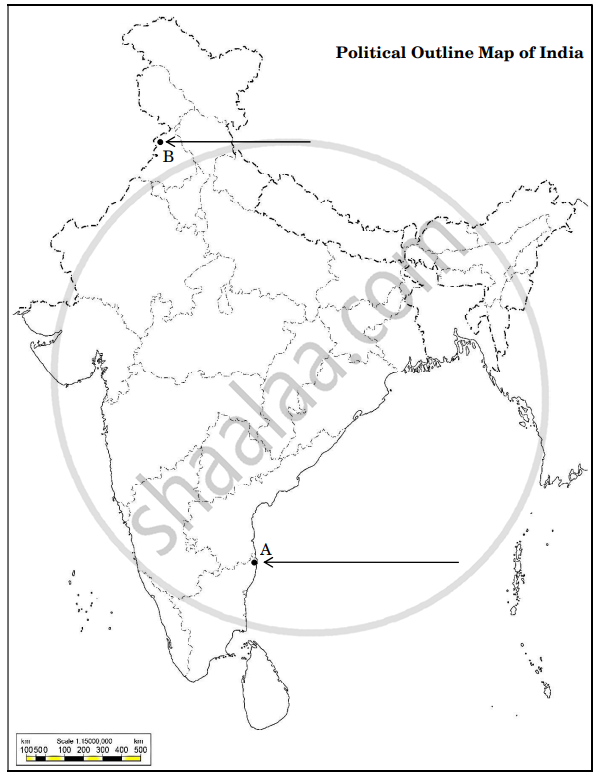
Two places A and B have been marked on the given political outline map of India. Identify them with the help of the following information and write their correct names on the lines drawn near them:
- The place where the session of Indian National Congress was held in December 1927.
- The place where Jallianwala Bagh incident took place.
Chapter:
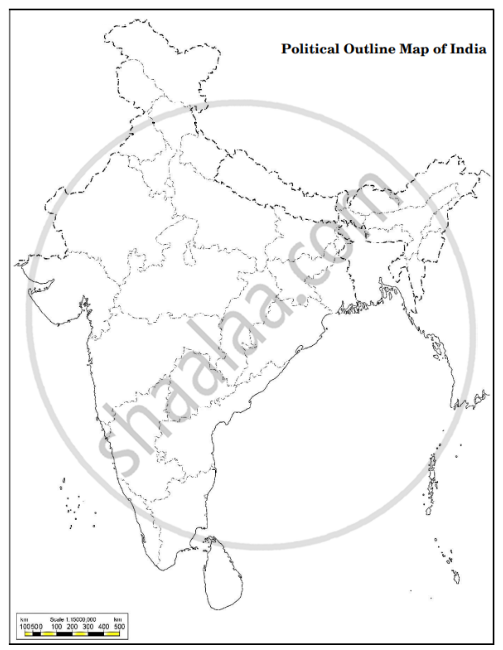
On the political outline map of India, locate and label any three of the following with suitable symbols:
- Eastern terminal station of the East-West Corridor
- Leading state in coffee production
- Nuclear power plant located in Uttar Pradesh
- Major sea port located in Odisha
Chapter:
Other Solutions
Submit Question Paper
Help us maintain new question papers on Shaalaa.com, so we can continue to help studentsonly jpg, png and pdf files
CBSE previous year question papers Class 10 Social Science with solutions 2024 - 2025
Previous year Question paper for CBSE Class 10 Social Science-2025 is solved by experts. Solved question papers gives you the chance to check yourself after your mock test.
By referring the question paper Solutions for Social Science, you can scale your preparation level and work on your weak areas. It will also help the candidates in developing the time-management skills. Practice makes perfect, and there is no better way to practice than to attempt previous year question paper solutions of CBSE Class 10.
How CBSE Class 10 Question Paper solutions Help Students ?
• Question paper solutions for Social Science will helps students to prepare for exam.
• Question paper with answer will boost students confidence in exam time and also give you an idea About the important questions and topics to be prepared for the board exam.
• For finding solution of question papers no need to refer so multiple sources like textbook or guides.
