Science (English Medium)
Academic Year: 2025-2026
Date & Time: 20th February 2026, 10:30 am
Duration: 3h
Advertisements
General Instructions:
Read the following instructions very carefully and strictly follow them:
- This question paper contains 33 questions. All questions are compulsory.
- This question paper is divided into five sections - Sections A, B, C, D and E.
- In Section A: Questions no. 1 to 16 are Multiple Choice type questions. Each question carries 1 mark.
- In Section B: Questions no. 17 to 21 are Very Short Answer type questions. Each question carries 2 marks.
- In Section C: Questions no. 22 to 28 are Short Answer type questions. Each question carries 3 marks.
- In Section D: Questions no. 29 and 30 are case study-based questions. Each question carries 4 marks.
- In Section E: Question numbers 31 to 33 are Long Answer type questions. Each question carries 5 marks.
- There is no overall choice given in the question paper. However, an internal choice has been provided in few questions in all the Sections except Section A.
- Kindly note that there is a separate question paper for Visually Impaired candidates.
- Use of calculator is not allowed.
You may use the following values of physical constants wherever necessary:
c = 3 × 10⁸ m/s
h = 6.63 × 10⁻³⁴ Js
e = 1.6 × 10⁻¹⁹ C
μ0 = 4π × 10−7 T m A−1
ε0 = 8.854 × 10⁻¹² C2 N−1 m−2
`1/(4 pi epsilon_0)` = 9 × 10⁹ N m2 C−2
Mass of electron (me) = 9.1 × 10⁻³¹ kg.
Mass of neutron = 1.675 × 10⁻²⁷ kg.
Mass of proton = 1.673 × 10⁻²⁷ kg.
Avogadro’s number = 6.023 × 10²³ per gram mole
Boltzmann’s constant = 1.38 × 10⁻²³ JK−1
In a region electric field is given by `vec E = 4 x hat i` N/C. The potential difference between points A(x = 1 m) and B(x = 3 m), (VA − VB) is ______.
−16 V
16 V
−8 V
8 V
Chapter:
In an unbiased p-n junction, at equilibrium, which of the following statements is true?
Diffusion current is zero but drift current exists.
Diffusion current exists but drift current is zero.
Diffusion and drift currents are equal and opposite.
Both the diffusion and drift currents exist but are unequal.
Chapter:
A copper wire is stretched to increase its length by 1%. Then the change in its resistance is close to ______.
1%
4%
−4%
2%
Chapter:
Four independent waves are expressed as:
- y1 = A1 sin ωt
- y2 = A2 sin 2ωt
- y3 = A3 cos ωt
- y4 = `A_4 sin(ωt + π/3)`
The interference between two of these waves is possible in:
(i) and (iii) only
(iii) and (iv) only
(i), (iii) and (iv) only
All of them
Chapter:
A concave lens of focal length 40 cm is coaxially in contact with two convex lenses, each of focal length 20 cm, on each side. The focal length of the combination is ______.
zero
`20/3` cm
`-20/3` cm
`40/3` cm
Chapter:
The distance of closest approach for an alpha particle is ‘d’ when it moves head-on with speed v towards a target nucleus. If the alpha particle is replaced by a proton moving with the same speed, the new distance of closest approach will be ______.
2d
d
`d/2`
`d/sqrt2`
Chapter:
Electromagnetic waves used for purification of water are ______.
X-rays
Ultraviolet rays
Infrared rays
Ultrasonic rays
Chapter:
A conducting wire connects two charged metallic spheres A and B of radii r1 and r2 respectively. The distance between the spheres is very large compared to their radii. The ratio of electric fields `(E_A/E_B)` at the surfaces of spheres A and B will be ______.
`r_1/r_2`
`r_2/r_1`
`r_1^2/r_2^2`
`r_2^2/r_1^2`
Chapter:
A straight conductor lies along x-axis. It carries a current of 10 A along +x direction. The magnetic field `vec B` due to 1 cm segment of this conductor. centred at the origin, at a point (0, 1 m, 0) is ______.
`(1 nT) hat j`
`(10 nT) hat k`
`-(10 nT) hat k`
`-(1 nT) hat j`
Chapter:
The angular width of interference fringes in Young’s double-slit experiment depends on ______.
distance between the slits and the screen only.
wavelength of light used only.
both wavelength of light used and the slits separation.
slits separation only.
Chapter:
An electromagnetic wave passes from vacuum into a dielectric medium with relative electrical permittivity `(3/2)` and relative magnetic permeability `(8/3)`. Then, its ______.
wavelength is doubled and frequency remains unchanged.
wavelength is doubled and frequency is halved.
wavelength is halved and frequency remains unchanged.
wavelength and frequency both will remain unchanged.
Chapter:
A resistor and an inductor of negligible resistance are connected in series to a 20 V ac source. If the voltage across the resistor is 12 V, the voltage across the inductor will be ______.
6 V
8 V
10 V
16 V
Chapter:
Assertion (A): In Bohr model of hydrogen atom, the energy levels are discrete and quantised.
Reason (R): In a hydrogen atom, the electrostatic force on the electron provides the necessary centripetal force to it to revolve around the nucleus.
Both Assertion (A) and Reason (R) are true and Reason (R) is the correct explanation of the Assertion (А).
Both Assertion (A) and Reason (R) are true, but Reason (R) is not the correct explanation of the Assertion (А).
Assertion (A) is true, but Reason (R) is false.
Both Assertion (A) and Reason (R) are false.
Chapter:
Assertion (A): The mass of a nucleus is less than the sum of the masses of the constituent nucleons.
Reason (R): Energy is absorbed when the nucleons are bound together to form a nucleus.
Both Assertion (A) and Reason (R) are true and Reason (R) is the correct explanation of the Assertion (А).
Both Assertion (A) and Reason (R) are true, but Reason (R) is not the correct explanation of the Assertion (А).
Assertion (A) is true, but Reason (R) is false.
Both Assertion (A) and Reason (R) are false.
Chapter:
Assertion (A): All atoms have a net magnetic moment.
Reason (R): A current loop does not always behave as a magnetic dipole.
Both Assertion (A) and Reason (R) are true and Reason (R) is the correct explanation of the Assertion (А).
Both Assertion (A) and Reason (R) are true, but Reason (R) is not the correct explanation of the Assertion (А).
Assertion (A) is true, but Reason (R) is false.
Both Assertion (A) and Reason (R) are false.
Chapter:
Assertion (A): If accelerated electrons are passed through a narrow slit, a diffraction pattern is observed.
Reason (R): Electrons behave as both particles and waves.
Both Assertion (A) and Reason (R) are true and Reason (R) is the correct explanation of the Assertion (А).
Both Assertion (A) and Reason (R) are true, but Reason (R) is not the correct explanation of the Assertion (А).
Assertion (A) is true, but Reason (R) is false.
Both Assertion (A) and Reason (R) are false.
Chapter:
Advertisements
A beam of light consisting of two wavelengths 400 nm and 600 nm is used to illuminate a single slit of width 1 mm. Find the least distance of the point from the central maximum where the dark fringes due to both wavelengths coincide on the screen placed 1.5 m from the slit.
Chapter:
In a Young’s double-slit experimental set-up with slit separation 0.6 mm a beam of light consisting of two wavelengths 440 nm and 660 nın is used to obtain interference pattern on a screen kept 1.5 m in front of the slits. Find the least distance of the point from the central maximum where the bright fringes due to both the wavelengths coincide.
Chapter:
Find the ratio `(lambda_a/lambda_p)` of the de Broglie wavelength λa associated with an alpha particle to de Broglie wavelength λp associated with a proton if both are moving with
- same velocity
- same kinetic energy.
Chapter:
What is the order of magnitude of drift velocity of electrons in a conductor?
Chapter:
Deduce the relation between the current flowing through a conductor and drift velocity of electrons in it.
Chapter:
A wire of length L is bent round into
- a square coil having N turns and
- a circular coil having N turns.
The coil in both cases is free to turn about a vertical axis coinciding with the plane of the coil, in a uniform, horizontal magnetic field and carry the same currents. Find the ratio of the maximum value of the torque acting on the square coil to that on the circular coil.
Chapter:
Draw a graph showing the variation of binding energy per nucleon as a function of mass number A. The binding energy per nucleon for heavy nuclei (A > 170) decreases with increase in mass number. Explain its significance.
Chapter:
Figure shows a narrow beam of electrons entering with a velocity of 3 × 10⁷ m/s, symmetrically through the space between two parallel horizontal plates P1 `P_1^'` and P2 `P_2^'` kept 2 cm apart.
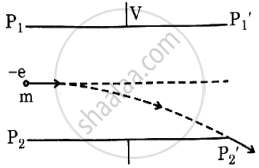
If each plate is 3 cm long, calculate the potential difference V applied between the plates so that the beam just strikes the end `P_2^'`.
Chapter:
State two conditions necessary for total internal reflection to occur.
Chapter: [9] Ray Optics and Optical Instruments
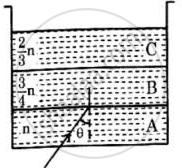
A transparent container contains layers of three immiscible transparent liquids A, B and C of refractive indices n, `3/4` n and `2/3` n, respectively. A laser beam is incident at the interface between A and B at an angle θ as shown in figure. Prove that the beam does not enter region C at all for sin θ ≥ `2/3`.
Chapter:
Using Gauss’s law, deduce an experession for electric field at a point due to a uniformly charged infinite plane thin sheet.
Chapter:
Two large thin plane sheets, each having surface charge density σ, are held close and parallel to each other in air. What is the net electric field at a point
- inside and
- outside, the sheets?
Chapter:
Obtain the condition for bridge balance in Wheatstone’s bridge.
Chapter: [3] Current Electricity [4] Moving Charges and Magnetism
Find net resistance of the network of resistors connected between A and B, as shown in figure.
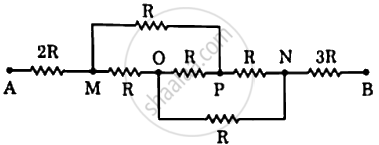
Chapter:
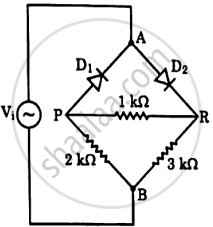
An ac voltage Vi = 12 sin(100 πt)V is applied between points A and B in a network of two ideal diodes and three resistors as shown in figure. During the positive half-cycle of the input voltage Vi supplied to the network.
- Identify which of the two diodes will conduct and why?
- Redraw an equivalent circuit diagram to show the flow of current.
- Calculate the output voltage drops V0 across the three resistors when the input voltage attains its peak value.
Chapter:
A 12.0 µF сapacitor is charged to a potential difference of 150 V. The terminals of the charged capacitor are then connected to those of an uncharged 6.0 µF capacitor. Calculate final potential difference across and charge on, each capacitor.
Chapter:
Advertisements
A semiconductor has equal electron and hole concentration of 3 × 10⁸ m−3. On doping with a certain impurity, the hole concentration increases to 6 × 10¹⁰ m−3.
- What type of semiconductor is obtained on doping?
- Calculate the new electron concentration of the semiconductor.
- How does the energy gap of semiconductor change with doping? Draw the energy band diagram for it.
Chapter:
Draw a labelled ray diagram showing the formation of image by a compound microscope when final image is formed at least distance of distinct vision. Derive an expression for its magnifying power for this case.
Chapter:
|
A researcher performs an experiment on photo-electric effect using two metals A and B with unknown work functions. She illuminates the surfaces of A and B with monochromatic radiation of various frequencies and records the value of corrosponding stopping potentials (Vs). The graph shows the variation of stopping potential (Vs) with the frequency of incident radiation (v) for metals A and B.
|
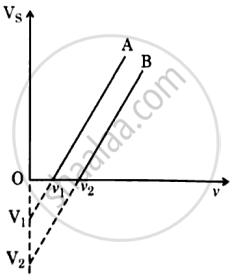
Answer the following questions:
(I) From the graph, the work functions of A and B are (h is Planck’s constant and e is charge of electron):
- v1 and v2
- V1 and V2
- hv1 and hv2
- `(h v_1)/e` and `(h v_2)/e`
(II) For radiation of frequency v > v2 incident on the surfaces of A and B, the maximum kinetic energy of ejected electron is ______.
- greater for metal A because it has a smaller work function.
- greater for metal B because it has a larger work function.
- greater for metal B because it has higher threshold frequency.
- the same for both metal A and metal B because it is independent of work functions of metals.
(III) If the intensity of the incident radiation for both metals A and B, is doubled keeping its frequency constant, then ______.
- the slope of the parallel lines will increase.
- the slope of the parallel lines will decrease.
- the threshold frequencies for both A and B will decrease.
- the slope of the parallel lines will not change but more electrons will be emitted per second.
(IV) The threshold frequency for a metal surface is ν0. If radiation of frequency 3ν0 illuminates the surface, the maximum kinetic energy (KE) of photoelectrons is E1. If frequency were increased to 6ν0, the maximum KE of photoelectrons becomes E2. Then `(E_1/E_2)` equals ______.
- `1/3`
- `1/2`
- `2/5`
- `3/4`
OR
Let m be the slope of the graph line for metal B. If e is the value of electron charge, then Planck’s constant ‘h’ is given by ______.
- m e
- `1/(m e)`
- `m/e`
- `e/m`
Chapter:
| A galvanometer is used to detect or/and measure small currents in an electrical circuit. It essentially works on the fact that a current-carrying coil experiences a deflecting torque when placed in a magnetic field. This deflection in the coil can be measured and it is related to the current flowing in the coil, the number of turns in the coil, area of the coil and the magnetic field. A hair spring attached to the coil provides a counter torque and helps in measuring the deflection. A galvanometer can be converted to an ammeter or a voltmeter of desired range by using suitable resistances. |
(I) The torque on the coil remains constant irrespective of the coil’s orientation during rotation due to ______.
- use of soft iron core which increases the magnetic field.
- radial magnetic field.
- hair spring which provides the counter torque.
- eddy current in the iron core which causes damping.
(II) The best way to increase current sensitivity of a galvanometer is by ______.
- increasing number of turns of the coil.
- increasing area of coil and magnitic field strength.
- decreasing area of coil and magnetic field strength.
- increasing torsional constant of the hair spring.
(III) A moving coil galvanometer has a coil with area of cross-section 4.0 × 10⁻³ m2 and number of turns 50. The coil is rotating in a magnetic field of 0.25 T. The torque acting on the coil when a current of 5 A passes through it is ______.
- 1.0 N m
- 2.0 N m
- 0.50 N m
- 0.25 N m
OR
A galvanometer coil has a resistance of 15 Ω and the meter shows full scale deflection for a current of 3 mA. The value of resistance required to convert it into a voltmeter of range (0-12 V) is ______.
- 4015 Ω
- 3985 Ω
- 415 Ω
- 385 Ω
(IV) A galvanometer with coil of resistance 20 Ω shows full scale deflection for a current of 5 mA. To convert it into an ammeter of range (0-10 A), a resistance of ______.
- 0.05 Ω should be connected in series with it.
- 0.05 Ω should be connected in parallel with it.
- 0.01 Ω should be connected in parallel with it.
- 0.01 Ω should be connected in series with it.
Chapter:
State Faraday’s laws of electromagnetic induction.
Chapter: [6] Electromagnetic Induction
Derive an expression for the self-inductance of an air-filled long solenoid of length l and cross-sectional area A having N turns.
Chapter:
A conducting rod of length 50 cm, with one end pivoted, is rotated with angular speed of 60 rpm in a uniform magnetic field of 4.0 mT directed perpendicular to the plane of rotation of rod. Find the emf induced in the rod.
Chapter:
Draw a labelled diagram to show the various components of a step-up transformer.
Chapter:
State the principle on which a step-up transformer works.
Chapter:
Obtain the ratio of secondary voltage to primary voltage in terms of number of turns in the two coils.
Chapter:
The ratio of the number of turns in the primary to the secondary of an ideal transformer is 1 : 5. If 5 kW power at 200 V is supplied to the primary, find
- current in the primary, and
- output voltage.
Chapter:
An electric dipole consists of two point charges q and −q separated by a distance 2a. Derive an expression for the electric field `vec E` due to this dipole at a point distant r from the centre of the dipole on the equatorial plane. Write the expression for the electric field at a far off point, i.e. r >> a.
Chapter:
A dipole is placed in x-y plane such that charges q and −q are located at x = a and x = b respectively. There exists an electric field `vec E = 2 hat i N/C` in the region. Calculate the force `vec F` and torque `vec tau` experienced by the dipole.
Chapter:
- Two cells of emf E1 and E2 with internal resistances r1 and r2 respectively, are connected in parallel by connecting their positive terminals together and negative terminals together. Deduce an expression for equivalent emf and equivalent internal resistance of the combination.
- A parallel combination, as stated in (a) above, of two cells of emfs Е and 3E and internal resistances R each is connected across a resistance 2R. Find the current that flows through resistance 2R.
Chapter:
Using the relation for refraction at a curved spherical surface, derive the expression for lens maker’s formula.
Chapter:
Three lenses L1, L2 and L3, each of focal length 40 cm, are placed coaxially. The distance between L1 and L2 and between L2 and L3 are 120 cm and 20 cm respectively. An object is kept at a distance of 80 cm to the left of lens L1.
Find the distance of the final image formed from the object.
Chapter:
Draw a ray diagram to show the image formation by a concave mirror when the object is kept between its focus and the centre of curvature. Using this diagram, derive the mirror formula.
Chapter:
A concave mirror produces a two times magnified virtual image of an object kept 10 cm in front of it. Calculate the focal length of the mirror.
Chapter:
Other Solutions
Submit Question Paper
Help us maintain new question papers on Shaalaa.com, so we can continue to help studentsonly jpg, png and pdf files
CBSE previous year question papers Class 12 Physics with solutions 2025 - 2026
Previous year Question paper for CBSE Class 12 Physics-2026 is solved by experts. Solved question papers gives you the chance to check yourself after your mock test.
By referring the question paper Solutions for Physics, you can scale your preparation level and work on your weak areas. It will also help the candidates in developing the time-management skills. Practice makes perfect, and there is no better way to practice than to attempt previous year question paper solutions of CBSE Class 12.
How CBSE Class 12 Question Paper solutions Help Students ?
• Question paper solutions for Physics will helps students to prepare for exam.
• Question paper with answer will boost students confidence in exam time and also give you an idea About the important questions and topics to be prepared for the board exam.
• For finding solution of question papers no need to refer so multiple sources like textbook or guides.
