Advertisements
Advertisements
प्रश्न
|
A researcher performs an experiment on photo-electric effect using two metals A and B with unknown work functions. She illuminates the surfaces of A and B with monochromatic radiation of various frequencies and records the value of corrosponding stopping potentials (Vs). The graph shows the variation of stopping potential (Vs) with the frequency of incident radiation (v) for metals A and B.
|
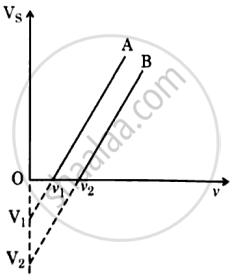
Answer the following questions:
(I) From the graph, the work functions of A and B are (h is Planck’s constant and e is charge of electron):
- v1 and v2
- V1 and V2
- hv1 and hv2
- `(h v_1)/e` and `(h v_2)/e`
(II) For radiation of frequency v > v2 incident on the surfaces of A and B, the maximum kinetic energy of ejected electron is ______.
- greater for metal A because it has a smaller work function.
- greater for metal B because it has a larger work function.
- greater for metal B because it has higher threshold frequency.
- the same for both metal A and metal B because it is independent of work functions of metals.
(III) If the intensity of the incident radiation for both metals A and B, is doubled keeping its frequency constant, then ______.
- the slope of the parallel lines will increase.
- the slope of the parallel lines will decrease.
- the threshold frequencies for both A and B will decrease.
- the slope of the parallel lines will not change but more electrons will be emitted per second.
(IV) The threshold frequency for a metal surface is ν0. If radiation of frequency 3ν0 illuminates the surface, the maximum kinetic energy (KE) of photoelectrons is E1. If frequency were increased to 6ν0, the maximum KE of photoelectrons becomes E2. Then `(E_1/E_2)` equals ______.
- `1/3`
- `1/2`
- `2/5`
- `3/4`
OR
Let m be the slope of the graph line for metal B. If e is the value of electron charge, then Planck’s constant ‘h’ is given by ______.
- m e
- `1/(m e)`
- `m/e`
- `e/m`
Advertisements
उत्तर
(I) hv1 and hv2
Explanation:
Threshold frequency ν0 is where stopping potential becomes zero.
Work function (Φ) = hv0
Hence, metals A and B have work functions hν1 and hν2.
(II) For radiation of frequency v > v2 incident on the surfaces of A and B, the maximum kinetic energy of ejected electron is greater for metal A because it has a smaller work function.
Explanation:
Photoelectric equation is given as:
Kmax = hν − Φ
For the same frequency samaller work function gives larger kinetic energy.
From the graph, metal A has a smaller threshold frequency and a smaller work function.
(III) If the intensity of the incident radiation for both metals A and B, is doubled keeping its frequency constant, then the slope of the parallel lines will not change but more electrons will be emitted per second.
Explanation:
Slope of the stopping potential vs frequency graph:
Slope = `h/e`
It depends only on fundamental constants, not intensity. The intensity affects the number of emitted electrons (photoelectrons). Hence, the slope remains unchanged, and the emission rate increases.
(IV) The threshold frequency for a metal surface is ν0. If radiation of frequency 3ν0 illuminates the surface, the maximum kinetic energy (KE) of photoelectrons is E1. If frequency were increased to 6ν0, the maximum KE of photoelectrons becomes E2. Then `(E_1/E_2)` equals `bbunderline(2/5)`.
Explanation:
The photoelectric equation is given as:
Kmax = hν − hν0
For the frequency 3v0:
E1 = h(3ν0 − ν0) = 2hν0
For frequency 6ν0:
E2 = h(6ν0 − ν0) = 5hν0
`E_1/E_2 = (2 h v_0)/(5 h v_0)`
= `2/5`
OR
Let m be the slope of the graph line for metal B. If e is the value of electron charge, then Planck’s constant ‘h’ is given by m e.
Explanation:
From the stopping potential vs frequency graph:
Vs = `h/e v - Phi/e`
Slope (m) = `h/e`
h = m e
