Advertisements
Advertisements
प्रश्न
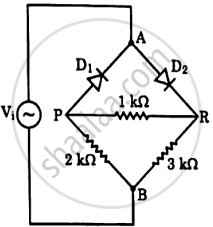
An ac voltage Vi = 12 sin(100 πt)V is applied between points A and B in a network of two ideal diodes and three resistors as shown in figure. During the positive half-cycle of the input voltage Vi supplied to the network.
- Identify which of the two diodes will conduct and why?
- Redraw an equivalent circuit diagram to show the flow of current.
- Calculate the output voltage drops V0 across the three resistors when the input voltage attains its peak value.
आकृति
लघु उत्तरीय
Advertisements
उत्तर
a. During positive half-cycle:
A is positive w.r.t. B.
Diode D1 is reverse-biased.
Diode D2 becomes forward-biased.
D2 conducts because it is forward-biased.
b.
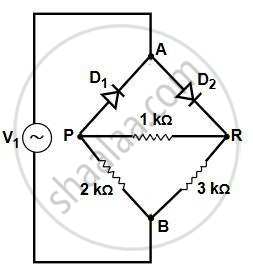
c. Peak input voltage:
Req = `3/2` kΩ
I = `12/(3//2)`
= `(12 xx 2)/3`
= `24/3`
= 8 mA
R(1Ω) = 1 × 4 mA
= 4 V
R(2kΩ) = 2 kΩ × 4 mA
= 8 V
V(3kΩ) = 4 mA × 3 kΩ
= 12 V
shaalaa.com
क्या इस प्रश्न या उत्तर में कोई त्रुटि है?
