Commerce (English Medium)
Arts (English Medium)
Academic Year: 2019-2020
Date & Time: 13th March 2020, 10:30 am
Duration: 3h
Advertisements
General Instructions:
- The question paper comprises two Sections - A and B. All questions are compulsory.
- Question numbers 1 - 10 and 18 - 27 are very short-answer questions carrying 1 mark each. They are required to be answered in one word or one sentence each.
- Question numbers 11 - 12 and 28 - 29 are short-answer questions carrying 3 marks each. Answers to them should not normally exceed 60 - 80 words each.
- Question numbers 13 - 15 and 30 - 32 are also short-answer questions carrying 4 marks each. Answers to them should not normally exceed 80 - 100 words each.
- Question numbers 16 - 17 and 33 - 34 are long-answer questions carrying 6 marks each. Answers to them should not normally exceed 100 - 150 words each.
- Answer should be brief and to the point, also the above word limit should be adhered to as far as possible.
- There is no overall choice. However, an internal choice has been provided in 2 questions of one mark, 2 questions of three marks, 2 questions of four marks, and 2 questions of six marks. Only one of the choices in such questions has to be attempted.
- In addition to this, separate instructions are given with each section and question, wherever necessary.
______ deficit includes interest payment by the Government on the past loans.
Chapter:
To reduce credit availability in the economy, the Central Bank may ______.
Buy securities in the open market.
Sell securities in the open market.
Reduce reserve ratio.
Reduce repo rate.
Chapter:
State whether the following statement is true or false:
‘Purchase of machinery by a producer is an intermediate good.’
Chapter:
In case of an under-employment equilibrium, which of the following alternatives is not true?
Aggregate Demand is equal to Aggregate Supply.
There exists excess production capacity in the economy.
Resources are not fully and efficiently utilised.
Resources are fully and efficiently utilised.
Chapter:
Which of the following is not a ‘factor payment’?
Free uniform to defence personnel
Salaries to the Members of Parliament
Rent paid to the owner of a building
Scholarship given to the students
Chapter: [2] Current Challenges Facing Indian Economy
Combined factor income, which can’t be separated into various factor income components is known as ______.
Chapter:
State whether the following statement is true or false:
‘All financial Institutions are banking institutions.’
Chapter:
Net Domestic Fixed Capital Formation + Change in Stock = ______.
Chapter:
When Nominal Gross Domestic Product (GDP) is ₹ 840 crores and price Index is 120, then the Real Gross Domestic Product (GDP) will be ______.
₹ 700 crores
₹ 900 crores
₹ 800 crores
₹ 500 crores
Chapter:
If Marginal Propensity to Save (MPS) is 0.25 and the initial change in investment is ₹ 250 crores, then the final change in income would be ______.
₹ 1000 crores
₹ 1200 crores
₹ 500 crores
₹ 3500 crores
Chapter: [2] Theory of Consumer Behaviour
Which of the following statement is incorrect?
Gross Domestic Product (GDP) at Market price = GDP at factor cost plus Net Indirect taxes.
Net National Product (NNP) at Market price = NNP at factor cost.
Gross National Product (GNP) at Market price = GDP at Market price plus Net Factor Income From Abroad.
Net National Product (NNP) at Factor cost = National Income.
Chapter:
If the Real Gross Domestic Product (GDP) in an economy is ₹ 520 crores and the Nominal Gross Domestic Product (GDP) is ₹ 650 crores, calculate the price Index.
Chapter:
‘Subsidies to the producers should be treated as transfer payments.’ Defend or refute the given statement with a valid reason.
Chapter:
Explain Circular Flow of Income in a two sector economy.
Chapter:
Calculate Net Value Added at factor cost from the following data:
| S. No. | Particulars | Amount (₹ in lakhs) |
| (i) | Durable producers goods (with a life span of 10 years) | 10 |
| (ii) | Single-use producer goods | 5 |
| (iii) | Sales | 20 |
| (iv) | Unsold Goods (Stock) | 2 |
| (v) | Goods & Services Tax (GST) | 1 |
Chapter:
Calculate Net Value Added at factor cost from the following data:
| S. No. | Particulars | Amount (₹ in lakhs) |
| (i) | Durable producers goods (with a life span of 10 years) | 10 |
| (ii) | Single-use producer goods | 5 |
| (iii) | Sales | 20 |
| (iv) | Unsold Goods (Stock) | 2 |
| (v) | Goods & Services Tax (GST) | 1 |
Chapter:
Advertisements
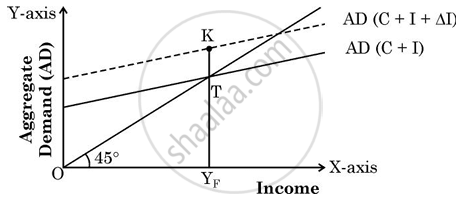
In the given figure, what does the gap ‘KT’ represent? State any two fiscal measures to correct the situation.
Chapter:
Explain how the ‘Reverse Repo Rate’ helps in correcting Excess Demand in an economy?
Chapter:
‘Taxation is an effective tool to reduce the inequalities of income.’ Justify the given statement with valid reasons.
Chapter:
Explain the ‘bank of note issue’ function of the Central Bank.
Chapter:
Answer the following questions based on the data given below:
|
- Determine the equilibrium level of income. (2)
- Calculate the value of Savings at the equilibrium level of National Income. (2)
- Calculate the value of the Investment Multiplier. (2)
Chapter:
Discuss the working of the adjustment mechanism in the following situations:
Aggregate demand is greater than the aggregate supply.
Chapter:
Discuss the working of the adjustment mechanism in the following situation:
Ex Ante Investments are lesser than Ex Ante Savings.
Chapter:
‘Recently, the Indian Rupee (₹) has depreciated significantly. This has led to distress for Indian importers.’ Defend or refute the given statement with valid reasons.
Chapter:
Distinguish between ‘trade deficit’ and ‘current account deficit’.
Chapter:
Which of the following countries initiated its process of Economic Reforms in the year 1991?
Pakistan
India
Russia
China
Chapter:
Greater proportion of women workers are found in ______ areas as a component of Indian work force.
Urban
Rural
Chapter:
State whether the following statement is true or false:
“GATT was established in 1923 with 48 member countries.”
Chapter:
‘GLF’ with respect to the People’s Republic of China referred to as ______.
Giant Leap Forward
Great Lead Forum
Great Leap Forward
Giant Lead Forum
Chapter: [3] Development Experience of India – a Comparison with Neighbours
Policy of ‘Import Substitution’ was targeted to protect ______ industries.
Chapter:
Advertisements
Which of the following is not used as a strategy for Sustainable Development?
Use of bio-gas
Use of solar power
Use of thermal power
Use of hydel power
Chapter:
Maternal mortality rate is high in ______.
China
Pakistan
Chapter: [3] Development Experience of India – a Comparison with Neighbours
State whether the following statement is true or false:
“As per the Human Development Report, 2018, India was ranked at 180th position.”
Chapter:
If a construction site Manager hires two workers on daily wages basis, such a situation is covered under ______ sector.
Formal
Informal
Chapter:
Discuss briefly the concept of ‘Informalisation of workforce’ in India.
Chapter:
What are the challenges facing rural development?
Chapter:
Compare and analyse the given data of India & China, with valid reasons.
| Country | Annual Growth Rate of Population (2015) | Gender Ratio (Per thousand males) |
| India | 1.2% | 929 |
| China | 0.5% | 941 |
Source: World Development Indicators, 2015.
Chapter:
Highlight the salient features of India’s pre independence occupational structure.
Chapter: [1] Development Experience (1947-90) and Economic Reforms since 1991
Explain ‘growth with equity’ as a planning objective.
Chapter:
“Modernisation as a planning objective shows a dichotomy with employment generation.” Justify the statement.
Chapter:
What was the two-fold motive behind the systematic deindustrialisation effected by the British in pre-independent India?
Chapter: [1] Development Experience (1947-90) and Economic Reforms since 1991
What problems are being faced by the power sector in India?
Chapter:
Critically examine the results of Poverty Alleviation Programmes implemented in India since Independence.
Chapter:
“Ujjawala Yojana has been a game changer for rural India.” State any three conventional fuels being targeted under the Ujjawala Yojana.
Chapter:
“Economists believe that India should spend atleast 6% of its GDP on Education for achieving desired results.” Justify the statement with a valid reason.
Chapter:
Discuss the need for ‘On-the-job training’ for an employee.
Chapter:
Other Solutions
Submit Question Paper
Help us maintain new question papers on Shaalaa.com, so we can continue to help studentsonly jpg, png and pdf files
CBSE previous year question papers Class 12 Economics with solutions 2019 - 2020
Previous year Question paper for CBSE Class 12 Economics-2020 is solved by experts. Solved question papers gives you the chance to check yourself after your mock test.
By referring the question paper Solutions for Economics, you can scale your preparation level and work on your weak areas. It will also help the candidates in developing the time-management skills. Practice makes perfect, and there is no better way to practice than to attempt previous year question paper solutions of CBSE Class 12.
How CBSE Class 12 Question Paper solutions Help Students ?
• Question paper solutions for Economics will helps students to prepare for exam.
• Question paper with answer will boost students confidence in exam time and also give you an idea About the important questions and topics to be prepared for the board exam.
• For finding solution of question papers no need to refer so multiple sources like textbook or guides.
