Advertisements
Advertisements
प्रश्न
Which of the following is true with respect to AUG?
विकल्प
It codes for methionine only
It is an initiation codon
It codes for methionine in both prokaryotes and eukaryotes
All of the above
Advertisements
उत्तर
All of the above
Explanation:
The codon AUG is unique because it serves as the universal initiation codon, signalling the ribosome to begin the process of translation. Beyond its role as a “start” command, it is the only codon that codes for the amino acid methionine, ensuring that this specific building block is the first one incorporated into most protein chains. This function is highly conserved across the tree of life, as AUG codes for methionine in both prokaryotes and eukaryotes, though prokaryotes use a slightly modified version called fMet for the starting position.
APPEARS IN
संबंधित प्रश्न
List two essential roles of ribosomes during translation.
The process of translation is ______.
The translation termination triplet is ______.
During translation, activated amino acids get linked to tRNA. This process is commonly called as ______.
Which of the following life processes is evolved around RNA?
UTRs are the untranslated regions present on ______.
Which of the following statements is correct regarding ribosomes?
Regulation of gene expression occurs at the level of ______.
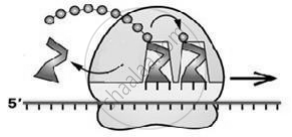
Which cellular process is shown below?
Aminoacylation of tRNA also known as ______.
(a) Identify the polarity of x to x’ in the diagram below and mention how many more amino acids are expected to be added to this polypeptide chain.

(b) Mention the codon and anticodon for alanine.
(c) Why are some untranslated sequences of bases seen in mRNA coding for a polypeptide? Where exactly are they present on mRNA?
Where are the untranslated regions located on mRNA and why?
How many different proteins does the ribosome consist of?
What is a triplet codon?
Which molecule acts as the template for translation?
Which of the following is the start codon in translation?
What are the three stop codons that signal the termination of translation?
Which enzyme is responsible for activating amino acids and attaching them to the correct tRNA?
During the elongation stage of translation, what ensures that the correct amino acid is placed in the sequence?
Which ribosomal site receives the incoming aminoacyl-tRNA during translation?
During elongation, what bonds are formed between adjacent amino acids?
Which site on the ribosome holds the peptidyl-tRNA during translation?
