Advertisements
Advertisements
प्रश्न
List two essential roles of ribosomes during translation.
State the function of ribosomes as a catalyst in bacteria during the process of translation.
Advertisements
उत्तर
- They provide a surface for binding of mRNA in the groove of the smaller subunit of ribosomes.
- As a larger subunit of the ribosome has peptide transferase on its ‘P’ site, it helps in joining amino acids by forming peptide bonds.
APPEARS IN
संबंधित प्रश्न
Ribosomes are composed of two subunits; the smaller subunit of a ribosome has a binding site for _________ and the larger subunit has two binding sites for two __________.
An operon is a ______.
The process of translation is ______.
The three codons which result in the termination of polypeptide chain synthesis are ______.
During translation, activated amino acids get linked to tRNA. This process is commonly called as ______.
In an mRNA molecule, untranslated regions (UTRs) are present at ______.
Which of the following statements is correct regarding ribosomes?
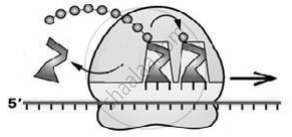
Which cellular process is shown below?
The first phase of translation is ______
(a) Identify the polarity of x to x’ in the diagram below and mention how many more amino acids are expected to be added to this polypeptide chain.

(b) Mention the codon and anticodon for alanine.
(c) Why are some untranslated sequences of bases seen in mRNA coding for a polypeptide? Where exactly are they present on mRNA?
Explain the process of aminoacylation of tRNA and its role in the process of translation.
How does initiation of the translation process occur in prokaryotes? Explain.
Where are the untranslated regions located on mRNA and why?
Anticodon loop of tRNA has ______.
How many different proteins does the ribosome consist of?
What is a triplet codon?
What are the three stop codons that signal the termination of translation?
Which enzyme is responsible for activating amino acids and attaching them to the correct tRNA?
Which ribosomal site receives the incoming aminoacyl-tRNA during translation?
During elongation, what bonds are formed between adjacent amino acids?
