Advertisements
Advertisements
प्रश्न
What is meant by the “Effective Demand Principle” in the Keynesian theory of employment? Discuss using a schedule or a diagram.
The logical starting point of Keynesian theory of employment is the principle of effective demand. Comment.
‘The starting point of Keynesian’ Theory is the Principle of Effective Demand.’ Discuss.
Advertisements
उत्तर
Effective Demand Principle refers to a situation in which the equilibrium output is determined solely by the level of aggregate demand. If there exists any inequality between AD and AS, then equilibrium output is influenced only by AD, and AS has to be adjusted in such a way that it equals AD.
According to the AD-AS approach, the equilibrium level of income is determined at that point where Aggregate Demand (AD) is equal to Aggregate Supply (AS). It should be noted that here AD refers to the planned/desired level of expenditure in the economy during an accounting year. Similarly, it refers to the planned/desired level of output in an economy during an accounting year.
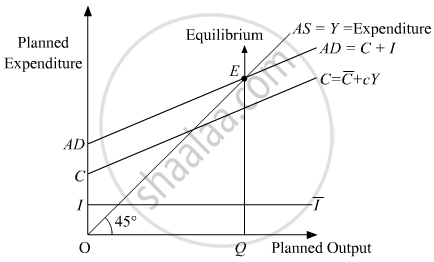
In the diagram, the consumption curve is depicted by C and the investment curve is depicted by the horizontal straight line parallel to the output/income axis. Summing up the investment curve and consumption curve, we get the Aggregate Demand curve represented by AD = C + I. The Aggregate Supply curve is represented by the 45° line. Throughout this line, the planned expenditure is equal to the planned output. That is AS = Y = Expenditure. The implication of 45° line is that in case of any disequilibrium, AS will be adjusted in a way to equate AD in order to restore equilibrium back. That is in other words, in case of any inequality between AD and AS, equilibrium output will be determined by AD. The point E is the equilibrium point, where the planned level of expenditure (AD) is equal to the planned level of output (AS). In other words, this suggests that there is no undesired inventory accumulation. The equilibrium level of output is OQ, which is also known as the ‘effective demand’.
संबंधित प्रश्न
Given consumption curve, derive saving curve and state the steps taken in the process of derivation. Use Diagram.
What is meant by aggregate demand?
State components of aggregate demand.
Derive the two alternative conditions of expressing national income equilibrium. Show these equilibrium conditions on a single diagram.
Explain the concept of deflationary gap.
explain the role of Bank Rate in correcting deficient demand?
Explain the role of 'Margin Requirements' in removing this deficient demand gap.
Explain the role of 'Open Market Operations' in reducing Deflationary Gap
Fill in the blank with appropriate alternatives given below
That part of income, which is not spent on consumption, is called __________.
Match the following Group:
| Group A | Group B | ||
| 1) | Aggregate Supply | a) | Expected receipts |
| 2) | Autonomous Investment | b) | Lord J. M. Keynes |
| 3) | Consumption | c) | Government Investment |
| 4) | A.P.C. | d) | ΔC/ΔY |
| 5) | Investment | e) | C/Y |
| f) | Addition to stock of capital | ||
| g) | Destruction of utility | ||
Answer in detail.
Explain the determinants of aggregate demand.
Discuss the adjustment mechanism in the following situation :
Aggregate demand is lesser than Aggregate Supply.
The main component of aggregate demand is ______
In a closed economy, aggregate demand is the sum of ______.
Keynes theory is associated with ______
Aggregate supply is equal to ______.
If TR is 1,00,000₹ when ₹20,000 units are sold, then AR is equal to:
When aggregate demand is greater than aggregate supply, inventories:
“In an economy Planned spending is more than Planned output”.
Explain its impact on the level of output, income and employment.
If aggregate demand exceeds aggregate supply in a situation of full employment, what will be its impact on the economy?
