Advertisements
Advertisements
प्रश्न
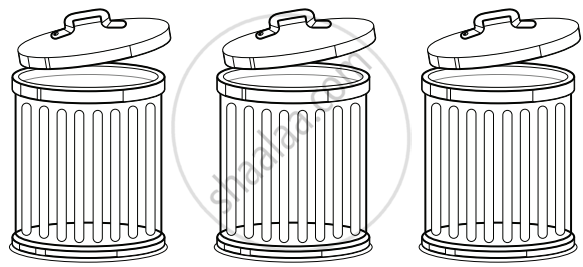
Read the passage three times and colour a dustbin each time.
|
I am Mani. I had to take a bus to nearby city. I crossed the road to reach the bus stand. I got the bus, sat down, and read a book. Before I started to read, I just looked at the people around me. The two men sitting next to me were talking loudly. Some were listening to music on their phone. I was unable to focus on reading. The men were talking about cleaning the city. As they were talking, they opened a pack of biscuits to eat. After some time I dozed off. When I opened my eyes, the bus had reached the city. The two men were not there but pieces of the biscuits and wrappers were there. I cleaned the wrappers and put them in the dustbin.
|
- What did Mani take out?
- What did Mani find on the seat when he woke up?
- If you were Mani, what would you do?
Advertisements
उत्तर

- Mani took out a book to read.
- When Mani woke up, he found pieces of the biscuits and wrappers on the seat.
- If I were Mani, I would have asked my fellow passengers to talk softly in public and to keep clean the surroundings.
APPEARS IN
संबंधित प्रश्न
Read the following passage and do the given activities :
B1 Select :
Complete the following sentences by selecting the correct alternatives:
(i) It is more important to have _______ before rushing to work. (lunch, breakfast, dinner)
(ii) Skipping breakfast brings a higher risk of _______ (cancer, heart attack, brain attack)
(iii) An adequate _______ is provided by your meal. (energy, weight, height)
(iv) More than half of the people risk heart attack due to _______ eating. (early morning, afternoon, late night)
MEN WHO SKIP BREAKFAST FACE
27% HIGHER RISK OF HEART ATTACK
Late-Night Eaters at 55% risk. TNN.
London-Breakfast is widely acknowledged as the most important meal of the day. But now, there’s more reason to have that piece of toast before rushing to work: Skipping breakfast has for the first time been associated with an increase in heart attacks.
A study published in the American Heart Association journal circulation showed that men who skipped breakfast had a 27% higher risk of heart attack or death from coronary heart disease than those who didn’t.
“Skipping breakfast may lead to one or more risk factors, including obesity, high blood pressure, high cholesterol, and diabetes, which may, in turn, lead to a heart attack over time,” said Leah E. Cahill, lead author from the Harvard School of Public Health.
“Our study group has spent decades studying the health effects of diet quality and composition, and now this new data also suggests overall dietary habits can be important to lower risk of coronary heart disease,” said co-author Eric Rimm.
“Don’t skip breakfast,” Cahill said. “Eating breakfast is associated with a decreased risk of heart attacks. Incorporating many types of healthy foods into your breakfast is an essay way to ensure your meal provides adequate energy and a healthy balance of nutrients.
B2 Find:
Find the pieces of ‘advice’ from the passage and write.
B3 Antonyms :
Find out the antonyms for the following words from the passage and write:
(i) higher (ii) decrease
(iii) excluding (iv) low
B4 Reported Speech :
Complete the reported speech of the following sentences given indirect form:
(i) “Our study group has spent decades studying the health effects of diet quality and composition,” said co-author Eric Rimm.
Co-author Eric Rimm _________
(ii) “Dont’s skip breakfast,” Cahill said.
Cahill _______
B5 Personal Response :
How will you practice the message implied in the passage in your life?
Give a brief account of the interaction between Grandpa and Jo.
The poem is a Petrarchan Sonnet. The poem is divided into two parts -
- An Octave
The first part comprising eight lines. - A sestet
The second part comprising six lines.
Read the first four lines of the poem. The rhyme scheme is a b b a. Read the rhyme scheme for the next four lines. It is a b b a. Now read the first three lines of the sestet and note the rhyme scheme. It is c d c. The rhyme scheme of the last three lines is d c d. This is the common design of a Petrarchan Sonnet.
This is a Petrarchan Sonnet. Complete the given table by giving examples from the poem.
| Features | Examples / Lines |
| Objects used | |
| Praise/blames | |
| Metaphor | |
| Simile | |
| Personification | |
| Number of lines | |
| Rhyme scheme |
Discuss the following in group.
Do people admit that they have bad habits?
Karmugilan went to __________ for higher studies.
The old man helped ______ and ______.
What was the age of Robinson Crusoe when he left for sea?
Why did Uthaman become angry with the old man?
Why did Nasruddin take someone else’s name each time he missed the target?
How can we identify insecure websites?
