Advertisements
Advertisements
प्रश्न
Two discs of moments of inertia I1 and I2 about their respective axes (normal to the disc and passing through the centre), and rotating with angular speed ω2 and ω2 are brought into contact face to face with their axes of rotation coincident.
- Does the law of conservation of angular momentum apply to the situation? why?
- Find the angular speed of the two-disc system.
- Calculate the loss in kinetic energy of the system in the process.
- Account for this loss.
Advertisements
उत्तर
a. As there is no net external torque on the system, the law of conservation of angular momentum may be applied.
Gravitational forces and their normal reactions are external forces, but their net torque is zero, therefore they have no impact.
b. By applying the Law of conversation of angular momentum,
`L_j = L_i`
⇒ `I_ω = I_1ω_1 + I_2ω_2`
I = moment of inertia
ω = angular speed
∴ ω = `(I_1ω_1 + ω_2ω_2)/I` ∴ I = I1 + I2
∴ ω = `(I_1ω_1 + ω_2ω_2)/I`
c. As `KE_f = KE_R + KE_T`
Translational Energy = 0
∴ KET = 0
∴ `KE_f = KE_R = 1/2 Iω^2 = 1/2 (I_1 + I_2) [(I_1ω_1 + I_2ω_2)/(I_1 + I_2)]^2`
`KE_f = 1/2 (I_1ω_1 + I_2ω_2)^2/((I_1 + I_2))`
`KE_i = KE_(1R) + KE_(2R) + KE_(1T) + KE_(2T)`
Because there is no translational motion which in turn results,
KE1T = 0
KE2T = 0
∴ `KE_i = 1/2 I_1ω_1^2 + 1/2 I_2ω_2^2 = 1/2 (I_1ω_1^2 + I_2ω_2^2)`
∴ `ΔKE = KE_f - KE_i = 1/2 (I_1ω_1 + I_2ω_2)^2/((I_1 + I_2)) - 1/2 (I_1ω_1^2 + I_2ω_2^2)`
= `1/2 [(I_1^2ω_1^2 + I_2^2ω_2^2 + 2I_1I_2ω_1ω_2 - [(I_1 + I_2)(I_1ω_1^2 + I_2w_2^2)]]/(I_1 + I_2)]`
= `[([I_1^2ω_1^2 + I_2^2ω_2^2 + 2I_1I_2ω_1ω_2] - [I_1^2ω_1^2 + I_2^2ω_2^2 + I_1I_2ω_1^2 + I_2^2ω_2^2])/(2(I_1 + I_2))]`
= `(-I_1I_2)/(2(I_1 + I_2)) (-2ω_1ω_2 + ω_2^2 + ω_1^2)`
ΔKE = `(-I_1I_2)/(2(I_1 + I_2)) (ω_1 - ω_2)^2 < 0`
d. `K_f < K_i` since energy is wasted due to friction between discs' moving surfaces.
APPEARS IN
संबंधित प्रश्न
A heavy particle of mass m falls freely near the earth's surface. What is the torque acting on this particle about a point 50 cm east to the line of motion? Does this torque produce any angular acceleration in the particle?
If several forces act on a particle, the total torque on the particle may be obtained by first finding the resultant force and then taking torque of this resultant. Prove this. Is this result valid for the forces acting on different particles of a body in such a way that their lines of action intersect at a common point?
A rectangular brick is kept on a table with a part of its length projecting out. It remains at rest if the length projected is slightly less than half the total length but it falls down if the length projected is slightly more than half the total length. Give reason.
A ladder is resting with one end on a vertical wall and the other end on a horizontal floor. If it more likely to slip when a man stands near the bottom or near the top?
Equal torques act on the disc A and B of the previous problem, initially both being at rest. At a later instant, the linear speeds of a point on the rim of A and another point on the rim of B are \[\nu_A\] and \[\nu_B\] respectively. We have
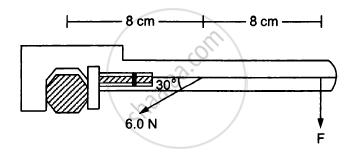
When a force of 6⋅0 N is exerted at 30° to a wrench at a distance of 8 cm from the nut it is just able to loosen the nut. What force F would be sufficient to loosen it if it acts perpendicularly to the wrench at 16 cm from the nut?
A flywheel of moment of inertia 5⋅0 kg-m2 is rotated at a speed of 60 rad/s. Because of the friction at the axle it comes to rest in 5⋅0 minutes. Find (a) the average torque of the friction (b) the total work done by the friction and (c) the angular momentum of the wheel 1 minute before it stops rotating.
A 6⋅5 m long ladder rests against a vertical wall reaching a height of 6⋅0 m. A 60 kg man stands half way up the ladder.
- Find the torque of the force exerted by the man on the ladder about the upper end of the ladder.
- Assuming the weight of the ladder to be negligible as compared to the man and assuming the wall to be smooth, find the force exerted by the ground on the ladder.
A rope is wound around a hollow cylinder of mass 3 kg and radius 40 cm. What is the angular acceleration of the cylinder if the rope is pulled with a force of 30 N?
What are the conditions in which force can not produce torque?
A Merry-go-round, made of a ring-like platform of radius R and mass M, is revolving with angular speed ω. A person of mass M is standing on it. At one instant, the person jumps off the round, radially away from the centre of the round (as seen from the round). The speed of the round afterwards is ______.
Choose the correct alternatives:
- For a general rotational motion, angular momentum L and angular velocity ω need not be parallel.
- For a rotational motion about a fixed axis, angular momentum L and angular velocity ω are always parallel.
- For a general translational motion , momentum p and velocity v are always parallel.
- For a general translational motion, acceleration a and velocity v are always parallel.
The net external torque on a system of particles about an axis is zero. Which of the following are compatible with it?
- The forces may be acting radially from a point on the axis.
- The forces may be acting on the axis of rotation.
- The forces may be acting parallel to the axis of rotation.
- The torque caused by some forces may be equal and opposite to that caused by other forces.
A uniform cube of mass m and side a is placed on a frictionless horizontal surface. A vertical force F is applied to the edge as shown in figure. Match the following (most appropriate choice):
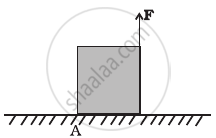
| (a) mg/4 < F < mg/2 | (i) Cube will move up. |
| (b) F > mg/2 | (ii) Cube will not exhibit motion. |
| (c) F > mg | (iii) Cube will begin to rotate and slip at A. |
| (d) F = mg/4 | (iv) Normal reaction effectively at a/3 from A, no motion. |
A uniform sphere of mass m and radius R is placed on a rough horizontal surface (Figure). The sphere is struck horizontally at a height h from the floor. Match the following:
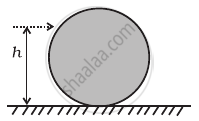
| Column I | Column II | |
| (a) h = R/2 | (i) | Sphere rolls without slipping with a constant velocity and no loss of energy. |
| (b) h = R | (ii) | Sphere spins clockwise, loses energy by friction. |
| (c) h = 3R/2 | (iii) | Sphere spins anti-clockwise, loses energy by friction. |
| (d) h = 7R/5 | (iv) | Sphere has only a translational motion, looses energy by friction. |
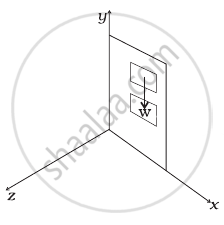
A door is hinged at one end and is free to rotate about a vertical axis (Figure). Does its weight cause any torque about this axis? Give reason for your answer.
A spherical shell of 1 kg mass and radius R is rolling with angular speed ω on horizontal plane (as shown in figure). The magnitude of angular momentum of the shell about the origin O is `a/3 R^2` ω. The value of a will be:

A rod of mass 'm' hinged at one end is free to rotate in a horizontal plane. A small bullet of mass m/4 travelling with speed 'u' hits the rod and attaches to it at its centre. Find the angular speed of rotation of rod just after the bullet hits the rod 3. [take length of the rod as 'l']
A solid sphere is rotating in free space. If the radius of the sphere is increased while keeping the mass the same, which one of the following will not be affected?
