Advertisements
Advertisements
प्रश्न
Two blocks each having a mass of 3⋅2 kg are connected by a wire CD and the system is suspended from the ceiling by another wire AB (See following figure). The linear mass density of the wire AB is 10 g m−1 and that of CD is 8 g m−1. Find the speed of a transverse wave pulse produced in AB and CD.
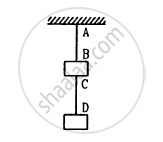
Advertisements
उत्तर
Given,
\[m_1 = m_2 = 3 . 2 kg\]
Linear mass density of wire AB = 10 gm−1 = 0.01 kgm−1
Linear mass density of wire CD = 8 gm−1 = 0.008 kgm−1
For string CD, velocity is defined as
\[v = \sqrt{\left( \frac{T}{m} \right)}\]
Here, T is the tension and m is the mass per unit length.
For string CD,
\[T = 3 . 2 \times g\]
Thus, we have:
\[v = \sqrt{\frac{\left( 3 . 2 \times 10 \right)}{0 . 008}}\]
\[= \sqrt{\frac{\left( 32 \times {10}^3 \right)}{8}}\]
\[= 2 \times 10\sqrt{10}\]
\[= 20 \times 3 . 14 \approx 63 \text{ s }\]
For string AB,
\[T = 2 \times 3 . 2g = 64 N\]
Thus, we have:
\[v = \sqrt{\left( \frac{T}{m} \right)}\]
\[= \sqrt{\left( \frac{64}{0 . 01} \right)} = \sqrt{6400}\]
\[= 80 \text{ m/s }\]
APPEARS IN
संबंधित प्रश्न
When a transverse wave on a string is reflected from the free end, the phase change produced is ..............
(a) zero rad
(b) ` pi/2 ` rad
(c) `(3pi)/4` rad
(d) `pi` rad
Explain the reflection of transverse and longitudinal waves from a denser medium and a rared medium.
A transverse wave travels along the Z-axis. The particles of the medium must move
A wave moving in a gas
Mark out the correct options.
A particle on a stretched string supporting a travelling wave, takes 5⋅0 ms to move from its mean position to the extreme position. The distance between two consecutive particles, which are at their mean positions, is 2⋅0 cm. Find the frequency, the wavelength and the wave speed.
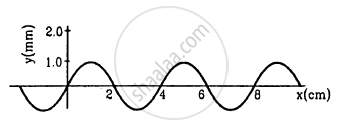
Figure shows a plot of the transverse displacements of the particles of a string at t = 0 through which a travelling wave is passing in the positive x-direction. The wave speed is 20 cm s−1. Find (a) the amplitude, (b) the wavelength, (c) the wave number and (d) the frequency of the wave.
An organ pipe, open at both ends, contains
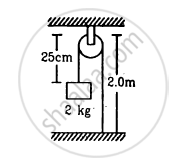
In the arrangement shown in figure , the string has a mass of 4⋅5 g. How much time will it take for a transverse disturbance produced at the floor to reach the pulley? Take g = 10 m s−2.
A heavy but uniform rope of length L is suspended from a ceiling. (a) Write the velocity of a transverse wave travelling on the string as a function of the distance from the lower end. (b) If the rope is given a sudden sideways jerk at the bottom, how long will it take for the pulse to reach the ceiling? (c) A particle is dropped from the ceiling at the instant the bottom end is given the jerk. Where will the particle meet the pulse?
If the speed of a transverse wave on a stretched string of length 1 m is 60 m−1, what is the fundamental frequency of vibration?
A 660 Hz tuning fork sets up vibration in a string clamped at both ends. The wave speed for a transverse wave on this string is 220 m s−1 and the string vibrates in three loops. (a) Find the length of the string. (b) If the maximum amplitude of a particle is 0⋅5 cm, write a suitable equation describing the motion.
Three resonant frequencies of a string are 90, 150 and 210 Hz. (a) Find the highest possible fundamental frequency of vibration of this string. (b) Which harmonics of the fundamental are the given frequencies? (c) Which overtones are these frequencies? (d) If the length of the string is 80 cm, what would be the speed of a transverse wave on this string?
The phenomenon of beats can take place
Given below are some functions of x and t to represent the displacement (transverse or longitudinal) of an elastic wave. State which of these represent (i) a traveling wave, (ii) a stationary wave or (iii) none at all:
`"y" = 2sqrt(x - "vt")`
Given below are some functions of x and t to represent the displacement (transverse or longitudinal) of an elastic wave. State which of these represent (i) a traveling wave, (ii) a stationary wave or (iii) none at all:
y = 3 sin (5x – 0.5t) + 4 cos (5x – 0.5t)
