Advertisements
Advertisements
प्रश्न
Try to trace the various components of human evolution (hint: brain size and function, skeletal structure, dietary preference, etc.).
Advertisements
उत्तर
Human evolution was a slow and continuous process that brought physical, mental, and cultural changes over millions of years. The main components are:
- Brain Size and Function:
- Early ancestors like Australopithecus had a brain size of about 400-500 cc.
- In Homo habilis, it increased to 650-800 cc, showing improved intelligence and tool use.
- Homo erectus had a brain volume of 900-1100 cc, and modern Homo sapiens possesses about 1400-1600 cc, enabling reasoning, speech, and creativity.
- Skeletal Structure and Posture:
- Dryopithecus was ape-like, without browridges, had a semierect posture, and a prognathous face (having a projecting jaw).
- Ramapithecus had jaws and teeth like humans (small canines and large molars), a prognathous face and walked on legs.
- Australopithecus africanus had an erect posture, human-like teeth, lacked a chin, had brow ridges, and had a prognathous face.
- Homo habilis walked nearly erect, had human-like teeth, and had a slightly prognathous face.
- Homo erectus had an erect posture, a prognathous face with projecting brow ridges, small canines, large molars, and a small chin.
- Homo sapiens sapiens had four curves in the vertebral column, an orthognathous face (without a projecting jaw), a broad forehead, a well-developed chin, and walked on the soles of their feet.
- Dietary Preference:
- Early humans were fruit-eaters (herbivores).
- Gradually, they became omnivorous, eating roots, fruits, and meat.
- The use of fire and cooking improved digestion and brain growth.
APPEARS IN
संबंधित प्रश्न
What is an organic evolution?
State whether the following statement is true or false :
Human beings have evolved from chimpanzees.
Which of the following is the first example of class Homo sapiens?
Define ‘reproductive isolation’ and explain two types of reproductive isolation.
The range of cranial capacities in the following ancestral forms were
Cro-magnon ______.
How would you justify that Australopithecus was a human ancestor?
Given alongside are two figures (A and B) representing the two stages of evolution of human beings.
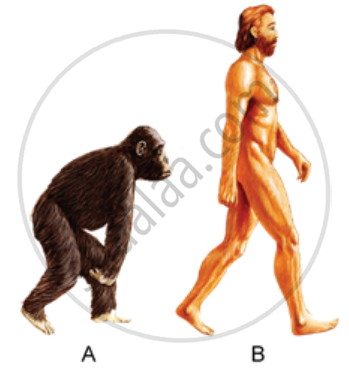
Answer the following:
- Mention any two contrasting characters between the two stages.
- Write all the stages of human evolution in their correct sequence.
- State any two characteristic features of stage B.
Write a note on Cro-magnon man.
Name the scientists who have contributed to the following:
Classified active and passive absorption of water by roots.
Answer the following question.
Write two differences between Homo erectus and Homo habilis.
What led to better utilization of hands for holding objects effectively and better motor skills?
Complete the table based on the special features of Human ancestors showing their cultural and social development.
| Ancestors | Special features |
| Homo erectus | |
| Buried their dead | |
| Made tools from stones |
Homo erectus probably existed during ____________.
Identify the character which is most relatable to Neanderthal man?
Match column - I with column - II and select the correct option.
| Column - I | Column - II | ||
| (a) | Propliopithecus | (i) | Miocene |
| (b) | Homoerectus pekinensis | (ii) | Early Pleistocene |
| (c) | Dryopithecus | (iii) | Middle Pleistocene |
| (d) | Australopithecus | (iv) | Oligocene |
The largest cranial capacity was found in ______.
In question 44, what are the combinations of character in the F2 progeny? What are their ratios?
Name the following:
Connecting link between ape and man
What was the significance of the development of an opposable thumb in human evolution?
How are the evolutionary stages of human development traced by paleontologists?
