Advertisements
Advertisements
प्रश्न
Distinguish between Homo erectus and Neanderthal man
Advertisements
उत्तर
| No. | Homo erectus | Neanderthal man |
| 1. | They are described as Apeman. | They are described as an advanced prehistoric man. |
| 2. | Homo erectus fossils found in Java are called Java man, whereas the fossils of the prehistoric man discovered in a cave near Peking, China are called Peking man. | Fossils of this advanced prehistoric man were collected by J.K. Fuhlrott (1856) from Neanderthal Valley, Germany. |
| 3. | It lived in the middle Pleistocene epoch about 1.5 million years ago. | They existed in the late Pleistocene epoch about 100000 to 400000 years ago. |
| 4. | It was about five feet in height and walked erect. | These were short and had heavily built. |
| 5. | Its face was prognathous and the jaws were massive with huge teeth. Chin was absent. Bony eyebrow ridge was present. | They had short prominent brow ridges, the skull bones were thick, the forehead was low and slanting, the jaw was deeper than that of a modern man with no chin. They had outwardly curved thigh bones |
| 6. | Their cranial capacity was around 900 cc. | Their cranial capacity was 1400 cc. |
| 7. | They probably ate meat and were omnivorous. They might have made use of fire. | They were quite intelligent to use and construct flint tools. |
APPEARS IN
संबंधित प्रश्न
Distinguish between ape and man.
Give two characteristic features of Cro-Magnon man.
Given alongside are two figures (A and B) representing the two stages of evolution of human beings.
Answer the following:
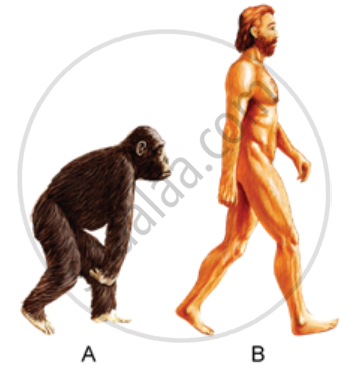
State any two characteristic features of stage B.
Name the scientists who have contributed to the following:
Reported Haemophilia.
Identify the CORRECT match.
A cross between a tall pea-plant (TT) and a short pea-plant (tt) resulted in progenies that were all tall plants because ______
All the human races like Africans, Asians, Europeans, Americans and others might have evolved from a common ancestor. Provide a few evidences in support of this view.
Homo sapiens have evolved in:
Among the human ancestors, the brain size was more than 1000 cc in ______.
Which of the following groups of primates are humans considered most closely related to?
