Advertisements
Advertisements
प्रश्न
Thinking about the Poem
The poet finds the snake beautiful. Find the words he uses to convey its beauty.
Advertisements
उत्तर
The words the poet uses to convey the snake’s beauty are “beautiful” and “graceful”.
संबंधित प्रश्न
Thinking about the Text
Answer these question.
Why does the intruder choose Gerrard as the man whose identity he wants to take on?
Go to the local library or talk to older persons in your locality and find legends in your own language. Tell the class these legends.
Answer of these question in a short paragraph (about 30 words).
How did Santosh begin to climb mountains?
Pick out word from the text that mean the same as the following word or expression. (Look in the paragraph indicated.)
the power to endure, without falling ill : _________
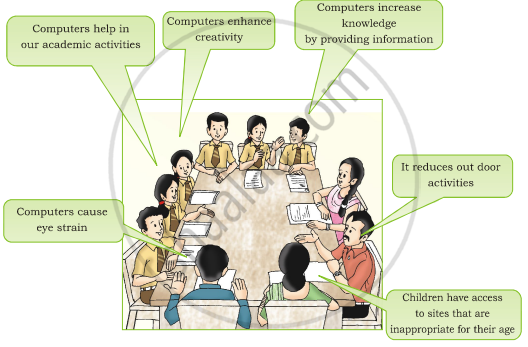
This is a meeting of the school’s Parent-Teacher Association. Some student representatives have also been invited to participate to discuss the role that Information technology/computers play in the growth and development of children.
What does he plant who plants a tree?
He plants, in sap and leaf and wood,
In love of home and loyalty
And far-cast thought of civic good____
His blessing on the neighbourhood,
Who in the hollow of his hand
Holds all the growth of all our land____
A nation's growth from sea to sea
Stirs in his heart who plants a tree.
Read the lines given above and answer the question that follow:
What motivates the man to plant a tree according to the poet?
"My father lived at Blenheim then,
Yon little stream hard by;
They burnt his dwelling to the ground,
And he was forced to fly;
So with his wife and child he fled,
Nor had he where to rest his head.
"With fire and sword the country round
Was wasted far and wide,
And many a childing mother then,
And new-born baby died;
But things like that, you know, must be
At every famous victory;
Read the lines given above and answer the question that follow.
Kaspar describes the horrors of war but how can his attitude be described?
The most important thing we've learned,
So far as children are concerned,
Is never, NEVER, NEVER let
Them near your television set-----
Or better still, just don't install
The Idiotic thing at all.
In almost every house we've been,
we've watched them gaping at the screen
They loll and slop and lounge about,
And stare until their eyes pop out.
(Last week in someone's place we saw
A dozen eyeballs on the floor.
They sit and stare and stare and sit
Until they're hypnotised by it,
Until they're absolutely drunk
With all that shocking ghastly junk.
Read the lines given above and answer the question given below.
Explain with reference to context.
It was my business to cross the bridge, explore the bridge head 3 beyond and find out to what point the enemy had advanced. I did this and returned over the bridge. There were not so many carts now and very few people on foot, but the old man was still there.’’Where do you come from?” I asked him.
“From San Carlos,” he said, and smiled.
That was his native town and so it gave him pleasure to mention it and he smiled.
“I was taking care of animals,” he explained.
“Oh,” I said, not quite understanding.
“Yes,” he said, “I stayed, you see, taking care of animals. I was the last one to leave the town of San Carlos.”
He did not look like a shepherd nor a herdsman and I looked at his black dusty clothes and his gray dusty face and his steel rimmed spectacles and said, “What animals were they?”
“Various animals,” he said, and shook his head. “I had to leave them.”
Read the extract given below and answer the question that follow.
What gave the old man pleasure?
As it turned out, Luz broke his own past record. In doing so, he pushed me on to a peak performance. I remember that at the instant I landed from my final jump—the one which set the Olympic record of 26 feet 5-5/16 inches—he was at my side, congratulating me. Despite the fact that Hitler glared at us from the stands not a hundred yards away, Luz shook my hand hard—and it wasn’t a fake “smile with a broken heart” sort of grip, either.
You can melt down all the gold medals and cups I have, and they couldn’t be a plating on the 24-carat friendship I felt for Luz Long at that moment. I realized then, too, that Luz was the epitome of what Pierre de Coubertin, founder of the modern Olympic Games, must have had in mind when he said, “The important thing in the Olympic Games is not winning but taking part. The essential thing in life is not conquering but fighting well.”
Read the extract given below and answer the question that follow.
You can melt down all the gold medals and cups I have, and they wouldn’t be a plating on the 24-carat friendship I felt for Luz Long at that moment.
“Do the scientists really know? Will it happen today, will it ?”
“Look, look; see for yourself !”The children pressed to each other like so many roses, so many weeds, intermixed, peering out for a look at the hidden sun. It rained. It had been raining for seven years; thousands upon thousands of days compounded and filled from one end to the other with rain, with the drum and gush of water, with the sweet crystal fall of showers and the concussion of storms so heavy they were tidal waves come over the islands. A thousand forests had been crushed under the rain and grown up a thousand times to be crushed again. And this was the way life was forever on the planet Venus, and this was the schoolroom of the children of the rocket men and women who had come to a raining world to set up civilization and live out their lives.
Read the extract given below and answer the question that follow.
Describe the rain and its effect on life on Venus.
Discuss the following topic in groups.
What problems are you likely to face if you keep ants as pets?
Answer the following question.
“Come here, little one, and I’ll whisper the answer to you.”The crocodile said this because
Discuss these questions in small groups before you answer them.
When do you think an adult would say this?
No one thinks you are funny.
Describe Plan A and its consequences
How does father react to the mother's warning?
Make noun from the word given below by adding –ness, ity, ty or y
kind ___________.
Replace the italicised portion of the sentence below with a suitable phrase from the box. Make necessary changes, wherever required.
I was in a difficult situation till my friends came to my rescue.
Look at the following phrases and their meanings. Use the phrase to fill in the blank in the sentence given below.
A fund has been _____________ for the soldiers’ families.
Which of the following BEST captures the central idea of the short story, The Medicine Bag?
