Advertisements
Advertisements
प्रश्न
The king got angry when he was shown to be wrong ______.
विकल्प
True
False
Advertisements
उत्तर
This statement is False.
संबंधित प्रश्न
Tick the right answer.
When you replicate something, you do it (for the first time/for the second time).
Match the meanings with the words/expressions in italic, and write the appropriate
meaning next to the sentence.
Wait until I tell his story — it will make your hair stand on end.
Study the words in italics in the sentences below. They are formed by prefixing un – or in – to their antonyms (words opposite in meaning).
• I was a short boy with rather undistinguished looks. (un + distinguished)
• My austere father used to avoid all inessential comforts.(in + essential)
• The area was completely unaffected by the war.(un + affected)
• He should not spread the poison of social inequality and communal intolerance. (in + equality, in+ tolerance)
Now form the opposites of the words below by prefixing un- or in-. The prefix in- can also have the forms il-, ir-, or im- (for example: illiterate –il + literate, impractical –im + practical, irrational – ir+ rational). You may consult a dictionary if you wish.
| _____adequate | _____acceptable | _____regular | _____tolerant |
| ____demanding | ____active | _____true | _____permanent |
| ____patriotic | ____disputed | ____accessible | _____coherent |
| _____logical | _____legal | _____responsible | _____possible |
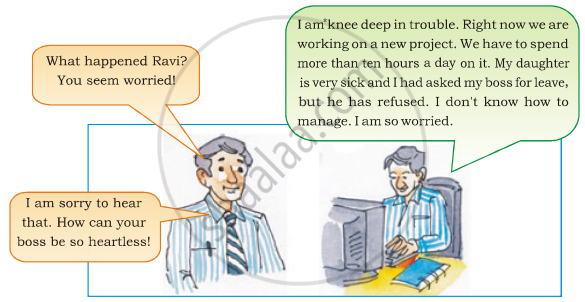
Read the following conversation between two friends.
Listen to this extract from Shakespeare's play As You Like It. As you listen, read
the poem aloud; you can do this more than once.
All the world's a stage
And all the men and women merely players:
They have their exits and their entrances;
And one man in his time plays many parts,
His acts being seven ages. At first the infant,
Mewling and puking in the nurse's arms.
Then the whining schoolboy, with his satchel
And shining morning face, creeping like snail
Unwillingly to school. And then the lover,
Sighing like furnace, with a woeful ballad
Made to his mistress' eyebrow. Then a soldier.
Full of strange oaths, and bearded like the pard,
Jealous in honour, sudden and quick in quarrel,
Seeking the bubble reputation.
Even in the cannon's mouth. And then the justice,
In fair round belly with good capon lined,
With eyes severe and beard of formal cut,
Full of wise saws and modern instances;
And so he plays his part. The sixth age shifts
Into the lean and slippered pantaloon,
With spectacles on nose and pouch on side,
His youthful hose, well saved, a world too wide
For his shrunk shank; and his big manly voice,
Turning again toward childish treble, pipes
And whistles in his sound. Last scene of all,
That ends this strange eventful history,
Is second childishness and mere oblivion,
Sans teeth, sans eyes, sans taste, sans everything.
About the Poet
William Shakespeare (1564-1616) was born in Stratford-upon-Avon. He is
considered by many to be the greatest dramatist of all time. He wrote 154 sonnets, two
long narrative poems and about three dozen plays. Shakespeare used poetic and
dramatic means to create unified aesthetic effects. In verse, he perfected the dramatic
blank verse.
Some are like fields of sunlit corn,
Meet for a bride on her bridal morn,
Some, like the flame of her marriage fire,
Or, rich with the hue of her heart's desire,
Tinkling,luminous,tender, and clear,
Like her bridal laughter and bridal tear.
Read the lines given above and answer the question that follow.
Explain with reference to context.
Mr. Oliver, an Anglo-Indian teacher, was returning to his school late one night on the outskirts of the hill station of Shimla. The school was conducted on English public school lines and the boys – most of them from well-to-do Indian families – wore blazers, caps and ties. “Life” magazine, in a feature on India, had once called this school the Eton of the East.
Mr. Oliver had been teaching in this school for several years. He’s no longer there. The Shimla Bazaar, with its cinemas and restaurants, was about two miles from the school; and Mr. Oliver, a bachelor, usually strolled into the town in the evening returning after dark, when he would take short cut through a pine forest.
Read the extract given below and answer the question that follow.
Who was Mr Oliver? Where was he working?
Margot stood apart from these children who could never remember a time when there wasn’t rain and rain and rain. They were all nine years old, and if there had been a day, seven years ago, when the sun came out for an hour and showed its face to the stunned world, they could not recall. Sometimes, at night, she heard them stir, in remembrance, and she knew they were dreaming and remembering an old or a yellow crayon or a coin large enough to buy the world with. She knew they thought they remembered a warmness, like a blushing in the face, in the body, in the arms and legs and trembling hands. But then they always awoke to the tatting drum, the endless shaking down of clear bead necklaces upon the roof, the walk, the gardens, the forests, and their dreams were gone. All day yesterday they had read in class about the sun. About how like a lemon it was, and how hot. And they had written small stories or essays or poems about it:
I think the snn is a flower,
That blooms for just one hour.
Read the extract given below and answer the question that follow.
Why are the other children unable to remember the sun?
What is De Levis going through at this point of time ? What light does it throw upon his character ? What change do we see in his character later in the play ? Give a reason to justiji; your answer.
Answer the following question.
Kari learnt the commands to sit and to walk. What were the instructions for each command?
Complete the following sentence.
Trying to hide beneath the tray of chillies, Mahendran________________________________.
Complete the sentence below by appropriately using anyone of the following:
if you want to/if you don’t want to/if you want him to
He’ll post your letter___________________.
Where did the author planned to do alongwith his friend?
What questions did Golu ask the python?
Word in the box given below indicates a large number of… For example, ‘a herd of cows’ refers to many cows.
Complete the following phrase with a suitable word from the box.
a _________________ of ships
Read the newspaper report to find the following facts about Columbia’s ill-fated voyage.
Number of astronauts on board: ____________
The Streetlamp has been compared to a _____.
Read the extract given below and answer the questions that follow:
| Portia: | ... Lorenzo, I commit into your hands The husbandry and manage of my house Until my lord's return: for mine own part, I have toward heaven breathed a secret vow To live in prayer and contemplation, Only attended by Nerissa here, Until her husband and my lord's return. |
- Who does Portia refer to as 'my lord'?
Where is her lord?
Why had he left in such haste? [3] - What does Portia ask Lorenzo to do? Why does she make this request? [3]
- Explain, in your own words, the ‘secret vow’ that Portia speaks of. [3]
- What instruction does Portia give to her servant, a little later in the scene? [3]
- What do we learn about Portia’s real intention from her conversation with Nerissa?
Which Portia do you prefer- the modest Portia of the Casket scene or the businesslike Portia we meet in this scene?
Give one reason for your response. [4]
What does Cares say to bless the young couple?
How does Prospero ask to be to be released from his “bands” in the Epilogue of the play, The Tempest?
